From Short-Distance Air Taxis Connecting Major Airports to Downtown Commercialization
Developing Mid-to-Long Distance Taxis, Cargo UAM, and Fully Unmanned Aviation Systems
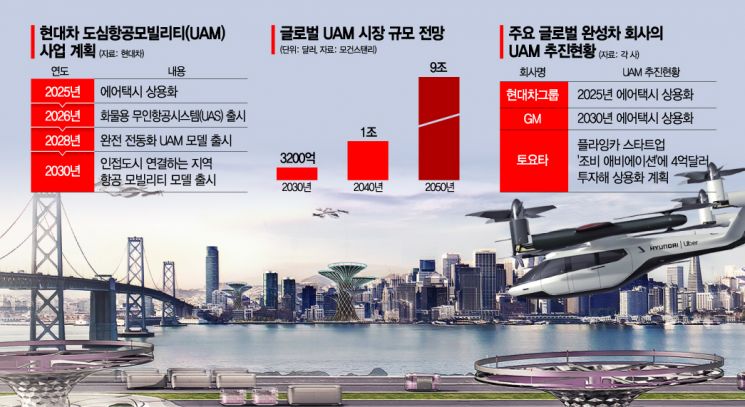
[Asia Economy Reporter Changhwan Lee] Hyundai Motor Company’s decision to commercialize air taxis three years ahead of schedule is an expression of its determination to secure a definitive leadership position in the future core business of Urban Air Mobility (UAM).
In particular, the announcement to first realize the commercialization of air taxis in the United States is interpreted as a declaration to compete head-on in the world’s largest mobility market, the U.S.
Air taxis connecting airports and downtown areas expected to launch first
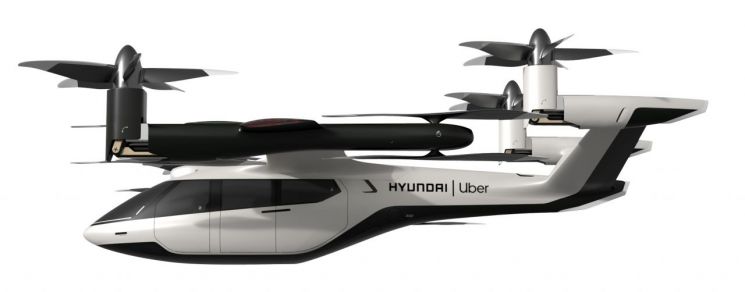
Hyundai Motor plans to develop short-distance air taxis connecting major airports and downtown areas, and later commercialize mid-to-long-distance air taxis connecting cities. It is also developing cargo UAM and fully electrified unmanned aerial systems (UAS).
Hyundai’s choice of UAM as a future growth engine is due to the very high potential for rapid market expansion. Consulting firm Samjong KPMG forecasted that the global UAM market will grow sharply from $7 billion (about 8.5 trillion KRW) in 2020 to $1.474 trillion (about 1,800 trillion KRW) by 2040. Investment bank Morgan Stanley also projected that the global flying mobility market will reach $9 trillion (1,000 trillion KRW) by 2050.
Accordingly, more than 250 companies worldwide have jumped into UAM-related technology development, aircraft development, design, and charging system research. Among them, the automotive industry is the most active. The U.S. leading automaker GM (General Motors) officially announced its entry into the UAM market at the Consumer Electronics Show (CES 2021) held earlier this year and unveiled the vertical takeoff and landing (VTOL) concept. GM plans to commercialize air taxis by 2030.
Japan’s Toyota is also rapidly advancing its business. Last year, Toyota invested $394 million (about 460 billion KRW) in the U.S. electric vertical takeoff and landing (e-VTOL) startup Joby Aviation. European companies such as Volkswagen, Porsche, and Audi are also pursuing UAM businesses.
"UAM is a revolutionary market that enhances quality of life"
Hyundai Motor has also selected UAM as a future core business and is accelerating technology development and commercialization. It plans to invest 1.8 trillion KRW by 2025 and inject more funds thereafter.
Talent acquisition is also active. Hyundai Motor is developing UAM aircraft centered on Shin Jae-won, head of the UAM business division (president), who was promoted to president within a year of joining from NASA at the end of last year. Additionally, aerospace industry expert Ben Dyerchin was recruited as CTO (Chief Technology Officer) earlier this year.
At Hyundai Motor’s Investor Day held at the end of last year, President Shin Jae-won said, "UAM can free us from ground traffic congestion, reduce travel time by two to three times, enable air travel between points, connect communities more closely, and revolutionize quality of life," adding, "Hyundai Motor has multifaceted capabilities to become a global leader in this exciting new business market."
Hyundai Motor Group Chairman Chung Euisun also emphasized the importance of UAM at a town hall meeting with employees last year, stating, "UAM will account for 30% of Hyundai Motor Group’s future business." One of the key reasons Chairman Chung traveled to the U.S. again this week after two months is reportedly to review the UAM business in the U.S. He is understood to be visiting the U.S. East Coast regions such as Boston, Washington D.C., and other areas where Hyundai’s future core businesses are concentrated.
Domestically, besides Hyundai Motor, Hanwha Group is also actively promoting the UAM business. Hanwha Systems, a Hanwha affiliate, invested $25 million (about 28.3 billion KRW) last year to acquire a 30% stake in Overair, a U.S. personal aircraft development specialist, and is developing a five-seater aircraft called ‘Butterfly.’ Hanwha Systems also aims to launch an air taxi pilot service by 2025.
© The Asia Business Daily(www.asiae.co.kr). All rights reserved.


















