Professor Cho Seung-woo's Yonsei University Team "Potential for Treatment and Prevention of Brain Meningitis, etc."
[Asia Economy Reporter Kim Bong-su] The human brain is surrounded by a uniquely structured barrier that allows only necessary substances to pass through, protecting it from toxins, drugs, viruses, fungi, and other external invaders. However, some pathogenic fungi can penetrate this barrier, invade the brain, and cause meningitis, leading to fatal diseases in humans. A Korean research team has elucidated how this occurs, signaling a breakthrough in the treatment of related diseases.
On the 15th, according to the National Research Foundation of Korea, Professor Seungwoo Cho's research team at Yonsei University's Department of Biotechnology announced that they have designed an artificial blood-brain barrier chip that mimics the structure and functional characteristics of the human brain's blood-brain barrier.
The blood-brain barrier is a selective permeable membrane surrounding the central nervous system, including the brain, which governs all bodily functions. It blocks pathogens and harmful external substances that can infect through the bloodstream.
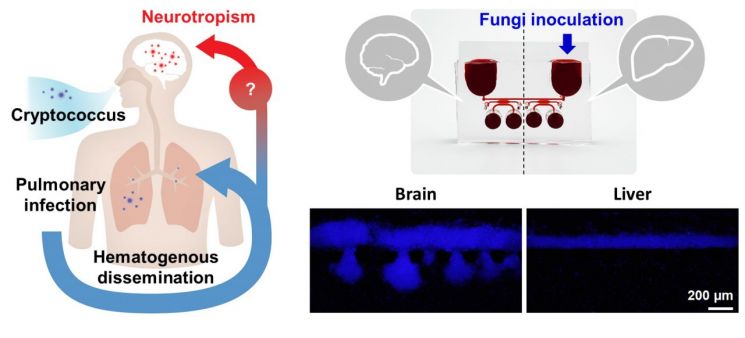
Through the artificial blood-brain barrier chip, the research team can now model in the laboratory whether certain pathogens or compounds can pass through this barrier and, if so, how they behave. The team cultured brain blood vessels and brain cells within a chip composed of microchannels at the scale of several hundred micrometers, implementing the blood-brain barrier between them. Using a microscope, they can observe in real-time whether various substances injected with culture medium through the microchannels mimicking brain blood vessels pass through the selective permeable membrane simulating the blood-brain barrier and move into the chamber mimicking brain cells.
The key was to simulate a microenvironment where cells can grow using a three-dimensional hydrogel, control the flow of culture medium, and co-culture neural stem cells, brain vascular endothelial cells, and brain vascular pericytes, thereby mimicking the growth of brain vascular cells and angiogenesis during actual brain development. They verified that the permeable membrane of the biochip acts as a selective barrier like the real blood-brain barrier by showing that only certain substances of varying molecular weights pass through the membrane when treated with cytokines.
In particular, the research team elucidated the mechanism by which a specific pathogenic fungus, Cryptococcus neoformans, causes meningitis or encephalitis. When injected into the biochip, they observed in real-time how this fungus moved toward the brain cells, passed through the permeable membrane in an aggregated form, and identified the genes involved in this process. Although brain infections caused by this fungus were known, the lack of appropriate experimental models had prevented understanding how the fungus reaches the brain. They also confirmed that fungi with the identified genes removed could not pass through the blood-brain barrier mimic membrane. This is expected to be applied in discovering candidate substances effective against fungal meningitis or compounds capable of crossing the blood-brain barrier.
The research results were published on the 15th in the international journal in the field of biomedical engineering, Nature Biomedical Engineering.
© The Asia Business Daily(www.asiae.co.kr). All rights reserved.

















