Government Recommends COVID-19 Vaccine Leave System
Adopted Mainly by Large Corporations like Samsung and LG
Small Businesses and Enterprises with Fewer Than 5 Employees Face Difficulties
"No Time for Vaccination, Let Alone Leave," Frustration on the Ground
Experts Urge Financial Support to Help Small Businesses Implement Vaccine Leave
 The government has recommended that companies introduce 'vaccine leave,' but small and micro enterprises struggling with labor shortages are facing difficulties, raising concerns about polarization in vaccine leave. The photo is unrelated to specific expressions in the article. [Image source=Yonhap News]
[Asia Economy Reporter Lim Juhyung] Kim Mo (25), who works at a packaging machine manufacturing company in Gimpo, Gyeonggi Province, expressed skepticism about the COVID-19 vaccine leave, saying, "I don't think the company will guarantee it." The company where Kim works is a small business with fewer than 50 employees, and since the staff handle not only simple machine assembly but also installation, test operation, and maintenance, overtime and business trips are essential. Kim said, "The schedule is so tight that if even one employee is absent, all the work gets tangled up," adding, "Even if vaccine leave is provided, I think I would feel self-conscious and sorry around others, so I probably wouldn't be able to use it properly."
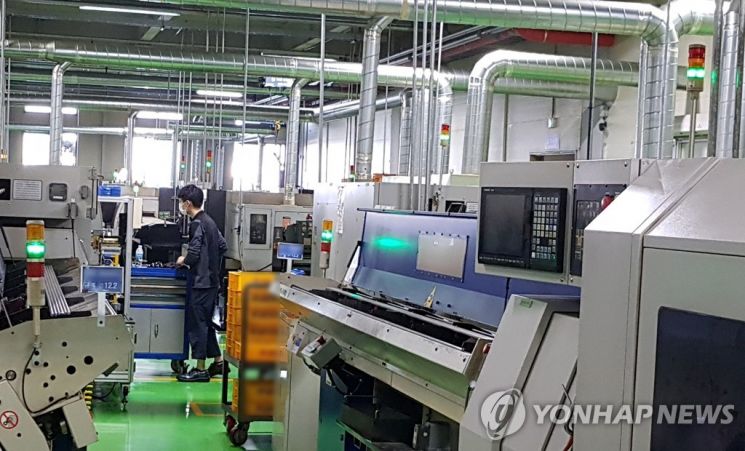 An automobile parts manufacturer in Gyeongnam. The photo is unrelated to specific expressions in the article. / Photo by Yonhap News
Although the government has recommended the introduction of 'vaccine leave' to facilitate smooth vaccination, some companies are unable to even consider it. While large and medium-sized enterprises are quickly adopting vaccine leave, small and micro businesses struggling with manpower shortages are facing difficulties, raising concerns about polarization in vaccine leave adoption.
The government introduced vaccine leave starting April 1. According to the 'Vaccine Leave Activation Plan' prepared by the Central Disaster and Safety Countermeasure Headquarters in consultation with related ministries such as the Ministry of Employment and Labor and the Ministry of Personnel Management, the core is to grant 1-2 days of paid leave or sick leave without a doctor's note the day after vaccination, considering that adverse reactions to the vaccine usually begin within 10 hours after inoculation.
However, for private companies that are not government agencies, the use of vaccine leave is a 'recommendation.' This means the government does not mandate private companies to introduce vaccine leave.
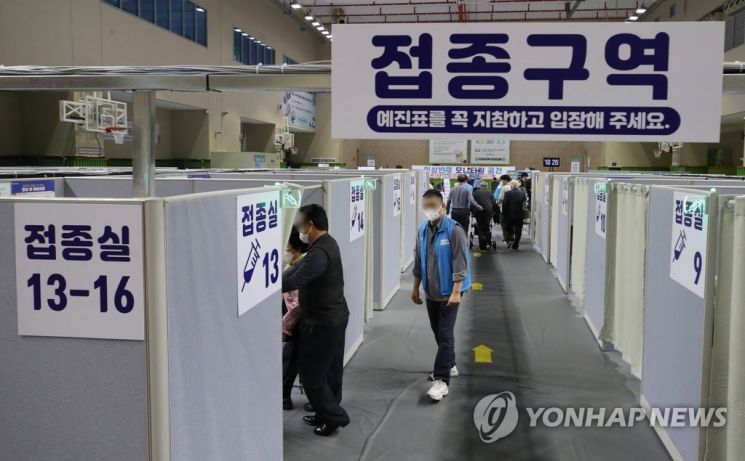 On the morning of the 29th of last month, citizens are heading to the vaccination rooms at Sadang Sports Complex, where the COVID-19 vaccination center is set up in Dongjak-gu, Seoul. / Photo by Yonhap News
Meanwhile, most large corporations have already introduced vaccine leave. Samsung Electronics was the first to implement paid leave for vaccinated employees, followed by LG Group and SK Hynix. Lotte Group, Hyundai Department Store Group, and Shinsegae Group, which suffered significant business impacts due to COVID-19, have also recently decided to introduce paid vaccine leave.
Not all companies are considering introducing vaccine leave. According to a survey conducted by the job site 'Saramin' targeting 903 companies, 51.1% of all companies said they 'have granted or plan to grant vaccine leave.' This means only about half of all companies plan to provide vaccine leave.
Among companies that responded they would not introduce vaccine leave (48.9%), the most common reason cited was 'concerns about manpower shortages' (41.2%).
Especially for small businesses and micro enterprises with fewer than five employees, which suffer from chronic manpower shortages, vaccine leave is an unattainable dream. This is why concerns are emerging about the polarization of vaccine leave between large and small companies.
A (30) working at a small design company in Gyeonggi Province said, "We receive orders every month and set deadlines for work, but we are always short on time and suffer from overwork," adding, "Even under normal circumstances, taking leave or leaving work on time is difficult, so how could we possibly take vaccine leave in this situation?"
B (32), who works in a restaurant, said, "In the food service industry, which is practically a two-shift system, vaccine leave seems like a story from another country," adding, "The problem is not vaccine leave, but that there is no time to even go get vaccinated."
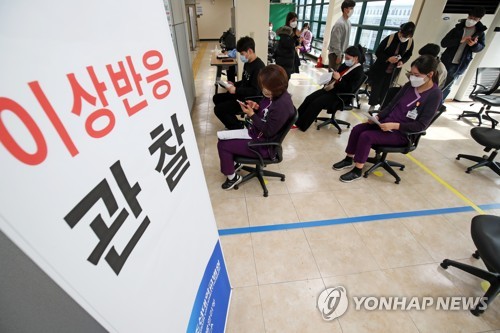 Citizens waiting to be observed for adverse reactions after receiving the COVID-19 vaccine. / Photo by Yonhap News
There are concerns that if vaccine leave is not widespread in private companies, vaccination plans may be disrupted. This is because workers worried about vaccine side effects may not actively participate in vaccination appointments.
The fact that many people experience discomfort due to adverse reactions after vaccination is also a reason why vaccine leave is necessary. According to the Korea Disease Control and Prevention Agency, since February 26, 32% of 18,000 vaccinated people reported discomfort, and 2.7% of them visited medical institutions. This means that 3 out of 10 vaccinated people experienced adverse reactions.
If someone with symptoms affecting physical functions such as muscle pain, fever, or dizziness works excessively, there is a risk of worsening symptoms or leading to safety accidents.
Experts have suggested that the government should support small businesses to smoothly introduce vaccine leave.
Professor Kim Taegi of Dankook University's Department of Economics said, "The government's priority in national administration is to protect the safety and health of the people, so it is most important to complete vaccination as quickly as possible to end COVID-19," emphasizing, "To achieve this, vaccine leave must be introduced even in small and micro businesses."
He added, "In this regard, the government can help small businesses introduce leave systems through financial support," advising, "I believe it is a more appropriate priority to redirect and concentrate current funds used for COVID-19 compensation schemes toward supporting vaccine leave."
© The Asia Business Daily(www.asiae.co.kr). All rights reserved.



















