Refining Facilities, Charging Stations, Power Generation Investment... 100,000 Tons/Year Blue Hydrogen Sales by 2025
[Asia Economy Reporter Kim Hyewon] Hyundai Oilbank is making a full-scale entry into the blue hydrogen business by establishing infrastructure that can recover and utilize all the carbon generated in the hydrogen production process.
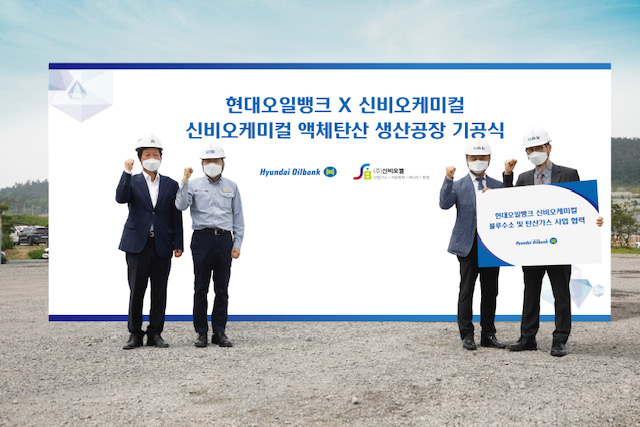
On the 14th, Hyundai Oilbank announced that it held a groundbreaking ceremony for a liquid carbon dioxide production plant with Shinbio Chemical, the largest liquid carbon dioxide manufacturer in Korea, at the Daejuk General Industrial Complex in Chungnam. The ceremony was attended by Jeong Haewon, Head of Safety Production Division at Hyundai Oilbank, and Hong Jiyu, CEO of Shinbio Chemical.
This plant, which manufactures carbon dioxide gas for semiconductor processes and dry ice, is scheduled to be completed by Shinbio Chemical by the first half of next year with an investment of 80 billion KRW.
Hyundai Oilbank will supply 200,000 tons of carbon dioxide annually generated from the hydrogen production process at the Daesan plant as raw material for products. It also plans to strengthen cooperation with existing customers such as Seondo Chemical and increase the amount of carbon dioxide supplied to these companies from about 90,000 tons last year to a maximum of 360,000 tons by the first half of next year.
Blue hydrogen is hydrogen produced by recovering and utilizing carbon dioxide emitted during the process of producing hydrogen from fossil fuels. Compared to gray hydrogen, where carbon is directly emitted into the atmosphere, and green hydrogen, which is made from renewable energy and has a high production cost, blue hydrogen is evaluated to have superior environmental friendliness and economic feasibility.
Refineries have facilities to produce hydrogen using naphtha, natural gas, and LPG as raw materials for desulfurization processes. Hyundai Oilbank also has a hydrogen production process with an annual capacity of 200,000 tons, which emits about 360,000 tons of carbon dioxide annually during this process.
Through this business cooperation, Hyundai Oilbank will recover and commercialize all the carbon dioxide generated during the hydrogen production process. This is the first attempt in the domestic refining industry, effectively transforming the existing hydrogen production process into a blue hydrogen production base.
Hyundai Oilbank aims not only to reduce carbon emissions but also to achieve additional profit creation. It plans to expand the blue hydrogen sales infrastructure as well.
Hyundai Oilbank plans to sell 100,000 tons of blue hydrogen annually by 2025 for hydrogen refueling stations and fuel cell power generation. As the first step, it will establish a high-purity refining facility that converts blue hydrogen into vehicle fuel at the Daesan plant by July. The daily refining capacity is 3,000 kg, enough to refuel 600 Nexo vehicles.
The refined hydrogen will be sold to hydrogen refueling stations established by special purpose companies and its own charging network. Hyundai Oilbank, which participated in establishing the special purpose company 'Co-Hygen' for building hydrogen refueling stations, plans to secure three additional directly operated or self-operated refueling stations within the year, operating a total of eight proprietary sales networks.
Kang Dalho, CEO of Hyundai Oilbank, said, "We plan to enter the fuel cell power generation business with a capacity of over 20MW from 2023 by establishing joint ventures with power generation companies," adding, "Our strategy is to establish manufacturing and sales infrastructure early to position ourselves as a leading company in the blue hydrogen business."
© The Asia Business Daily(www.asiae.co.kr). All rights reserved.

















