Korea Economic Research Institute, Employment Scale Analysis Report by Scenario Following Minimum Wage Increase
[Asia Economy Reporter Jeong Hyunjin] A study has found that if the minimum wage is raised to 10,000 won next year, more than 300,000 jobs could be lost.
On the 15th, the Korea Economic Research Institute under the Federation of Korean Industries commissioned Professor Choi Nam-seok of Jeonbuk National University to conduct the report titled "Employment Scale by Scenario According to Minimum Wage Increase (2021)." The report projected that if the minimum wage reaches 10,000 won next year, the number of jobs could decrease by at least 125,000 and up to 304,000. Specifically, jobs in the food and accommodation service industry could decrease by up to 77,000, youth jobs by up to 84,000, and regular positions by up to 58,000.
The report used individual panel data from the Korea Welfare Panel from 2017 to 2019 to estimate the job reduction rate and employment elasticity due to minimum wage increases, and applied the number of workers affected by the minimum wage based on the Economically Active Population Supplementary Survey to estimate the scale of job losses.
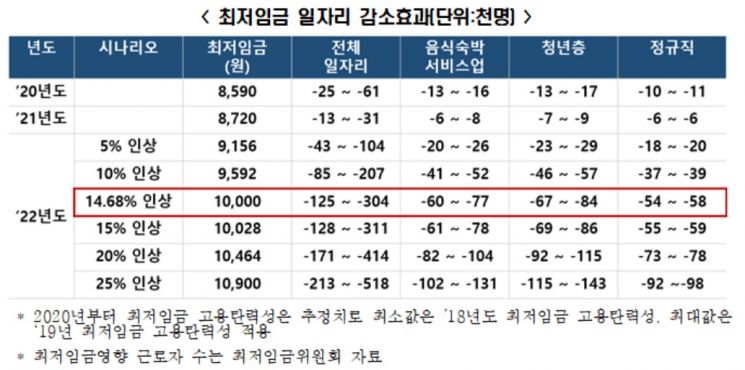
As a result, if the minimum wage is increased by 5% to 9,156 won, jobs are expected to decrease by 43,000 to 104,000; if increased by 10% to 9,592 won, the decrease is projected to be 85,000 to 207,000. If the minimum wage is raised by 20% (to 10,464 won), a maximum loss of 414,000 jobs is expected, with youth jobs decreasing by up to 115,000, indicating a significant impact.
Professor Choi previously analyzed that the 16.4% minimum wage increase in 2018 resulted in a loss of 159,000 jobs, and the 10.9% increase in 2019 led to a reduction of 277,000 jobs. In particular, in 2018, the food and accommodation service sector, youth jobs, and regular positions were most affected. It is estimated that the food and accommodation service industry lost about 86,000 to 110,000 jobs, youth jobs decreased by approximately 93,000 to 116,000, and regular positions declined by about 63,000 to 68,000.
Professor Choi emphasized, "With COVID-19 not yet over, raising the minimum wage could significantly reduce labor demand and the jobs of low-wage workers," adding, "Considering the job loss effects of minimum wage increases, it is necessary to adjust the pace of raising the minimum wage."
The minimum wage has increased by an average of 7.3% annually over the past decade. The Korea Economic Research Institute anticipates that workers will demand raising next year's minimum wage to over 10,000 won. Choo Kwang-ho, Director of Economic Policy at the Korea Economic Research Institute, said, "Even this year, the youth perceived unemployment rate exceeds 25%, meaning one in four young people is effectively unemployed," and added, "At this time, creating more jobs for young people should take priority over raising the minimum wage."
© The Asia Business Daily(www.asiae.co.kr). All rights reserved.
![Clutching a Stolen Dior Bag, Saying "I Hate Being Poor but Real"... The Grotesque Con of a "Human Knockoff" [Slate]](https://cwcontent.asiae.co.kr/asiaresize/183/2026021902243444107_1771435474.jpg)
















