SMBA Announces 'Current Status of Digital Transformation for Small Businesses'
Manufacturing and Accommodation/Food Services Show Low Digital Usage Among Older Age Groups
"Digital Expansion System Needs Fairness Protection Measures"
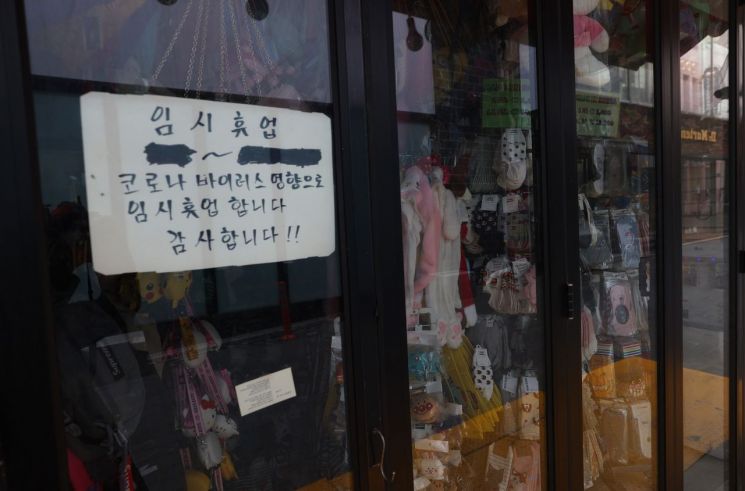
[Asia Economy Reporter Kim Bo-kyung] A survey revealed that only 15.4% of small business owners are actually utilizing digital technology in the era of digital-centered economic growth. There are calls for small business owners to swiftly transition to a 'smart' way of operating.
The Small and Medium Business Venture Institute announced on the 13th a report titled "Current Status of Digital Transformation of Small Business Owners and Step-by-Step Promotion Strategies" to respond to the spread of non-face-to-face transactions accelerated by COVID-19.
The institute emphasized in the report, "The acceleration of non-face-to-face transactions due to COVID-19 is delivering a fatal blow to the operations of traditional small business owners," and stressed, "Digital transformation must be promptly induced through policies."
As the scale of online shopping centered on mobile rapidly grows, if small business owners continue traditional business methods, there is a concern that sales may decline due to customers accustomed to digital transactions turning away.
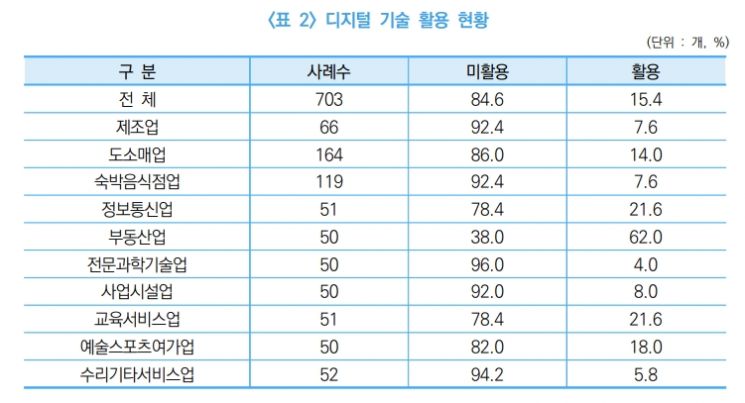
However, a survey conducted on 703 small business owners showed that only 15.4% are currently utilizing digital technology.
In particular, low utilization was observed in professional scientific and technical services (4.0%), repair and other services (5.8%), accommodation and food services (7.6%), and manufacturing (7.6%).
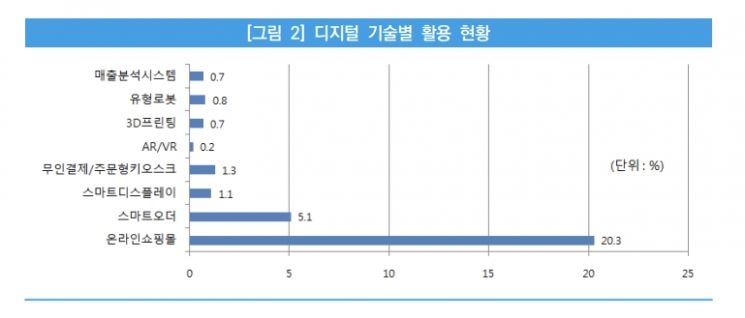
The technologies being used are mostly online shopping malls (20.3%), followed by smart orders (5.1%) and unmanned payment/order kiosks (1.3%).
Only 29.7% of small business owners felt the necessity to utilize digital technology. The areas where digital transformation is needed among small business owners were found to be business operation management (34.9%), product/service sales (33.4%), customer management (15.4%), and raw material ordering and delivery (9.0%) in that order.
The acceptance of digital technology by small business owners remained below average (2.98 out of 5 points). It was especially low in industries such as real estate and repair/other services, and among older age groups in their 50s and 60s.
The level of preparation for digital transformation among small business owners was found to be lacking in funds (2.21 points), workforce (2.38 points), and knowledge (2.53 points) compared to infrastructure (3.12 points).
The Small and Medium Business Venture Institute pointed out that a step-by-step tailored strategy according to the digital capabilities of individual small business owners is important to improve this situation.
To this end, they proposed a three-stage classification with corresponding promotion strategies: ▲ small business owners who lack digital awareness and stick to traditional methods ▲ those who recognize the need for transformation but still have insufficient digitalization ▲ and those who can digitally transform on their own.
The first stage is the Digitization phase. It targets small business owners who have not utilized online or digital technologies and remain in traditional business methods. The approach should be to raise awareness of the need for digital transformation and prepare them to adapt to the digital era. Support projects such as customized education and consulting for digital transformation and training on using online platforms were suggested.
The second stage is the Digitalization phase, which involves the effective use of digital data. It targets small business owners who recognize the need for digital transformation and want to establish a foundation but feel limited in their ability to transform digitally on their own. The policy direction proposed includes promoting the adoption of digital technologies, enhancing utilization capabilities, and improving adaptability to digital technology environments. Projects such as building online sales and delivery systems, promoting live commerce use, and digital tutoring were suggested.
The third stage is the Digital Transformation phase, which focuses on creating new businesses based on digital foundations. It targets small business owners equipped with necessary digital devices and capable of actively utilizing them. The policy direction encourages new business methods using digital and smart technologies, proposing projects for distributing smart devices and utilizing AR/VR technologies.
The institute stated, "To efficiently promote the digital transformation of small business owners, it is necessary to build and manage big data and establish a dissemination system through franchises, associations, and merchant organizations," adding, "Policy infrastructure should be established by preparing safeguards against unfair issues and encouraging participation from local governments."
© The Asia Business Daily(www.asiae.co.kr). All rights reserved.
![Clutching a Stolen Dior Bag, Saying "I Hate Being Poor but Real"... The Grotesque Con of a "Human Knockoff" [Slate]](https://cwcontent.asiae.co.kr/asiaresize/183/2026021902243444107_1771435474.jpg)


















