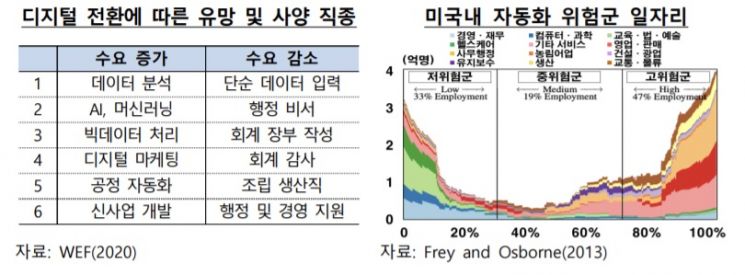
[Asia Economy Reporter Eunbyeol Kim] Amid the acceleration of 'digital transformation,' where technology replaces labor due to the COVID-19 pandemic, an analysis has emerged suggesting that digital transformation may widen the gap between workers and companies. In the United States, it is projected that 47% of workers will face job threats from advanced automation within the next 20 years.
On the 13th, the Bank of Korea stated in its 'Overseas Economic Focus' report that "digital sectors such as e-commerce systems in major countries like the US and Germany are steadily expanding, and companies are increasingly utilizing digital technologies such as big data analysis and ultra-high-speed internet," adding, "While there are positive evaluations regarding productivity improvements from technological innovation, concerns about employment reduction and polarization between industries also exist."
The report pointed out that the shift to a digital economy has accelerated significantly due to the increase in non-face-to-face economic activities amid the COVID-19 pandemic. In particular, it noted the spread of 'digital labor platforms' that connect labor demand and supply through mobile applications or websites, along with the expansion of the 'Gig Economy' scale.
The report conveyed that digital transformation generally has a positive impact on productivity improvement through enhanced production and distribution efficiency by expanding digital capital, network effects that promote competition among companies, and increased consumer welfare. However, it also explained that temporary unemployment may occur during the process where technology replaces labor.
As automation expands through digital transformation, the phenomenon of technology replacing labor is occurring not only in low-skilled, repetitive jobs such as production but also in medium-skilled jobs like office administration. The Bank of Korea cited a research result (Frey and Osborne, 2013) projecting that 47% of American workers will face job threats from advanced automation within the next 20 years.
Furthermore, the report advised, "It is necessary to recognize and prepare countermeasures for the negative effects of digital transformation, such as the widening gap by worker skill level and company size, in addition to the positive effects of efficiency improvement." It recommended, "In terms of employment, if the labor replacement effect due to digital transformation appears significantly in the short term, it is desirable to provide not only livelihood support for a certain period but also educational opportunities to adapt to new technologies or industries."
© The Asia Business Daily(www.asiae.co.kr). All rights reserved.

















