Korea Research Foundation "Artificial Intelligence, Autonomous Driving Usable for Ultra-High-Speed Computing"
[Asia Economy Reporter Kim Bong-su] High-performance computers capable of ultra-high-speed calculations are essential for artificial intelligence (AI) and autonomous driving. A domestic research team has developed a next-generation ultra-high-speed memory device that boasts a calculation speed 100 times faster than existing ones while being less harmful to the environment.
The National Research Foundation of Korea announced on the 13th that Professor Jang-Sik Lee's research team at Pohang University of Science and Technology developed a next-generation memory device called resistive random-access memory (ReRAM) that can operate at ultra-high speeds using halide perovskite.
Resistive random-access memory is a type of non-volatile memory device that retains stored information even when the power is turned off. It utilizes the phenomenon where the resistance state of the resistive switching layer changes from high resistance to low resistance or vice versa depending on the applied voltage.
According to the research team, with the active exchange of vast amounts of diverse information and the emergence of new technologies in the Fourth Industrial Revolution era such as AI, autonomous vehicles, the Internet of Things, and 5G, research on next-generation memory devices capable of processing and storing large volumes of information at high speeds is necessary.
Halide perovskite materials have been studied as new materials for next-generation memory devices because their resistive switching characteristics can be controlled. However, previous studies faced issues with slow operation speeds, and the use of lead, which causes severe environmental pollution in perovskite fabrication, limited practical application.
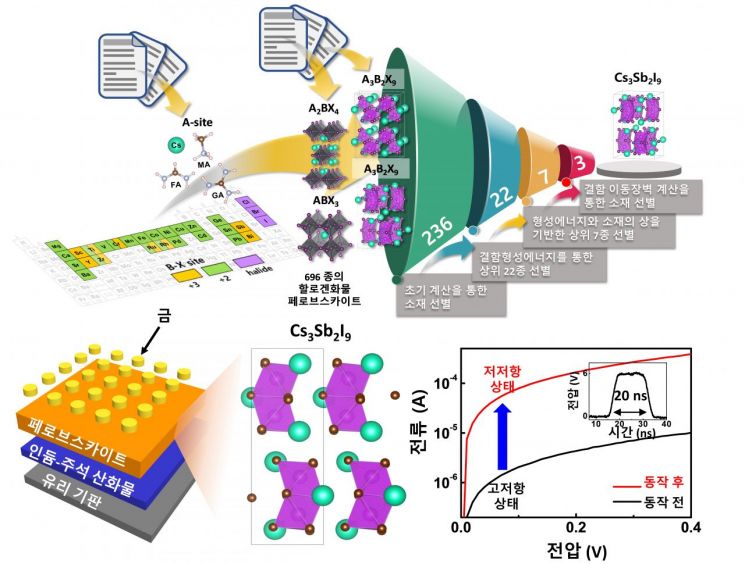
The research team designed halide perovskite materials capable of ultra-high-speed operation through first-principles calculations (a quantum mechanics theory-based prediction method) and experimental verification, and developed technology applicable to resistive random-access memory devices. For experimental verification, they synthesized the inorganic halide perovskite Cs3Sb2I9 (dimer-Cs3Sb2I9), the selected material, and applied it to memory devices.
The developed memory device demonstrated an operation speed of 20 ns (1 ns = one billionth of a second). Compared to memory devices using the layered structure Cs3Sb2I9 (layer-Cs3Sb2I9) with a different crystal structure of the same composition, it showed excellent characteristics operating at speeds more than 100 times faster.
The research team explained, "It is expected to be applied to various electronic devices such as AI and supercomputers that require high-speed processing capabilities," adding, "Since the memory device was fabricated using a material that does not contain lead, which was a problem in existing perovskite materials, environmental pollution issues have been resolved."
The results of this research were published online on the 10th in the international academic journal Nature Communications.
© The Asia Business Daily(www.asiae.co.kr). All rights reserved.

















