[Asia Economy Reporter Changhwan Lee] As carbon neutrality has become a major global issue, interest in the new concept of eco-friendly fuel, e-fuel, is increasing, according to an analysis.
On the 14th, the Korea Automotive Technology Institute released a report titled "Eco-friendly Synthetic Fuel Reducing Greenhouse Gases, e-fuel," stating that due to the global strengthening of carbon dioxide (CO2) emission regulations and the 2050 carbon neutrality declarations, the importance of emission reduction technologies and the use of eco-friendly alternative fuels such as e-fuel is increasing.
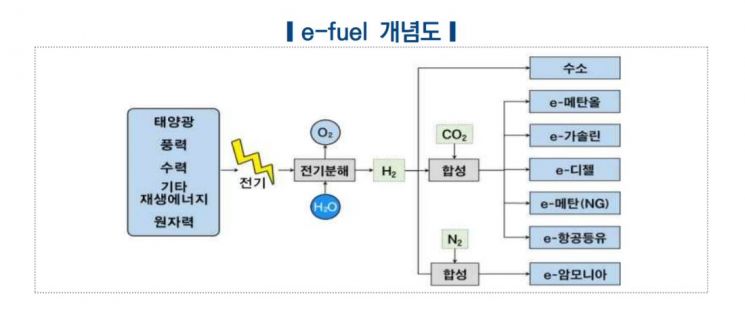
e-fuel is a new concept fuel produced by electrolyzing water to generate hydrogen (H2), then synthesizing it with CO2 or nitrogen (N2) to create liquid and gaseous fuels (methane, gasoline, diesel, etc.) for use.
Currently, governments of countries such as Japan and Germany have announced policies related to e-fuel as a means to achieve carbon neutrality. In particular, Japan set a goal last October to realize carbon neutrality by 2050 by promoting electric vehicle adoption, expanding battery performance, and developing e-fuel to achieve prices below gasoline by 2050.
Companies are also conducting e-fuel research. Audi began e-fuel production and engine testing after establishing an e-fuel research facility in 2017, and the three Japanese automakers Toyota, Nissan, and Honda started e-fuel research in July last year to develop carbon-neutral engines.
The airline Lufthansa signed a manufacturing and purchasing agreement for e-aviation fuel with the refinery Heide and plans to replace 5% of aviation fuel in the Hamburg area with e-aviation fuel within five years.
Additionally, Siemens and Porsche jointly established an e-fuel demonstration complex in Chile, and Norsk e-fuel is preparing to operate Europe's first e-fuel production facility in Norway in 2023.
Korea's e-fuel technology is in its early stages, with related production technologies being researched and developed by the Korea Research Institute of Chemical Technology and KAIST.
High Eco-friendliness Calls for Expanded National Research and Development Support
The advantages of e-fuel include its eco-friendliness by reducing greenhouse gases during production, ease of storage, high energy density, and compatibility with existing internal combustion engine infrastructure.
However, it also has drawbacks such as high renewable energy costs and the need for high temperature, high pressure, and large energy consumption during manufacturing. Therefore, further technological development is necessary for commercialization.
The institute pointed out that although e-fuel research has been insufficient domestically, it is necessary for industry, academia, research institutes, and government to cooperate and broadly prepare for the growth potential of e-fuel.
Senior Researcher Jaewan Yang of the Korea Automotive Technology Institute emphasized, "It is necessary for industry, academia, research institutes, and government to unite and discuss technology development directions and cost reduction methods," adding, "The government should maintain continuous interest and institutionally prepare for the expanded use of e-fuel."
© The Asia Business Daily(www.asiae.co.kr). All rights reserved.

![User Who Sold Erroneously Deposited Bitcoins to Repay Debt and Fund Entertainment... What Did the Supreme Court Decide in 2021? [Legal Issue Check]](https://cwcontent.asiae.co.kr/asiaresize/183/2026020910431234020_1770601391.png)














