4th Committee 23rd Plenary Meeting Held
Deliberation and Resolution on MyData and Data Platform
Consultation with Ministry of Science and ICT, Ministry of the Interior and Safety, and Personal Information Protection Commission
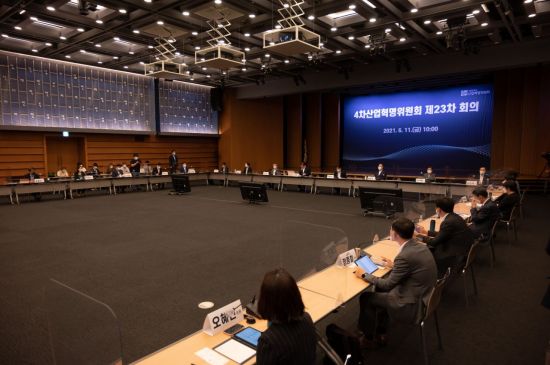 The Presidential Committee on the Fourth Industrial Revolution held its 23rd plenary meeting on the morning of the 11th at the Korea Chamber of Commerce and Industry International Conference Hall, deliberating and approving two agenda items: the "Comprehensive Plan for MyData Development" and the "Measures to Revitalize Data Platforms." Photo by the plenary meeting scene
[Asia Economy Reporter Cha Min-young] "With South Korea's MyData policy, the scope in which individuals can utilize their information data is currently the widest in the world. It can be said to be provided at a world-class level."
Kim Tae-hoon, a private sector member of the Presidential 4th Industrial Revolution Committee, stated at the briefing of the 23rd plenary meeting on the 11th, "In Europe, the scope where individuals are granted the right to data portability is limited to bank account details."
He added, "On the other hand, Korea's financial sector MyData covers a total of eight industries, including banks, cards, securities, insurance, as well as electronic payment service providers like Naver Pay and Kakao Pay."
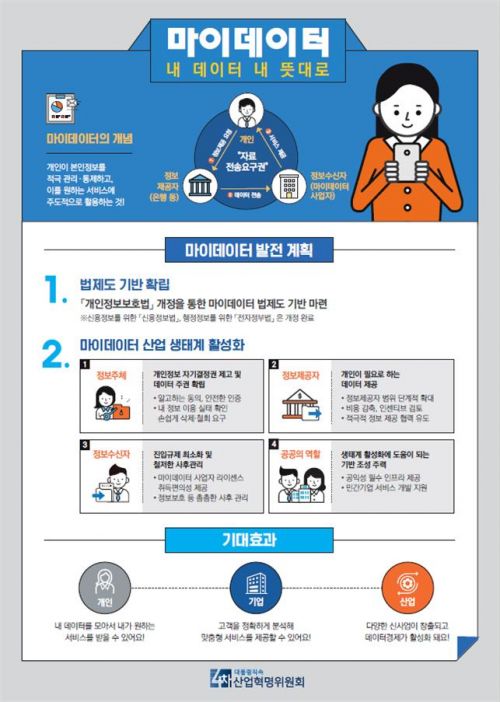
MyData refers to the active management and control of personal information by the data subject and its proactive use in credit, assets, health management, etc. The core is the data subject's right to request the transfer of personal information. Financial companies, hospitals, and other businesses must, in principle, provide all data to designated MyData operators upon individual request.
Resolving Private Sector Inconveniences... Establishing Legal Grounds for the 4th Industrial Revolution Committee
Earlier, the 4th Industrial Revolution Committee held its 23rd plenary meeting at the Korea Chamber of Commerce and Industry International Conference Hall in the morning, chaired by Prime Minister Kim Boo-kyum, where it deliberated and approved two agenda items: the 'Comprehensive Plan for MyData Development' and the 'Data Platform Activation Plan.' These plans were derived through several meetings with private sector members.
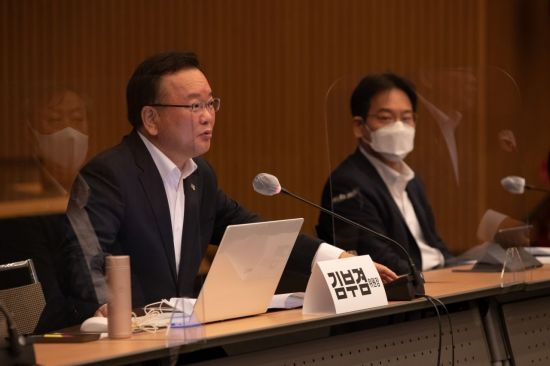 The Presidential Committee on the Fourth Industrial Revolution held its 23rd plenary meeting on the morning of the 11th at the Korea Chamber of Commerce and Industry International Conference Hall, deliberating and approving two agenda items: the "Comprehensive Plan for MyData Development" and the "Measures to Revitalize Data Platforms." Prime Minister Kim Boo-kyum, who presided over the meeting, is speaking during the opening remarks.
The 4th Industrial Revolution Committee sees the need to establish an institutional foundation to efficiently promote the MyData business at the national level and plans to establish legal grounds for MyData within the Personal Information Protection Act. Individual laws such as the 'Credit Information Act,' which is being amended and enforced, or the 'Electronic Government Act,' which is scheduled for amendment and enforcement, will be revised only when their special characteristics are recognized.
To reduce the burden on data subjects, phased opening will be pursued, and incentives such as intermediary systems and fees will be provided. This process will proceed sequentially starting with large companies above a certain scale.
Expanding MyData to Public, Medical, and Telecommunications Sectors in the Second Half
Taking a step further, the government plans to expand the MyData policy to all industries beyond the financial sector in the second half of this year. Expanding the MyData business beyond finance to public, medical, and telecommunications sectors is the world's first.
For example, when MyData is applied, it is expected that convenience in the public sector will increase. Kim Tae-hoon, a private sector member, said, "Pilot services such as MyData packages for my health records or documents required for bank credit loans are already being used by over one million people," adding, "Income and taxes can be managed more securely."
Standardization of metadata (attribute information about data) will also be carried out by data platforms. The Ministry of Science and ICT, the Ministry of Public Administration and Security, and the National Information Society Agency will take the lead in this effort.
Kim Tae-hoon explained, "It took about two years for the financial sector to standardize all data for the realization of MyData. Issues such as interoperable data specifications and standardization between industries will be resolved through a working group under the Personal Information Protection Commission."
Support for Data Analysis Vouchers... Shortening Purchase Periods
Along with this, the government plans to promote a data platform development strategy based on public-private cooperation. This is a concrete implementation plan for the 4th Industrial Revolution Committee's data platform activation plan. It includes nurturing the 16 currently operating big data platforms and 15 new platforms to be established as representative platforms, enhancing the entire process from data accumulation to utilization.
The government will strengthen the foundation for data trading and distribution and will support 'analysis service vouchers' for demand companies next year. Song Kyung-hee, Director of AI-based Policy at the Ministry of Science and ICT, explained, "Currently, the analysis service voucher reflects the analysis demand that service providers needed while conducting the existing data voucher project, and we are pushing for the inclusion of new budgets."

She added, "The voucher system is evaluated as an effective way to support companies in areas they actually need," and stated, "We will thoroughly manage to minimize problems arising in some fields, such as data brokers."
Next year, data services will be added to the digital service specialized contract system to facilitate public sector procurement. Song Kyung-hee said, "Once we hold a committee meeting and get approval, it will be uploaded to the Digital Service Utilization Support System in the form of a catalog at the Public Procurement Service," adding, "Demand institutions can immediately select and make direct contracts, reducing the existing 2-3 months to 2-3 days."
© The Asia Business Daily(www.asiae.co.kr). All rights reserved.



















