First Step as Grand National Party Emergency Committee Member at 27
Symbol of New Wave but Also Criticized for Fueling Gender Conflict and Cold Meritocracy
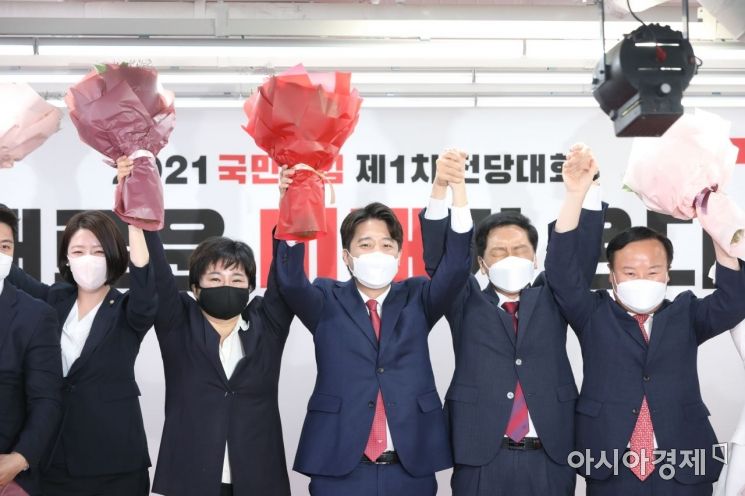 On the 11th, at the People Power Party Central Party Office in Yeouido, Seoul, newly elected party leader candidate Lee Jun-seok and the Supreme Council members are posing at the party convention held to elect the new party leader. Photo by Yoon Dong-ju doso7@
[Asia Economy Reporter Park Cheol-eung] Lee Jun-seok, the newly appointed leader of the People Power Party, emphasized coexistence and change in his acceptance speech on the 11th. He stated, "We must shed the obsession with stereotyping, that is, the compulsion of 'being a certain way,'" adding, "Politics that creates a single image within fixed stereotypes and forces people to follow it must disappear."
He continued, "Just as emphasizing 'femininity' to women is a violence that stifles individual personality, I hope we do not grind down the precious individualities in our society?like the egg, spinach, and bracken in bibimbap?by forcing youthfulness, seniority, or sometimes the 'way a party leader should be' on someone."
He also advocated for party unity. Lee said, "There have been countless slanders, harsh criticisms, and fake news about me. I will not hold anyone responsible, and no one needs to personally apologize to me," adding, "We must be tolerant of young people expressing their opinions, and the barbarism of blindly cursing a presidential candidate just because one does not support them must end."
Ten years ago, at the age of 27, he became an emergency committee member of the Grand National Party. He was personally selected by then Emergency Committee Chairman and former President Park Geun-hye after persistent persuasion, earning him the label 'Park Geun-hye Kids.' It was an unprecedented shock in Korean political history, but his actual role was minimal, and some viewed him as a 'decorative' figure to showcase a youth party. From the start, he was marked by his '27 years old' age.
"I didn't come here to work part-time on Twitter. I will say everything I need to say." His inaugural remarks were considered reasonable, but criticism intensified over time, and he even directly targeted former President Park, saying, "You keep saying 'the people, the people,' but the people listening feel nothing and are not moved. Please stop repeating textbook stories." The media commented, "Has the Grand National Party ever captivated people's eyes and ears like this?" However, within the party, there were also remarks like, "Are even kids doing politics now?"
After 10 years in politics, Lee, who now leads the main opposition party, has consistently embodied 'youth and innovation,' symbolizing change in the conservative party. In this primary, candidate Joo Ho-young emphasized experience, saying, "You can't climb Everest by only hiking the local hills," but Lee retorted, "Hasn't senior Joo Ho-young only climbed Palgongsan?" In any case, the People Power Party chose youth.
His strongest asset remains being 'born in 1985.' His election as the leader of the main opposition party, marking the first entry of the 80s and 90s generation into the central political stage, is a historic event in Korean political history. He is also an 'elite.' He graduated from Seoul Science High School and majored in computer science at Harvard University in the United States. An essay he wrote, citing Chinese political leader Hu Jintao as an example, mentioned that in the East, those who manage water (dams) well become political leaders, and as a science high school graduate with a background in science and engineering, he aspires to be such a leader. After graduating from university, he returned to Korea and served as the lead teacher of a volunteer organization that provides free education to low-income children and also ran a venture company called Classe Studio. He also has experience working as an intern for former lawmaker Yoo Seung-min.
In 2014, he served as the innovation committee chairman of the Saenuri Party, and during the impeachment crisis of former President Park, he joined the Bareunmirae Party and served as a supreme council member. During this primary, he reiterated his stance, saying, "I am grateful to President Park Geun-hye for bringing me into politics, but the impeachment was justified."
While symbolizing a new wave, he has also faced criticism for actively representing men in their 20s, fueling gender conflicts, and opposing quotas for women, regions, and youth, thereby packaging 'cold meritocracy' as fairness. Despite losing three times in the Seoul Nowon-byeong district parliamentary elections and being called a 'zero-term' lawmaker, he boldly jumped straight to party leader.
© The Asia Business Daily(www.asiae.co.kr). All rights reserved.

















