Frequent Demolitions Violating 'Top-Down Approach' Regulations
Plans Not Meeting Work Sequence Standards Also Pass Review Without Issue
Cost-Cutting Leads to Reckless Subcontracting to Small Businesses Like 'Jaejae Subcontracting'
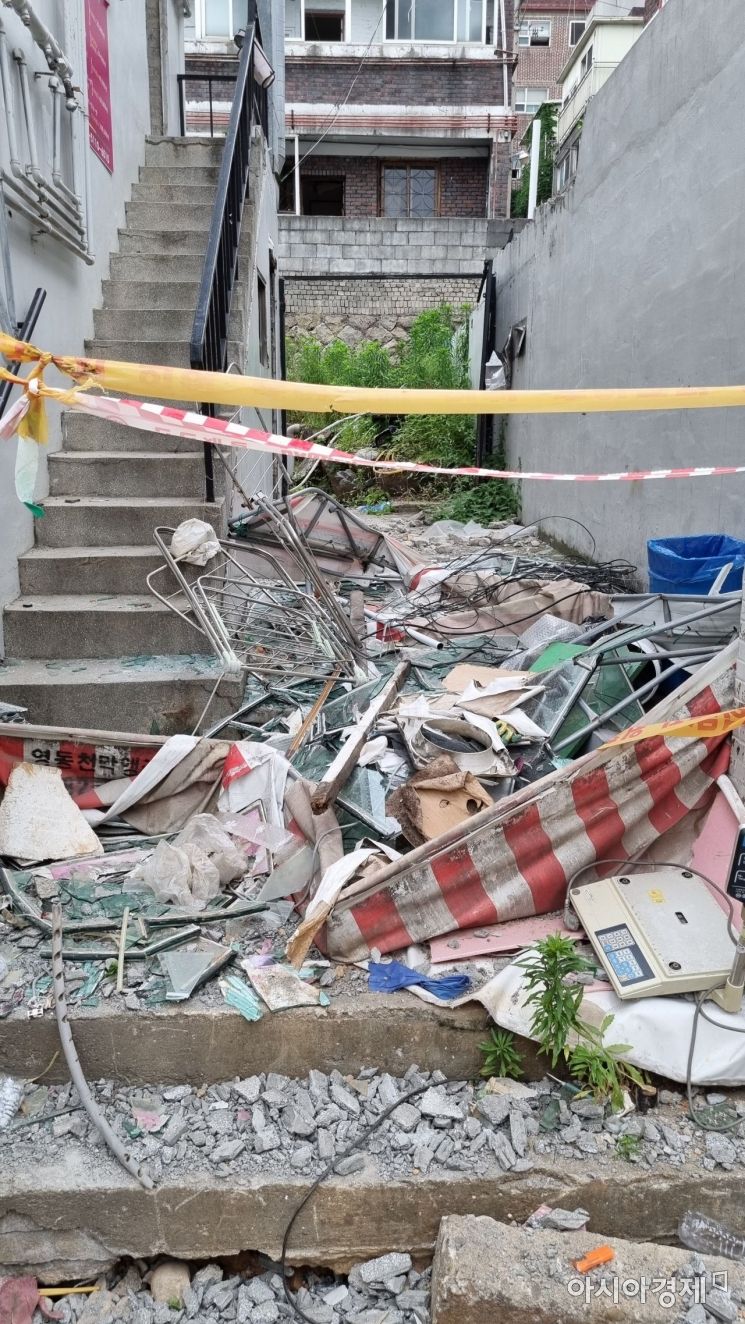 On the afternoon of the 10th, broken glass shards and rebar were scattered messily in front of an empty building within a redevelopment area in Gwangmyeong-si, Gyeonggi-do. This area is exposed without any safety fences or no-entry signs.
[Asia Economy Reporters Kim Dong-pyo, Moon Je-won, Ryu Tae-min] The building collapse accident at the Gwangju Hakdong 4 District redevelopment site on the 9th, which resulted in 17 casualties, is increasingly being confirmed as a "predicted disaster" caused by a combination of safety negligence at the site and lax management and supervision by authorities, shocking the public. Similar cases have occurred multiple times in the past, but it has become clear that these issues have not been improved at demolition sites on the front lines. As Asia Economy confirmed through an inspection of a redevelopment demolition site in Gwangmyeong City, Gyeonggi Province, dangers at construction sites nationwide can strike citizens' daily lives at any time.
Chronic Safety Negligence at Demolition Sites...Suspicions of Illegal Subcontracting
First, this accident revealed that the chronic safety negligence at construction sites has not been corrected at all. The demolition company subcontracted by HDC Hyundai Development Company, the redevelopment contractor, piled up a three-story high earth mound next to the building and placed an excavator on top to carry out demolition work using the so-called 'top-down' method. The demolition debris can act as a horizontal load on a structurally unstable building, posing a risk.
There are even testimonies that workers demolished some of the lower-level structural parts. If lateral pressure is applied while the foundation is weakened, the collapse was practically inevitable. Professor Lee Chang-moo of Hanyang University's Department of Urban Engineering pointed out, "It appears that even the ABCs (basics) related to demolition were not followed," adding, "This is the result of accumulated disregard for safety rules and regulations at demolition and construction sites."
There is also a possibility that this disaster was caused by the illegal subcontracting practice of outsourcing risks to reduce construction costs. An industry insider said, "Compared to construction and new building, demolition work is relatively easier," adding, "In reality, many demolition companies are small-scale, and few have specialized engineering technology." In this process, to increase profits, subcontracting is passed down repeatedly, and safety is neglected as it goes further down the chain. Professor Lee said, "The illegal structure of 'subcontracting-sub-subcontracting-sub-sub-subcontracting,' a chronic problem in the Korean construction industry, appears to be one of the biggest causes."
According to Article 29, Paragraph 4 of the current Framework Act on the Construction Industry, subcontracting by subcontractors is basically prohibited, but it is frequently ignored at demolition sites. According to data on 'Illegal Subcontracting Cases Detected over Five Years (2014 to August 2019)' disclosed during the 2019 National Assembly audit of the Ministry of Land, Infrastructure and Transport, a total of 885 illegal subcontracting cases were detected over five years.
New Law Ineffective...Government's 'After-the-Fact Measures'
However, in the case of the collapsed building in Hakdong 4 District, Dong-gu, Gwangju, evidence is emerging that the contents specified in the plan and the supervision obligations were not properly followed. For safety, demolition should proceed from the upper floors to the lower floors, but photos provided by citizens show that demolition started from the lower floors, below the third floor, of the five-story building. Despite strengthening supervision through the Building Management Act, there was no supervisor responsible for safety at the site during the accident, according to investigations.
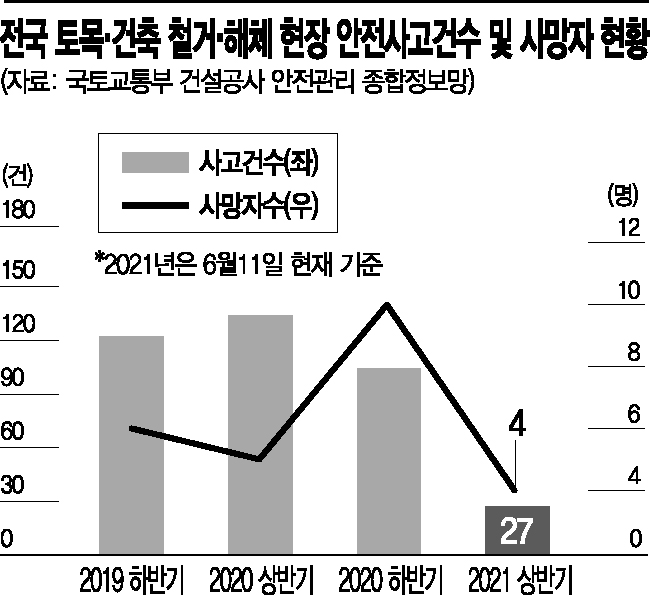
In particular, there are suspicions that the work sequence in the plan did not meet standards but passed through a formal review process. Despite the law being enacted following a five-story building collapse accident in Jamwon-dong, Seoul, in July 2019, a similar 'man-made disaster' has repeated, raising calls for comprehensive institutional improvements to the Building Management Act.
In fact, many in the industry point out that the law lacks provisions such as requiring supervisors to be present on-site. As the situation escalated, the Ministry of Land, Infrastructure and Transport issued an after-the-fact measure called a nationwide 'emergency safety inspection.' Starting immediately, inspections will be conducted on demolition sites located along roads. Along with this, an accident investigation committee composed of 10 experts in construction, structure, and law, led by Chairman Professor Lee Young-wook of Kunsan University, was formed to identify the cause. However, despite the government’s efforts to promote safety accident prevention since last year, similar accidents continue to occur, leading to criticism that the response is merely for show. A Ministry official said, "Separately from the police, we will investigate the appropriateness of dismantling methods and subcontracting relationships to identify causes and promptly present measures to prevent recurrence."
© The Asia Business Daily(www.asiae.co.kr). All rights reserved.
![Clutching a Stolen Dior Bag, Saying "I Hate Being Poor but Real"... The Grotesque Con of a "Human Knockoff" [Slate]](https://cwcontent.asiae.co.kr/asiaresize/183/2026021902243444107_1771435474.jpg)

















