People Power Party Main Primary 70% Party Member Vote
Among Party Members, 60s from Yeongnam Region Are Absolutely Dominant
Expert: "The Situation Where Lee Jun-seok Fails Is Rather the Incident"
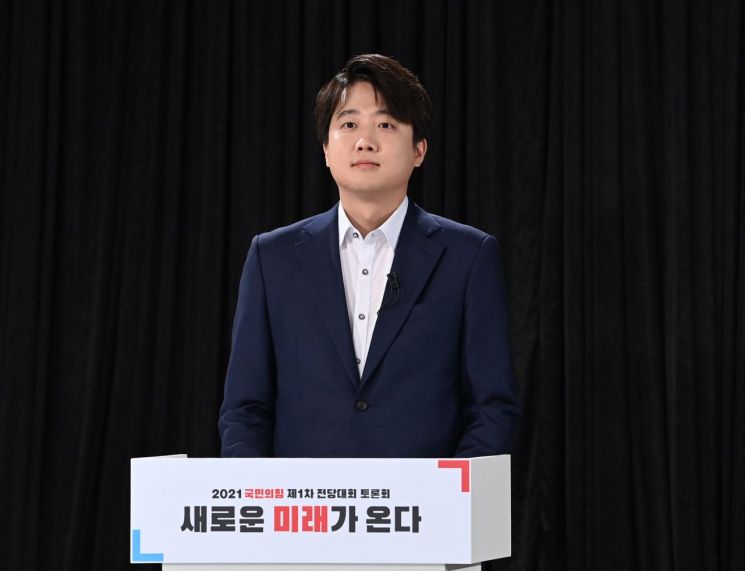
[Asia Economy reporters Naju-seok and Park Joon-yi] Attention is focused on whether the ‘Lee Jun-seok trend’ will materialize at the People Power Party’s leadership election held on the 11th. The Lee Jun-seok trend or surge stems from his overwhelming first-place support rate in nationwide public opinion polls, but the actual party leader election may differ as ‘party member votes’ are weighted more heavily. The People Power Party leader is decided by 70% party member votes and 30% public opinion polls.
Citizen opinion polls are sampled proportionally to the population, but the composition of People Power Party members is skewed toward certain age groups and regions. It is also necessary to consider that these are people with a high level of political knowledge. Taking these variables into account, we analyzed how the Lee Jun-seok surge in opinion polls might change in party member voting.
Analyzing the status of People Power Party responsible party members and opinion poll results obtained by Asia Economy on the 10th, the possibility of the Lee Jun-seok trend being significantly shaken seems low. Political commentator Yoo Chang-sun also evaluated, "It would be an event if Lee Jun-seok does not become party leader, not if he does." Looking at the regional status of responsible party members of the People Power Party, they are distributed as follows: Seoul metropolitan area 29.6%, Daegu-Gyeongbuk 30.7%, Bu-Ul-Gyeong (Busan-Ulsan-Gyeongnam) 24.6%, Chungcheong area 10.1%, Gangwon-Jeju 4.2%, Honam area 0.8%. By age group: 20s 3.9%, 30s 7.7%, 40s 15.7%, 50s 30.6%, 60 and above 42%, with males at 60.1% and females at 39.9%. Among the total electorate of 328,889, responsible party members account for 276,698 (84.1%), with an overwhelmingly high proportion from Yeongnam, 60 and above, and males.
However, former Supreme Council member Lee already shows strength in Yeongnam, 60 and above, and male groups even in general opinion polls. This means that the opinion poll results are unlikely to change significantly just because party members are concentrated in these groups. According to a survey conducted by Hankil Research on 1,001 adults from the 5th to 7th commissioned by Cookie News, former Supreme Council member Lee received 39.3% support among those aged 60 and above, surpassing former lawmaker Na Kyung-won (27.4%). In Daegu-Gyeongbuk, former Supreme Council member Lee also led with 48.7%, while former lawmaker Na had 25.2%. In Bu-Ul-Gyeong, former Supreme Council member Lee had 37.1%, and former lawmaker Na 17.6%. Among male voters, former Supreme Council member Lee received 50.9% support, far ahead of former lawmaker Na (19.2%). This means former Supreme Council member Lee has the conditions to be dominant in party member voting as well.
The variables are party members’ ‘change of mind’ or ‘organizational power exertion’ in the actual vote, but experts’ analyses are generally negative even in this regard. Kim Bong-shin, senior deputy director of Realmeter, said, "Considering the high turnout, it should be seen that both the organizational power of the senior candidates and the wind of Lee Jun-seok are blowing simultaneously." ResearchView CEO Ahn Il-won also said, "This time, the gap between party sentiment and public sentiment will be small," but added, "Since senior lawmakers will do their utmost to mobilize organizational power, former Supreme Council member Lee’s vote share may be somewhat lower than in opinion polls."
© The Asia Business Daily(www.asiae.co.kr). All rights reserved.

















