Job Committee - Busan, Daegu, Ulsan, Gyeongbuk, Gyeongnam Hold 'Regional Job Special Committee'
Government Selects Gyeongnam Changwon, Busan Myeongji Noksan, Ulsan Mipo Industrial Complex for 'Industrial Complex Revitalization'
Discussing Issues and Gathering Opinions on Industrial Complex Revitalization, Win-Win Regional Jobs, and Regional Balanced New Deal
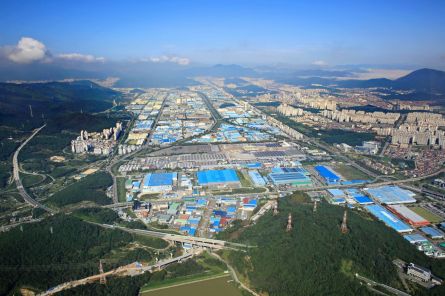
[Sejong=Asia Economy Reporter Moon Chaeseok] Following the government's announcement of measures to nurture software (SW) talent to create 'quality jobs' in the private sector, it has decided to accelerate the pace of regional industrial complex renovations. The government aims to establish a win-win regional job model centered on advanced industries in Busan, Daegu, Ulsan, and Gyeongsang Province to achieve both job creation and industrial restructuring. In particular, the government has been intensively reviewing the 'Industrial Complex Renovation' project, which has been promoted since March to transform aging national industrial complexes into Korean New Deal and carbon-neutral hubs.
The Presidential Committee on Jobs held the 'Eastern Region Special Committee on Regional Jobs' at the Changwon Industrial Complex in Gyeongnam at 2 p.m. on the 10th. About 20 people, including special committee members and job officers from Busan, Daegu, Ulsan, Gyeongbuk, and Gyeongnam regions, attended and presented plans for industrial complex renovations in each area. This was the second regional job special committee meeting following the metropolitan area special committee held last month, notable for being held at the site of the industrial complex renovation project, a pressing local issue.
The goal is to create 'good jobs.' Kim Yong-gi, Vice Chairman of the Jobs Committee, emphasized, "To alleviate the shortage of good jobs, which has worsened due to the challenges of digital and low-carbon economic transitions and the prolonged COVID-19 pandemic, it is important to operate national policies centered on jobs and to discover creative job models led by local governments."
On this day, Busan announced plans to develop the Myeongji and Noksan industrial complexes into a global supply base for future cars and eco-friendly ships, and a Northeast Asia hub for eco-friendly and smart logistics. The targets are to create 10,000 jobs, increase production by 3.8 trillion KRW, and nurture 120 material, parts, and equipment companies. Through concessions by local labor, management, civil society, and government, they shared the 'Busan-type regional job creation model,' where Corens EM, an electric vehicle powertrain company, and its partners will establish an electric vehicle core parts complex. They plan to complete Corens EM's production and research facilities by next month and finish the relocation of partner companies to the future car parts complex by 2023.
Daegu introduced its industrial complex renovation plan to upgrade existing key industries such as machinery, metal, transportation equipment, and textiles in Seongseo (hub industrial complex) and Seodaegu and the 3rd industrial complex (linked complexes) into robotics and functional materials. The goal is to create 5,000 jobs and increase production by 1.7 trillion KRW. They also announced the results of the '5+1 Future New Industry Strategy,' a program to foster smart cities centered on water, future cars, medical, energy, and more.
Ulsan announced its industrial complex renovation plan focusing on the Ulsan Mipo industrial complex to develop hydrogen fuel cell and autonomous vehicle industries, promote eco-friendly energy transition, and create an eco-friendly mobility innovation smart complex. The plan aims to create 12,000 jobs, increase production by 320 billion KRW, and attract 200 mobility companies. They also introduced a regional job project worth 8.25 billion KRW won by a consortium from Buk-gu and Ulju-gun in early last month. The project focuses on overcoming employment crises in the automobile parts industry by providing employment services for retirees, improving working conditions, and training specialized personnel.
Gyeongbuk Province plans to fill the void left by large corporations by creating a specialized ICT and electronics convergence industrial complex through a cooperation model between Gumi (hub) and Gimcheon, Seongju, and Waegwan (linked) industrial complexes. They also plan to improve job conditions through urban regeneration and shared transportation systems. The goal is to increase the number of global leading companies by 20 and create 21,000 jobs. They also plan to create 58,000 jobs by implementing 123 tasks under the 'Gyeongbuk-type New Deal 3+1' plan, which includes digital and green new deals, safety net reinforcement, and the construction of the Daegu-Gyeongbuk integrated new airport, a pressing issue.
Gyeongnam Province announced an industrial complex renovation plan to establish a supply chain between Changwon (hub) and Gimhae, Sacheon, and Haman (linked) industrial complexes based on existing machinery equipment and parts complexes to create a future mobility industrial complex. Through this, they aim to create 13,000 jobs, increase production by 5.1 trillion KRW, and achieve 207 new startups. They also mentioned implementing the 'Gyeongnam-Miryang-type job creation model,' where 26 root companies (small and medium enterprises) form a cooperative to create an eco-friendly and smart root industrial complex. They plan to invest 340.3 billion KRW in the Gyeongnam-Miryang model to create 505 jobs.
Before the special committee meeting, Vice Chairman Kim visited companies in the Changwon national industrial complex to check local job issues and listen to corporate difficulties. He said, "Starting this year, industrial complex renovation areas will receive preferential treatment in government public projects, and support funds are expected to increase significantly from the initially planned 256.2 billion KRW. Support for the Southeast region industrial complexes selected this year is also expected to expand. So far, five win-win regional job models, including Miryang and Busan types, have been selected, and about ten regions such as Gumi, Tongyeong, and Daegu are developing new models. We plan to actively support them in cooperation with related ministries."
The Jobs Committee plans to continue holding regional special committees by area at industrial complexes and other local job sites to discuss improvement directions and difficulties in city and provincial job policies for job-centered national governance. Policy ideas and suggestions discovered at the special committees will be submitted as agenda items to the Jobs Committee plenary session and concretized into government regional job policies.
© The Asia Business Daily(www.asiae.co.kr). All rights reserved.
![Clutching a Stolen Dior Bag, Saying "I Hate Being Poor but Real"... The Grotesque Con of a "Human Knockoff" [Slate]](https://cwcontent.asiae.co.kr/asiaresize/183/2026021902243444107_1771435474.jpg)
















