International Grain Prices Surge Over 20% This Year
Ramen Industry Faces Rising Costs... "Must Raise Prices by at Least 10%"
Competition Amid Perception of 'Ramen as Common People's Food'
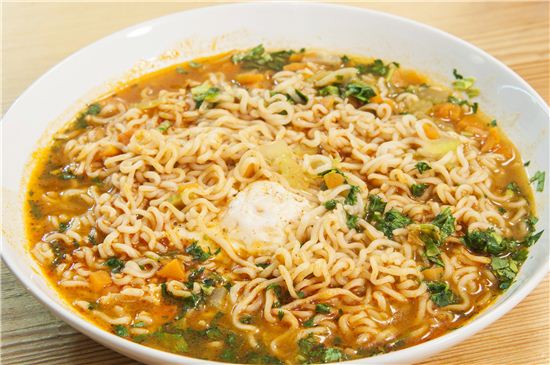 Ramen (Photo by Getty Images Bank)
[Asia Economy Reporter Seungjin Lee] Recently, as raw material prices have surged significantly, the ramen industry is facing increasing concerns over raising product prices. Although the price of imported grains has risen by more than 30% within a year, ramen is widely perceived as an affordable food for the common people, leaving the industry in a dilemma.
According to the ramen industry on the 10th, raw material prices have increased by over 30% in the past year, resulting in at least a 10% upward pressure on ramen prices. Generally, raw material costs such as flour and palm oil account for 50-60% of the factory price of ramen products. This proportion is especially higher for low-priced products.
The problem is that the recent sharp rise in raw material prices has caused product profit margins to plummet. Among ramen raw materials, palm oil, which holds the largest share, recently hit its highest price in 13 years. As of last month, the price of palm oil in Kuala Lumpur, Malaysia, was $10.60 per metric ton (mt, 1000 kg), soaring 106.6% compared to the same period. The futures price of palm oil has surged more than 20% just this year.
Wheat prices are also continuously rising. According to the Food Industry Statistical Information System (FIS), international wheat prices jumped from $158 per ton in May 2017 to $260 last month, an increase of over $100 in four years. From the end of last year’s $221.77 to $260 in May, it rose by 17.2%. Notably, the Chicago Board of Trade (CBOT) wheat futures price, which serves as the benchmark for international wheat prices, recently reached its highest level in seven years.
Despite ongoing cost pressures, ramen prices have remained frozen for several years. Nongshim’s "Shin Ramyun" has kept its price unchanged since 2016, Ottogi has not raised the price of "Jin Ramen" since 2008, and Samyang Foods has maintained the price of "Samyang Ramen" since its increase in 2017. These products are the flagship items of each company and account for a significant portion of total sales, creating a paradox where higher sales actually lead to lower operating profit margins.
In fact, in the first quarter of this year, the operating profits of the three ramen companies?Nongshim, Ottogi, and Samyang Foods?declined sharply. Nongshim’s operating profit dropped 55.5% year-on-year, while Ottogi and Samyang Foods saw decreases of 12.3% and 46.2%, respectively. With international grain prices continuing to rise, the outlook for second-quarter earnings is also bleak.
As this situation persists, the ramen industry has recently been engaged in a cautious game of timing the product price increases.
An industry insider said, "In an era where even a pack of gum costs over 1,000 won, it is absurd that a single pack of ramen, which can substitute a meal, is priced around 700 won. Although there has been a 10% price increase pressure this year alone, if a company announces a price hike first, it may face heavy criticism, so everyone is waiting for someone else to take the lead." Earlier in February, Ottogi attempted to raise ramen prices but withdrew the plan due to public opposition.
Meanwhile, as cost burdens in the ramen industry grow, it is highly likely that ramen prices will be raised soon. If a price increase occurs, reflecting the rise in raw material costs, prices are expected to rise by around 10%, with the main products of the three ramen companies increasing from the current 750-850 won to approximately 1,000 won.
© The Asia Business Daily(www.asiae.co.kr). All rights reserved.
![Clutching a Stolen Dior Bag, Saying "I Hate Being Poor but Real"... The Grotesque Con of a "Human Knockoff" [Slate]](https://cwcontent.asiae.co.kr/asiaresize/183/2026021902243444107_1771435474.jpg)










