'Number 1' Johnson Followed by Kokrak, Homa, and Others Joining One After Another, Large Hitting Area Useful for Escaping Tough Rough, 'Player Fitting' Adding Shaft Length Reduction
[Asia Economy Reporter Kim Hyun-jun, Golf Specialist] The '7-wood' is gaining popularity on the PGA Tour.
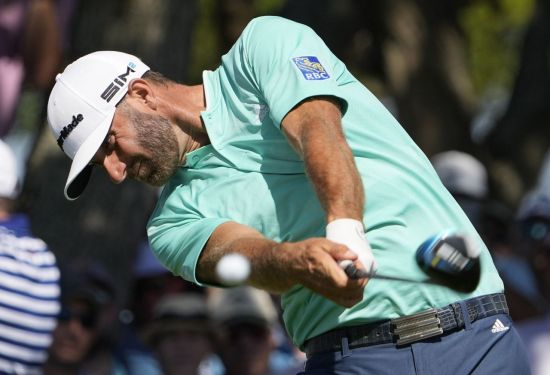
Jason Kokrak, known for his long drives, is a prime example. On the 31st of last month, he secured a 2-stroke victory at the Charles Schwab Challenge, marking his second career win just seven months after his breakthrough at The CJ Cup in October 2021, where he succeeded on his 232nd attempt. World No.1 Dustin Johnson fell for the charm of the '7-wood' earlier this year at the Genesis Invitational in February, and others like Max Homa (USA), Adam Scott (Australia), Tyrrell Hatton (England), and Joaquin Niemann (Chile) have joined in.
The 7-wood is typically favored by women and senior golfers. Nowadays, hybrids (utility clubs) have largely taken over that role because amateur golfers find 1-3 iron long shots challenging. Club makers are expanding the hybrid category with lofts of 16, 19, 22, 25, 28, and 31 degrees. Compared to woods, hybrids have shorter shafts making them easier to swing, and their thin-faced design produces high launch and low spin shots that increase distance.
However, players have focused on the strengths of the 7-wood. Compared to a 3-iron or 4-hybrid with the same loft, the 7-wood has a wider sole and larger hitting area, making it useful for escaping thick rough. PGA Tour courses are notorious for their deep rough on the narrow 'ant waist' fairways. The 7-wood is thus used as a 'trouble shot specialist.' Experts explain, "Players highly value the utility of the 7-wood."
It is surprising that Johnson’s 7-wood shots approach 300 yards. He commented, "I first used it at the PGA Championship last August. The distance is similar to a 5-wood, but the trajectory is relatively higher, so the ball doesn’t roll too far away." Todd Chu, TaylorMade’s player support representative, added, "The perception that the 7-wood is for women or seniors is meaningless on the PGA Tour. Design, feel, and versatility are what matter."
The 'player’s 7-wood' naturally involves a unique fitting process. Amateur 7-woods typically have longer shafts to increase head speed and distance. Conversely, players use shorter shafts. Control and the ability to overcome rough resistance take priority over sheer distance. For example, Ping Golf’s amateur 7-wood has a 42-inch shaft, while Hatton and Niemann use 40.5 inches, and Stewart Cink (USA) uses 41.5 inches.
© The Asia Business Daily(www.asiae.co.kr). All rights reserved.

















