Ministry of Land and Seoul City Announce Comprehensive Housing Policy Cooperation Plan
Prevent Excessive Privatization through Redevelopment
Coordinate to Avoid Overlapping Public and Private Project Sites
Relaxation of Reconstruction Safety Inspections to Be Discussed Later Considering Market Stability

[Asia Economy Reporters Kim Hyemin and Moon Jewon] The recognition timing for redevelopment and reconstruction association member qualifications will be significantly advanced. For reconstruction, the transfer of association member shares will be prohibited after passing the safety inspection, and for redevelopment, after the designation of the maintenance zone. Areas with frequent ownership changes will face disadvantages in public or private maintenance project competitions.
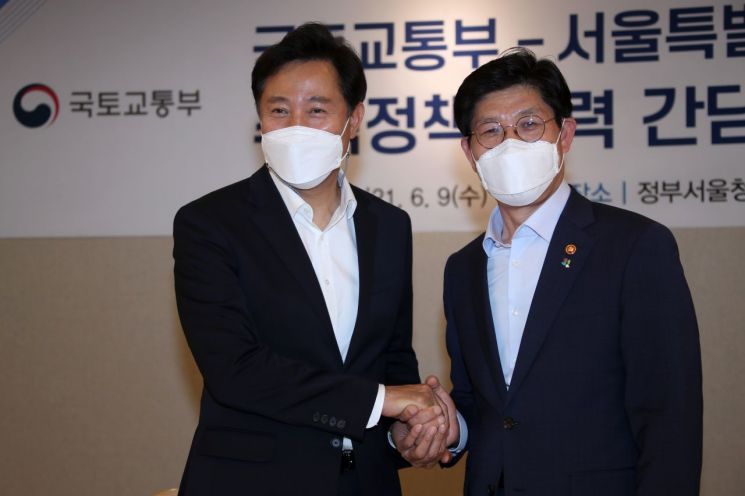
On the afternoon of the 9th, the Ministry of Land, Infrastructure and Transport (MOLIT) and the Seoul Metropolitan Government held a policy meeting at the Government Seoul Office to stabilize the housing market and revitalize housing supply, announcing cooperation plans with these details. The meeting was attended by MOLIT Minister Noh Hyungwook, Seoul Mayor Oh Sehoon, and housing policy officials from both organizations.
The meeting was arranged to restore trust in supply policies and to promptly alleviate market anxiety. It was based on the judgment that it is necessary for the heads of institutions to meet directly to share perceptions of the market situation and establish a cooperative system.
Through the meeting, MOLIT and Seoul reaffirmed their joint goal of "stabilizing low-income housing through supply expansion." They agreed to make joint efforts prioritizing housing market stability and to cooperate mutually to activate the supply of quality housing. Furthermore, they decided to implement thorough market management measures to prevent supply projects from being perceived as development boons that could trigger short-term speculative demand and market instability.
Specifically, private redevelopment will adopt a public planning method, and public-led projects will establish reasonable maintenance plans through a preliminary review committee to prevent excessive privatization of development profits generated as incentives. The easing of reconstruction safety inspections will be further discussed considering the housing market's stabilization trend.
The timing for restricting the transfer of association members' status in maintenance projects will be moved forward to the early stages of the project. This is a measure to preemptively block speculative demand aiming for development profits. Previously, in speculative overheated zones, reconstruction restricted association member status transfers after association establishment approval, and redevelopment after management disposition plan approval. However, going forward, reconstruction will restrict transfers after passing the safety inspection, and redevelopment after the designation of the maintenance zone. The reference date will be separately determined by the city or provincial governor.
Maintenance zones where speculation concerns are detected will face disadvantages in public and private redevelopment project competitions by improving evaluation criteria. For example, if transaction volume and price trends exceed the average of the relevant autonomous district, additional points will be assigned.
MOLIT and Seoul will regularly share market trend monitoring data and, through joint real transaction investigations, will promptly implement additional measures such as designating land transaction permission zones if signs of market instability are detected even before related laws on restricting association member status transfers are amended.
They will also strengthen cooperation on housing supply expansion policies. First, to expedite the public-led maintenance projects announced by the government, a preliminary review committee will be formed within this month to finalize project plans early. The Korea Land and Housing Corporation (LH) and Seoul Housing and Communities Corporation (SH) will expand related personnel and organizations to ensure smooth project implementation. Various incentives will be applied to improve project feasibility, such as increasing the floor area ratio to 700% for station-area semi-residential projects and raising the classification for low-rise residential projects to type 1 or the legal maximum of 120%.
Additionally, public-led maintenance project candidate sites will be excluded from Seoul's redevelopment competition areas, and Seoul's redevelopment selected areas will also be excluded from public-led maintenance project candidate sites to prevent conflicts between public and private projects. Discussions will also be held regarding housing supply on the Yongsan Camp Kim site announced earlier.
In terms of residential welfare, cooperation will be pursued to expand the supply of long-term lease housing, a key initiative of Seoul City. Considering the support levels for other public rentals and financial conditions, the city will prepare housing fund support plans and consult with related ministries. Among public rental housing supplied through public-led maintenance projects, SH Corporation's portion will be supplied as long-term lease housing. The possibility of supplying some LH units as long-term lease housing will also be actively examined.
Seoul's planned introduction of "Sangsaeng Housing" (private land lease-type housing where the city rents private land and supplies housing to youth and newlyweds) will also be discussed with related ministries after preparing incentives for landowners' participation. Additionally, joint review will be conducted on expanding metropolitan government participation in the selection of targets and price calculation processes related to official apartment announcements.
Through these efforts, Seoul plans to supply an average of 107,000 housing units annually from 2021 to 2030 based on move-in volume. This represents a 46.5% increase compared to past averages. Especially, units supplied through public-led maintenance projects will be offered at 70-80% of market prices in prime urban locations. The share of general supply units with exclusive areas of 85㎡ and sales prices below 900 million KRW will be increased to half of the total, and the lottery system will be expanded to 30%, significantly increasing homeownership opportunities for genuine non-homeowners.
Minister Noh emphasized, "With the increased possibility of US-origin interest rate hikes, if supply policies are implemented without disruption, housing prices are expected to stabilize downward in the mid to long term. When purchasing housing, it is necessary to consider the mid to long-term housing market outlook at least after 2023, making it a time when market participants need to exercise more cautious judgment than ever."
Mayor Oh stated, "The ultimate goal of Seoul's housing policy is, first and foremost, the stabilization of low-income housing, and all premises are the stabilization of the real estate market. Through this cooperation, if the system improves, a foundation will be established to accelerate various housing supply projects."
© The Asia Business Daily(www.asiae.co.kr). All rights reserved.


















