On the 9th, the Anti-Corruption and Civil Rights Commission Announces 'Adjustment Plan for 5 Government Support Projects for Public Mask Distribution'
Korean Pharmaceutical Association Filed a Collective Complaint on February 19... "Mental and Financial Damages Are Significant"
Pharmaceutical Association Requests "Reduction of Income Tax and VAT"... Adjustment Plan Shifted Due to Ministry of Economy and Finance Opposition
Concerns Arise That "Instead of Tax Compensation, Only Public Healthcare Obligations May Increase"
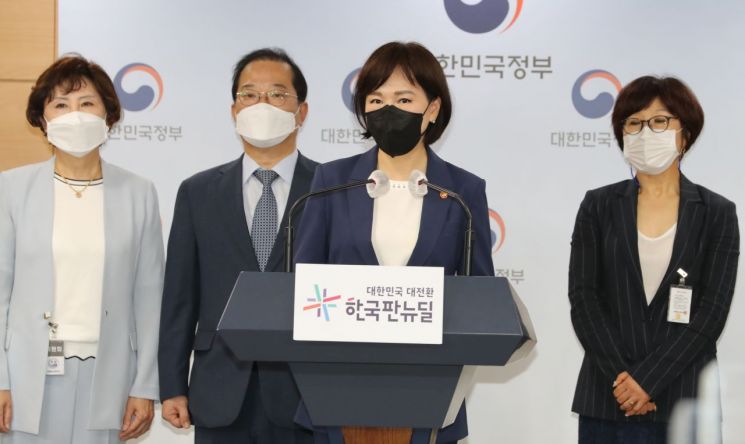 Jeon Hyun-hee, Chairperson of the Anti-Corruption and Civil Rights Commission (second from the right), announces the results after concluding the on-site mediation meeting for collective complaints demanding the government's fulfillment of support promises for public mask distribution at the Government Seoul Office Building on the 9th. The man to Chairperson Jeon's left is Kim Dae-eop, President of the Korea Pharmaceutical Association. (Photo by Yonhap News)
[Sejong=Asia Economy Reporter Moon Chaeseok] The government and the Korea Pharmaceutical Association have prepared a revised plan to promote five support projects, including the nationwide distribution of non-contact thermometers to pharmacies, instead of the income tax and value-added tax reductions demanded by pharmacists who suffered mental and financial damages during the public mask distribution process. It is unlikely that individual pharmacists or pharmacies will receive tax benefits.
The Anti-Corruption and Civil Rights Commission announced on the 9th at 11:40 a.m. that a final agreement was reached at an on-site mediation meeting held at the Government Complex Seoul, chaired by Chairperson Jeon Hyun-hee, with the participation of the Korea Pharmaceutical Association, Ministry of Health and Welfare, Korea Disease Control and Prevention Agency, and Ministry of Food and Drug Safety.
Earlier, on February 19, the Korea Pharmaceutical Association filed a collective complaint with the Commission, stating that the government had not fulfilled its specific promises regarding public mask distribution support projects amid the prolonged COVID-19 crisis. The association appealed, "Due to the government policy of selling public COVID-19 masks, pharmacists had to endure mental distress such as verbal abuse and criticism caused by mask shortages at the site, and suffered financial losses including value-added tax and income tax amounting to hundreds of thousands of won."
In February last year, the government announced a public mask supply policy to cope with the 'mask crisis' caused by the spread of COVID-19. About 23,000 pharmacies nationwide participated in the public mask distribution, contributing to the prevention of COVID-19 spread. Although the government repeatedly promised tax support, implementation was delayed due to resistance from financial authorities. Subsequently, the matter was handed over to the Commission for mediation, and the revised plan was prepared on this day.
The main points of the agreement include ▲ distribution and installation of non-contact thermometers at pharmacies nationwide ▲ pilot project for public late-night pharmacies ensuring access to medicines during vulnerable hours ▲ deployment of pharmacist personnel at nationwide vaccination centers ▲ promotion of pharmacists' roles during the COVID-19 situation ▲ support projects for suicide prevention at local pharmacies.
Currently, non-contact thermometers are being distributed based on applications from about 17,000 pharmacies nationwide. Regarding concerns that this might be overlapping support for an ongoing project, Ahn Junho, Director of the Grievance Handling Bureau at the Commission, explained, "After the collective complaint from the Pharmaceutical Association in February, during inter-agency consultations, it was concluded that tax support was difficult, so the agencies agreed to propose a mediation plan. During the consultation process, an additional supplementary budget of 8.2 billion won was reflected, and non-contact thermometers are scheduled to be distributed to pharmacies nationwide within this month." Kim Dae-up, President of the Korea Pharmaceutical Association, added, "The government will bear 90% of the 8.2 billion won, and the association will cover the remaining 10% (about 900 million won)."
The conflict has not been completely extinguished. From the perspective of individual pharmacists, there may be backlash that instead of the originally requested tax benefits, they are being assigned more work in government public healthcare. Regarding such criticism, President Kim said, "That is true and embarrassing. When negotiating with the Commission, rather than seeking benefits that would return to individual pharmacies, we proposed alternatives focused on necessary policy projects such as expanding government public healthcare." He added, "I consider the dissatisfaction that pharmacies (and pharmacists) have in this regard as something the president must persuade and bear on behalf of the members."
Chairperson Jeon said, "In fact, pharmacists who cooperated with government policy by selling public masks and suffered mental and financial damages will not receive direct compensation from the mediation plan, but it was adjusted to expand public healthcare for the people, and the Pharmaceutical Association proposed such policy alternatives. On behalf of the government, I highly appreciate and respect this, and I hope the public will also recognize this."
When asked again what compensation pharmacists and pharmacies would receive, President Kim explained, "In Europe, the United States, and Japan, pharmacists are required to work at vaccination centers, but in our country, among 12 personnel at the centers, there are only 4 doctors and 8 nurses." He added, "Pharmacists should manage aspects such as COVID-19 vaccine transportation, frozen storage, thawing, and preparation." He further explained, "Since there could be various responsibilities arising from the missing parts in regulations, this means correcting that. It would be good to understand this as a matter of principles and roles, not individual profit."
Chairperson Jeon said, "In a way, since vaccines containing germs must be managed from arrival to administration, and pharmacists are the top experts who should be involved, this mediation plan includes essential measures for public health and safety."
Before the mediation, the Commission held a meeting in February chaired by then Prime Minister Chung Sye-kyun and Chairperson Jeon to listen to pharmacists' difficulties. Subsequently, meetings were held with the Ministry of Economy and Finance, Ministry of Health and Welfare, and Korea Disease Control and Prevention Agency.
© The Asia Business Daily(www.asiae.co.kr). All rights reserved.

















