"Influence of Pro-China Countries like Cambodia"
Engagement While the US Focuses on Middle East Issues
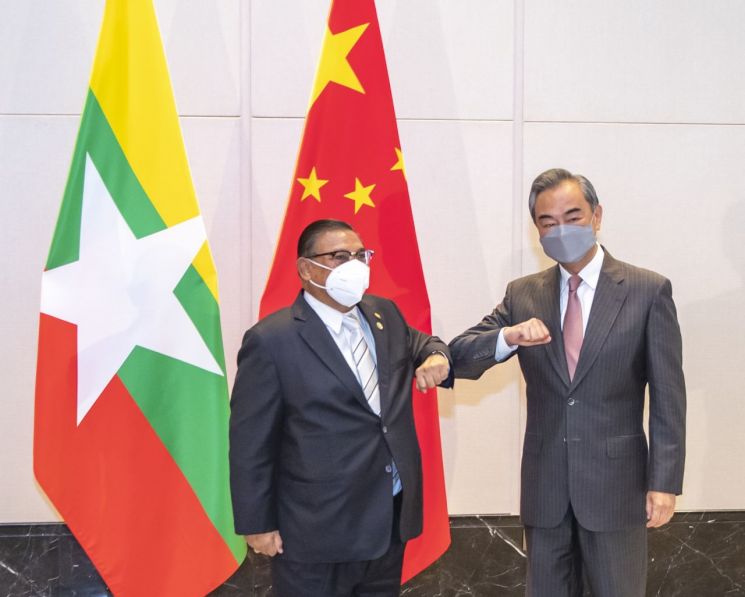 On the 8th, Wang Yi, China's Foreign Minister (right), attending the China-ASEAN Special Foreign Ministers' Meeting held in Chongqing, Sichuan Province, China, is seen exchanging elbow greetings with U Nyan Maung Lwin (left), Myanmar's Foreign Minister. China faced criticism for inviting the Foreign Minister appointed by the Myanmar military to this meeting, which was seen as supporting the military junta. Chongqing, China = Photo by Xinhua and Yonhap News Agency
[Asia Economy Reporter Hyunwoo Lee] China has secured a joint statement from ASEAN (Association of Southeast Asian Nations) countries agreeing to mutually restrain provocations in the South China Sea. There are forecasts that the diplomatic standing of the United States, which had been aiming to expand the membership of the anti-China military alliance ‘Quad’ in the Southeast Asian region, will weaken. It is reported that China has taken an active approach to wooing extremely poor countries such as Cambodia and Laos by promising large-scale vaccine and economic support while the U.S. is focused on Middle East issues due to the Palestinian conflict.
On the 8th, the foreign ministers of China and the 10 ASEAN countries concluded a special foreign ministers' meeting held in Chongqing since the previous day and issued a joint statement centered on mutually restraining provocations in the South China Sea. ASEAN foreign ministers agreed to adopt a statement regarding the South China Sea dispute that "China and ASEAN countries will cooperate to enhance maritime security in the South China Sea and refrain from activities that escalate disputes or undermine peace and stability."
Prior to the announcement of this statement, the Philippines, which recently had maritime sovereignty disputes with China, and Malaysia, which experienced airspace violations by Chinese military aircraft, argued that stronger wording to prevent Chinese provocations in the South China Sea should be included in the statement. However, it is reported that this was blocked due to opposition from pro-China ASEAN countries such as Cambodia and Laos.
The Singapore daily The Straits Times cited anonymous sources, pointing out that "Cambodia and Laos, who were preemptively wooed by China with vaccine and economic support, opposed the Philippines' claims, resulting in a lack of unified voices among ASEAN countries regarding the South China Sea, which significantly lowered the level of the statement's content."
Regarding the Myanmar situation, which was also a major agenda item at this meeting along with the South China Sea, the statement only included content about "striving to maintain regional peace and stability." There was no condemnation of the military coup, which was identified as a major cause of the Myanmar crisis, nor any mention of joint sanctions or pressure on the military junta. This is also presumed to be because China exerted influence behind the scenes to restrain criticism of the Myanmar military.
The U.S. plan to expand its influence in the Asia-Pacific region is also expected to face setbacks. Voice of America (VOA) reported that "China is seeking to expand its influence by promising large-scale vaccine support to countries such as Bangladesh and Sri Lanka, which the U.S. had proposed for Quad membership," and pointed out that "India's current inability to export vaccines is giving China a strategic opportunity."
© The Asia Business Daily(www.asiae.co.kr). All rights reserved.
![Clutching a Stolen Dior Bag, Saying "I Hate Being Poor but Real"... The Grotesque Con of a "Human Knockoff" [Slate]](https://cwcontent.asiae.co.kr/asiaresize/183/2026021902243444107_1771435474.jpg)
















