7 Major Commercial Banks Consolidated 207 Branches in the Past Year... 39 Branches Closed from January to May This Year
Accelerating Digital Transformation and Organizational Restructuring... Eliminating Inefficient Branches to Reduce Various Costs
[Asia Economy Reporter Kwangho Lee] Over the past year, more than 200 bank branches have closed. This year alone, about 30 branches have disappeared. Although financial authorities have strengthened branch closure procedures and called for a 'speed adjustment,' banks appear to be accelerating the reorganization of their offline operations to facilitate digital transformation. In particular, with about a hundred branch closures scheduled for the second half of the year, the number of branches closing this year is expected to reach an all-time high.
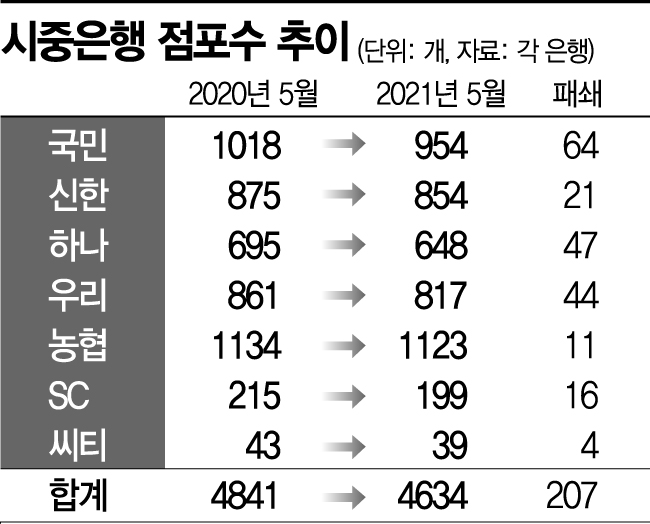
According to the financial sector on the 9th, from January to May this year, seven banks including KB Kookmin, Shinhan, Hana, Woori, NH Nonghyup, SC Jeil, and Citibank have closed a total of 39 branches. As of May last year, the number of branches that disappeared over one year reached 207.
This is interpreted as a result of the expansion of non-face-to-face services due to COVID-19, which accelerated the closure of inefficient offline branches.
Among the banks, KB Kookmin Bank, which has the largest number of branches, saw the biggest decrease. The number of branches, which was 1,018 in May last year, dropped by 64 to 954 as of the end of last month. During the same period, Hana and Woori Banks closed 47 and 44 branches respectively, while Shinhan (21), SC Jeil (16), Nonghyup (11), and Citibank (4) also withdrew one after another.
Branch closures are expected to accelerate further in the second half of the year. KB Kookmin Bank plans to close 27 branches including the Yeoksam-dong Comprehensive Financial Center and Jeju Comprehensive Financial Center in July, and 2 branches including the Guri Comprehensive Financial Center and Namdaemun Comprehensive Financial Center in September. Woori Bank will consolidate 2 branches in June and 19 branches in July, Shinhan Bank plans to close 17 branches in September, and Nonghyup Bank will close 3 branches in August. SC Jeil Bank will close 2 branches, the Chungju branch and the Guro-dong branch, at the end of June.
The reason banks are driving branch reductions is due to a significant decrease in financial consumers visiting branches after the COVID-19 outbreak, as well as operating costs. Maintaining branches located in downtown areas of major cities costs commercial banks about 1.2 to 1.7 billion KRW per year. It is interpreted as an intention to reduce various costs by eliminating inefficient branches that customers do not visit due to non-face-to-face services.
A representative from a commercial bank said, "Branch consolidation is for the efficient operation of branches," adding, "We will promote the establishment of complex branches to help financial consumers' convenience." Another official explained, "As competition with internet-only banks intensifies, branch reductions, which inevitably involve fixed costs, are expected to continue for some time," and "With non-face-to-face channels becoming central, the online sales ratio of major commercial banks has exceeded 70%."
In fact, it was found that 7 out of 10 customers who subscribed to financial products such as loans and deposits at major banks used online channels. As of April, Hana Bank's online sales ratio for loan products reached 88%. Industrial Bank of Korea, whose main customers are small and medium-sized enterprises, also had a high online subscription ratio of 82.2%, and Shinhan Bank showed that 60% of customers subscribed to products online.
© The Asia Business Daily(www.asiae.co.kr). All rights reserved.

















