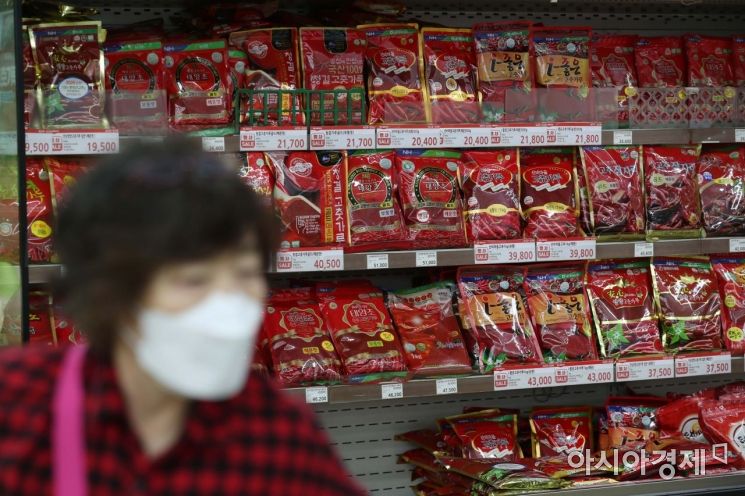
 On May 4th, citizens were shopping at the Nonghyup Hanaro Mart Yangjae branch in Seocho-gu, Seoul. According to the 'Consumer Price Trends' announced by Statistics Korea on the same day, the consumer price index in April rose by 2.3% compared to the same month in 2019. This is the largest increase since August 2017 (2.5%). Due to poor crop yields and the impact of highly pathogenic avian influenza (AI), prices of grocery items such as green onions, eggs, and red pepper powder have surged. Photo by Moon Honam munonam@
[Asia Economy Reporter Seungjin Lee] As the prices of key ingredients such as red pepper powder continue to soar for several months, more consumers are turning to packaged kimchi. This is because the price of packaged kimchi products is similar to or even cheaper than the cost of making kimchi at home.
According to the Korea Agro-Fisheries & Food Trade Corporation (aT) on the 9th, the retail price of 1 kg of red pepper powder was recorded at 37,583 KRW as of the previous day. This is a 44.0% increase from 20,696 KRW a year ago.
The sharp rise in red pepper powder prices is due to the dried chili pepper prices failing to stabilize for several months since October last year. As of the 8th, the retail price of 600g of dried chili peppers (Hwageon) was 20,313 KRW, 59.8% higher than the previous year.
Other key ingredients have also been rising in price daily. On the same day, peeled garlic (1 kg) was priced at 11,301 KRW, up 54.8% from the previous year, and green onions (1 kg) were 3,163 KRW, up 18.1%. This is due to reduced supply caused by last year's prolonged monsoon season and cold damage affecting harvests.
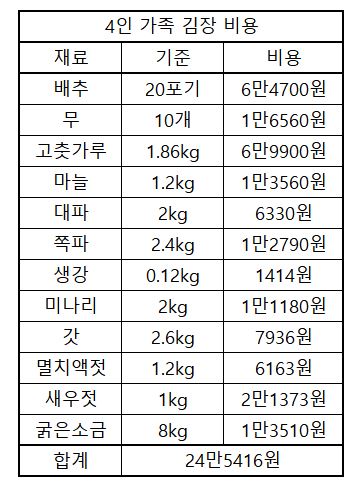
As the prices of key ingredients rise, the cost of making kimchi for kimjang (kimchi-making season) has also increased. Calculating the cost of making kimchi directly based on quantities for a family of four?20 heads of napa cabbage, 10 radishes, 1.86 kg of red pepper powder, 1.2 kg of garlic, 2 kg of green onions and water parsley, and 1 kg of salted shrimp?results in approximately 245,400 KRW. This is about a 10% increase compared to the same period last year.
On the other hand, as kimjang costs increased, the price gap with packaged kimchi products has narrowed. Some products were even cheaper than making kimchi at home. Considering the top domestic packaged kimchi brand Jongga Jip’s 'Haengboki On Pogikimchi 10 kg' priced at 49,000 KRW, and that one head of kimchi weighs about 3 kg, the cost for 20 heads would be approximately 290,000 KRW. Although this is more expensive than making kimchi directly, when factoring in labor costs involved in making kimchi, the difference is not significant.
Besides Jongga Jip, packaged kimchi products from Pulmuone and Ourhome were priced similarly to or even cheaper than making kimchi at home. Some packaged kimchi products were more than 20,000 KRW cheaper than making kimchi directly.
In this situation, online shopping mall Gmarket compared kimchi sales from last month’s 7th to this month’s 6th with the same period last year, showing increases of 28% for fresh kimchi (geotjeori), 15% for dongchimi, 47% for green onion kimchi, and 41% for young radish kimchi.
A food industry official explained, "In the case of packaged kimchi, companies sign large-scale contracts with farms and store some ingredients for a year, making them relatively less sensitive to price fluctuations. The taste and quality of packaged kimchi continue to improve, so the number of consumers purchasing packaged kimchi is expected to increase further."
© The Asia Business Daily(www.asiae.co.kr). All rights reserved.


















