Focus on Strengthening Own Competitiveness Rather Than Clashing with China
Indicates Possible Tariff Measures on Rare Earths
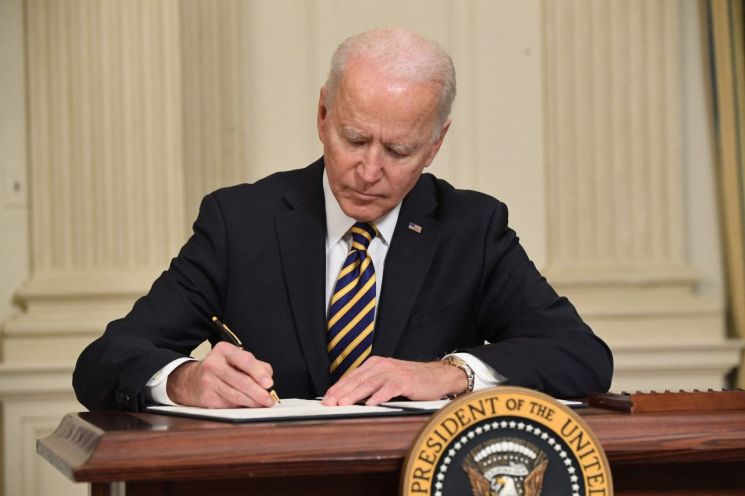 U.S. President Joe Biden is signing an executive order at the White House on the 24th (local time) to review the supply chain status of critical industrial items. President Biden has ordered a 100-day review of the supply chains for four key items that have revealed supply and demand issues: semiconductor chips, large-capacity batteries for electric vehicles, rare earth elements, and pharmaceuticals. [Image source=Yonhap News]
[Asia Economy New York=Correspondent Baek Jong-min] The United States has unveiled a 'blueprint' to counter China in supply chains of key industries such as semiconductors and batteries. While restraining China, the U.S. emphasized strengthening cooperation with allies including South Korea, which is expected to have considerable impact on Korean companies.
On the 8th (local time), the White House released a report outlining a strategy to address supply chain disruptions in four critical sectors: semiconductors, large-capacity batteries, critical minerals including rare earth elements, and pharmaceuticals.
This is the result of President Biden’s directive in February to review supply chain issues at the whole-of-government level.
The White House stated, "The United States cannot resolve supply chain vulnerabilities alone," emphasizing the need to cooperate with allies and strengthen supply chain resilience in areas where domestic production increases alone are insufficient.
The White House mentioned the $17 billion investment by Korean companies such as Samsung Electronics announced during the U.S.-South Korea summit, stating, "We will enhance engagement with allies and partners to ensure fair semiconductor chip allocation, increase production, and promote investment."
The U.S. also plans to convene an international supply chain strengthening conference involving key government officials and private sectors from major allies. Korean companies in sectors like semiconductors and batteries are expected to be invited.
The report also highlighted the continued need for cooperation with South Korea through bilateral engagement alongside the Quad to promote complementary investments in the semiconductor sector.
Peter Harrell, Senior Director for International Economics and Competitiveness at the White House, mentioned Samsung Electronics’ investment in the U.S. and stressed cooperation with allies and partners during a White House briefing on the same day.
In the battery sector, the report includes plans to actively utilize loan programs to expand and establish manufacturing facilities in the U.S. This is also seen as an intention to promote investments in the U.S. by overseas companies including South Korea’s LG Energy Solution and SK Innovation. A 'Battery Round Table' is scheduled to be held later this month.
The report repeatedly mentioned key U.S. allies related to semiconductors and batteries, citing South Korea 74 times, Taiwan 84 times, and Japan 85 times, emphasizing the role of allies.
The U.S. supply chain response strategy is largely aimed at countering China. The words 'China' and 'Chinese' were mentioned 458 and 108 times respectively in the report.
A representative example is the response to rare earth elements. The Department of Commerce is considering whether to apply Section 232 of the Trade Expansion Act to imports of neodymium magnets, which are rare earth elements essential for manufacturing automobiles, smartphones, and defense materials. The U.S. imports most of its neodymium magnets from China.
Section 232 of the Trade Expansion Act allows the president to impose high tariffs without congressional approval when national security is threatened. Following the Trump administration, the Biden administration has also prepared a strategy to respond to China with tariffs.
While high tariffs are anticipated, plans to produce rare earth elements domestically, which China has virtually monopolized, have also been established.
The newly established 'Supply Chain Trade Enforcement Task Force,' led by the U.S. Trade Representative (USTR), is expected to respond to China’s unfair trade practices.
However, the announcement did not include measures that would immediately impact China. It is interpreted as reflecting the Biden administration’s policy to gain superiority through technology and influence rather than confrontation or friction with China.
© The Asia Business Daily(www.asiae.co.kr). All rights reserved.
![Clutching a Stolen Dior Bag, Saying "I Hate Being Poor but Real"... The Grotesque Con of a "Human Knockoff" [Slate]](https://cwcontent.asiae.co.kr/asiaresize/183/2026021902243444107_1771435474.jpg)











