[Asia Economy Reporter Kim Bong-su] A material that hides objects from light like the invisibility cloak in the movie 'Harry Potter' has been developed by domestic researchers.
The Gwangju Institute of Science and Technology (GIST) announced on the 8th that the research team led by Senior Researcher Ki Cheol-sik at the Institute of Advanced Photonics Technology developed a photonic Dirac dispersion material that can hide objects from light like an invisibility cloak or completely remove the phase information of incident light, making it impossible to restore.
The research team proposed a theoretical method to implement photonic crystals with photonic Dirac dispersion characteristics by understanding the relationship between the Fourier-harmonic components of photonic crystals and the radiation loss of photonic crystal modes and manipulating specific Fourier-harmonic components. A photonic crystal is a structure with a periodically varying refractive index that strongly reflects light in a specific frequency range. Fourier-harmonic components refer to multiples of frequencies corresponding to the period of the periodic structure.
Previous studies on Dirac dispersion characteristics using photonic crystals were mainly conducted in the low-frequency range where the wavelength is longer than the period of the photonic crystal. There have been no reports in the high-frequency range where the wavelength is similar to the period. This is because the mutual interference among higher-order Fourier-harmonic components of the photonic crystal induces radiation loss, hindering the implementation of Dirac dispersion characteristics in the high-frequency range.
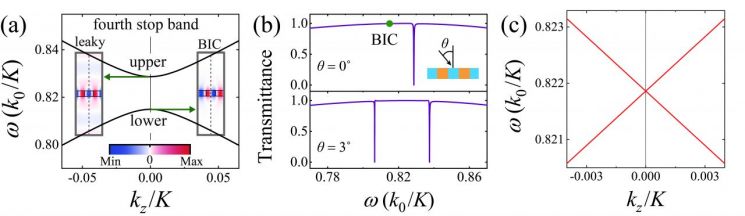
The research team has theoretically studied the relationship between the Fourier-harmonic components of photonic crystals and the radiation loss of photonic crystal modes, and through this study numerically proved that the interaction among higher-order Fourier-harmonic components is closely related not only to Dirac dispersion characteristics but also to bound states in the continuum and Fano resonance. Based on these results, they manipulated specific Fourier-harmonic components to realize Dirac dispersion characteristics, bound states in the continuum, and Fano resonance in the high-frequency range. A bound state in the continuum (BIC) is a quantum mechanical state where an electron with a continuous energy level higher than the bound energy is spatially confined; recently, it has been discovered as a state that traps light (photons) forever in photonic crystals. Fano resonance is a resonance caused by the interference between radiation modes and bound modes, characterized by an asymmetric transmission spectrum in a very narrow frequency range.
The research team stated, “This study is significant in that it provides an understanding of the correlation between Fourier-harmonic components and radiation loss of photonic crystal modes and proposes a method to realize Dirac dispersion characteristics, bound states in the continuum, and Fano resonance in the previously unreported high-frequency range.” They added, “It is expected to be utilized in stealth technology, electromagnetic wave shielding technology, high-efficiency nonlinear devices, and high-sensitivity optical sensors in the future.”
The research results were published online on the 27th of last month in the international academic journal ‘Photonics Research.’
© The Asia Business Daily(www.asiae.co.kr). All rights reserved.
![Clutching a Stolen Dior Bag, Saying "I Hate Being Poor but Real"... The Grotesque Con of a "Human Knockoff" [Slate]](https://cwcontent.asiae.co.kr/asiaresize/183/2026021902243444107_1771435474.jpg)
















