Former Party Leader Lee Nak-yeon
Continues to Advocate for May Gwangju Declaration Constitutional Amendment
Suddenly Proposes Revival of Three Land Public Concept Laws
Former Prime Minister Chung Sye-kyun
Holds Press Conference Revealing Constitutional Amendment Plans Including 4-Year Presidential Two-Term System and Power Decentralization
Lower Approval Ratings Compared to Governor Lee Jae-myung
Attempts a Turnaround with Constitutional Amendment Debate
[Asia Economy Reporters Jeon Jin-young and Oh Ju-yeon] On the 8th, a ‘constitutional amendment theory’ sparked by leading presidential candidates of the Democratic Party of Korea emerged. It includes many sensitive issues such as the public concept of land and power decentralization. The main figures are former Democratic Party leader Lee Nak-yeon and former Prime Minister Chung Sye-kyun. Compared to Gyeonggi Province Governor Lee Jae-myung, who has relatively lower approval ratings, their constitutional amendment proposals could serve as a kind of ‘mood changer’ or ‘winning move.’ Not only Governor Lee but also potential opposition presidential candidates will need to express their opinions on constitutional amendments in some way going forward. Thus, as the election phase intensifies, the constitutional amendment debate could become one of the key battlegrounds.
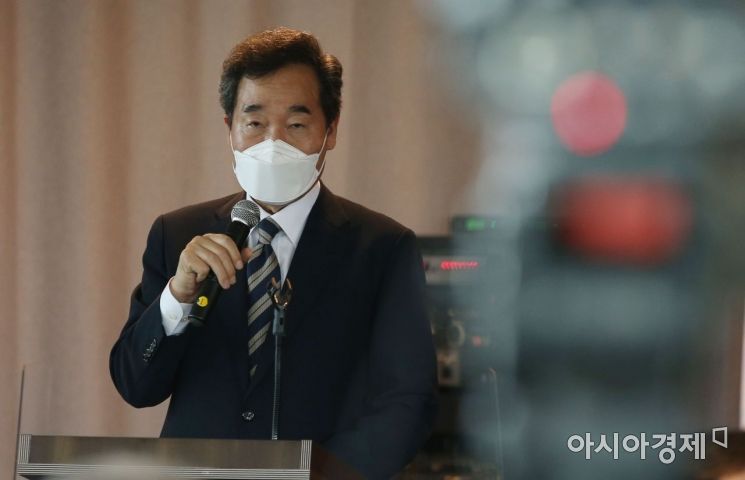 Former Democratic Party presidential candidate Lee Nak-yeon is attending the K-Security Forum inaugural seminar held at the Marina Convention Center in Yeouido, Seoul on the 7th, delivering a congratulatory speech. Photo by Yoon Dong-joo doso7@
The first among the ruling party’s ‘Big 3’ presidential candidates to advocate for constitutional amendment was former leader Lee. At last month’s Gwangju Declaration, Lee called for constitutional amendments to strengthen citizens’ fundamental rights. This time, he boldly proposed reviving the ‘three laws on the public concept of land’?the Land Ownership Limit Act, the Land Excess Profit Tax Act, and the Development Profit Recovery Act?as part of a constitutional amendment. He stated, "We must improve the unfairness and inequality stemming from land and strengthen the state’s responsibility for housing welfare," emphasizing the need for constitutional amendments to reinforce and actualize the public concept of land. The additional tax revenue collected would be used to supply housing more affordably to the homeless. These three laws were introduced during the Roh Tae-woo administration but were later ruled unconstitutional or incompatible with the constitution.
Lee stressed the need to expand the public concept of land as a solution to inequality, saying, "Our society is becoming more polarized due to widening income gaps, and while labor income disparities are increasing, the expansion of asset income disparities is particularly severe globally." He added, "Even if excessive parts of the past three laws are adjusted, I hope the purpose of the public concept is properly preserved," and proposed, "The content and meaning of the public concept of land should be included in the constitution to legislate the ‘three laws on the public concept of land’ without controversy."
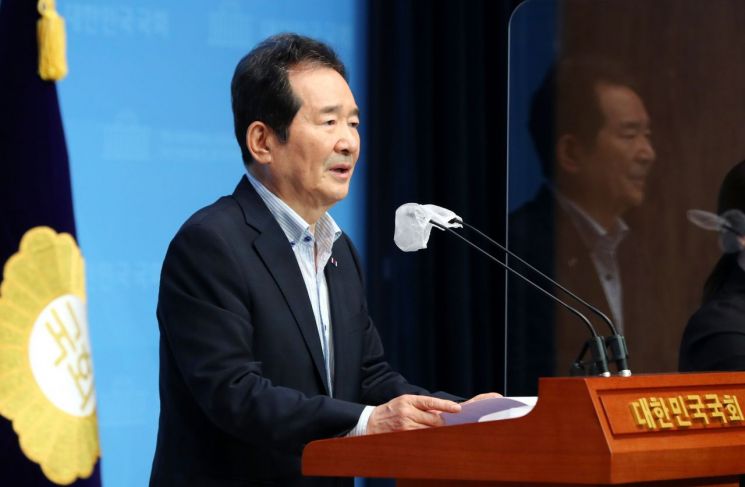
On the same day, former Prime Minister Chung also held a press conference at the National Assembly Communication Office to reveal his constitutional amendment plan. He said, "(Our constitution) has not properly reflected changes over 34 years, so efforts are needed to revise issues including power structure, decentralization, and fundamental rights provisions." His proposed directions for constitutional amendment included ▲horizontal decentralization among the legislative, judicial, and executive branches and vertical decentralization between central and local governments ▲a four-year presidential term with one re-election ▲decentralization of presidential powers focusing on foreign affairs ▲lowering the presidential eligibility age ▲strengthening fundamental rights such as the public concept of land and economic democratization. He proposed, "I suggest pushing for constitutional amendment now and putting it to a national referendum alongside next year’s presidential election." Regarding the issue of lowering the presidential eligibility age, which became a hot topic due to the surge of People Power Party leader candidate Lee Jun-seok, he said, "It is not aimed at any specific individual. It is necessary to keep up with the times," and suggested, "It is time to serve in public office regardless of age. Efforts are needed to adjust or abolish the eligibility age, possibly aligning it with the National Assembly eligibility age (25 years old)."
Meanwhile, no other ruling or opposition presidential candidates besides Lee Nak-yeon and Chung Sye-kyun have expressed specific positions on the necessity or content of constitutional amendments. Governor Lee, who leads the ruling party’s approval ratings, expressed an opinion in May that ‘livelihood issues are more important than constitutional amendments.’ Former Prosecutor General Yoon Seok-youl, a leading opposition figure, has not issued any particular stance.
© The Asia Business Daily(www.asiae.co.kr). All rights reserved.


















