Semiconductor Supply Shortage Expected to Ease from Next Month
Automotive Industry Performance Anticipated to Improve in Second Half of the Year
[Asia Economy Reporter Changhwan Lee] The global automotive industry's shortage of vehicle semiconductors, which has severely impacted companies like Hyundai Motor and Kia, is expected to significantly ease starting next month. There is also growing anticipation that the performance of automakers will greatly improve due to the normalization of vehicle production and new car launches in the second half of the year.
Kia: "Vehicle Semiconductor Shortage to Ease from July"
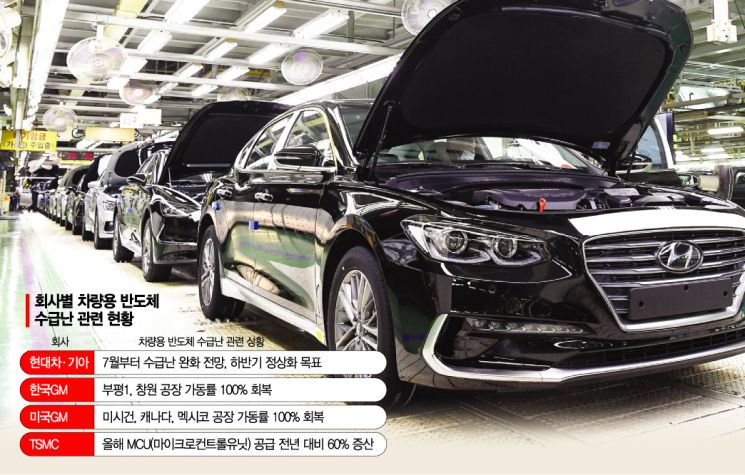
According to the automotive industry on the 8th, Kia recently announced during a private conference call with major domestic institutional investors that the shortage of vehicle semiconductors will ease starting next month. Accordingly, they explained that the normalization of automobile production and sales will begin in earnest from July.
Kia has been experiencing production disruptions this year due to the shortage of vehicle semiconductors. Last month, the number of vehicles affected by production delays caused by the semiconductor shortage was around 27,000 units. This corresponds to about 88% of the monthly production target. Production disruptions are expected to continue through this month as well, with weekend overtime work suspended.
However, from next month, it is anticipated that production will normalize as semiconductor supply increases. Hyundai Motor is understood to be in a similar situation as it shares the same supply sources as Kia.
Prior to Hyundai Motor Group, GM (General Motors) also announced improvements in the vehicle semiconductor supply shortage. Since the 31st of last month, Korea GM has increased the operating rate of its Bupyeong 1 plant and Changwon plant from the previous 50% to 100%. Due to the shortage of vehicle semiconductors, only daytime shifts were previously operated, but now normal operations with two shifts (day and night) have been restored.
In North America, four plants are resuming operations. The Lansing Grand River plant in Michigan, USA, which had been halted since February 5th, will resume assembly of the Chevrolet Camaro starting on the 21st of this month. Assembly of the Cadillac CT4 and CT5 at the same plant will return to normal operation one week later. The Canadian plant will restart operations on the 14th, and the San Luis Potosi and Ramos Arizpe plants in Mexico have been back in operation since the 31st of last month.
Effect of Increased Vehicle Semiconductor Production by Semiconductor Companies
The improvement in the vehicle semiconductor shortage is attributed to semiconductor companies gradually increasing production in response to requests from automakers and governments worldwide.
TSMC, the world's largest semiconductor foundry company based in Taiwan, has decided to increase production of MCU (Microcontroller Unit), one of the key components of vehicle semiconductors, by about 60% compared to last year.
In response to urgent requests from governments including the United States, China, Europe, and Korea, TSMC has pledged to boost vehicle semiconductor production even if it means reducing production of other products. Other vehicle semiconductor companies, including Japan's Renesas, are also increasing their production volumes.
With the easing of the vehicle semiconductor shortage, there are forecasts that the performance of domestic automakers will notably improve in the second half of the year. Despite the semiconductor shortage, Hyundai Motor and Kia have recorded the highest market shares in key markets such as Korea, the United States, and Europe in the first half of this year, so their market shares are likely to increase further as conditions improve in the second half.
Hyundai Motor is expecting normalization of production for its dedicated electric vehicle Ioniq 5, increased sales of its premium brand Genesis, and strengthening of its SUV (Sports Utility Vehicle) lineup. Kia is expected to see sharper performance improvements due to the upcoming mass production of its dedicated electric vehicle EV6 and the launch effects of new models such as the new Sportage.
Researcher Eunyeong Lim of Samsung Securities stated, "With sustained strong demand and production normalizing from July, quarterly sales growth without seasonality will be possible," adding, "Expectations for this year's performance will be revised upward."
© The Asia Business Daily(www.asiae.co.kr). All rights reserved.

















