Nearly KRW 33 Trillion Increase in Tax Revenue Boosts Ruling Party's KRW 32 Trillion Supplementary Budget Proposal
Blue House Also Seems to Emphasize Nationwide Disaster Relief Payments
Experts Concerned About Potential Future Tax Revenue Deterioration
[Asia Economy Reporters Kim Hyunjung (Sejong), Jang Sehee] The scale of the second supplementary budget (추경) is likely to increase beyond initial discussions due to a tax revenue windfall exceeding expectations. As the ruling party and government review the support targets and scale considering the strong national tax income, President Moon Jae-in also mentioned "all citizens" as beneficiaries. However, experts advise that fiscal balance still records a deficit of tens of trillions of won, and that tax revenue conditions could worsen if interest rate hikes occur this year.
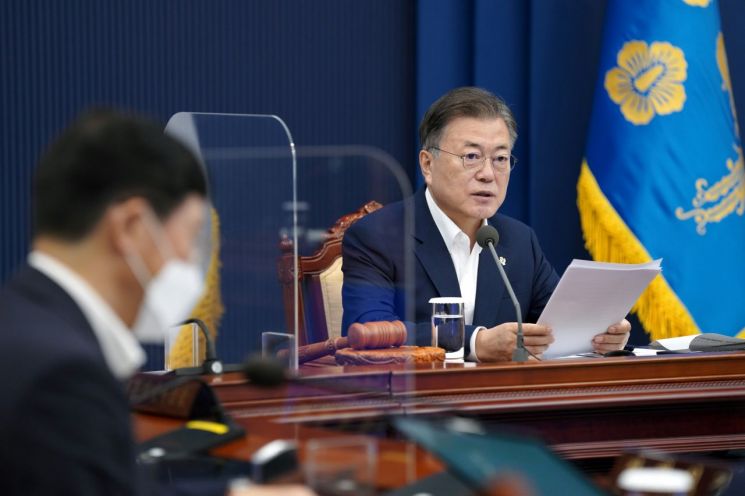
On the 8th, at a Cabinet meeting held at the Blue House, President Moon Jae-in said regarding the supplementary budget, "Including the supplementary budget utilizing additional tax revenue exceeding expectations, please make every effort for an inclusive economic recovery where all citizens can share warmth, by revitalizing struggling businesses and self-employed, restoring consumption among ordinary people, and accelerating job recovery." Analysts suggest that the Blue House has effectively emphasized nationwide disaster relief payments regarding the ongoing tug-of-war over support targets between the ruling party and government. Park Wan-joo, chairman of the Democratic Party Policy Committee, also said at a party strategy meeting in the National Assembly, "The fiscal role can be further expanded to revitalize the livelihood economy" in relation to the supplementary budget.
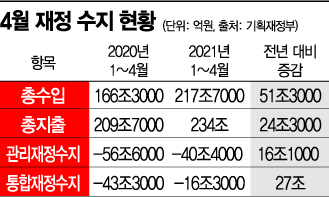
◆Increase Across All Tax Categories... KRW 32.7 Trillion More Collected= According to the June issue of the Fiscal Trend report published by the Ministry of Economy and Finance on the same day, tax revenue increased across all categories. Income tax and corporate tax amounted to KRW 36.7 trillion and KRW 29.9 trillion respectively, which is KRW 7.9 trillion and KRW 8.2 trillion more than a year ago. Value-added tax revenue reached KRW 34.4 trillion, up KRW 4.9 trillion over the same period. Excise tax and customs duties also increased by KRW 2.6 trillion and KRW 200 billion respectively.
Non-tax revenue such as fines, compensation payments, and national treasury subsidy returns, along with fund income, each increased by KRW 16.2 trillion, resulting in a total revenue increase of KRW 51.3 trillion to KRW 217.7 trillion.
However, fiscal capacity remains challenging. Although the fiscal balance deficit has narrowed, it remains in deficit. According to the Ministry of Economy and Finance, the cumulative fiscal management deficit as of April was KRW 40.4 trillion. While the deficit narrowed by KRW 16.1 trillion compared to last year (-KRW 56.6 trillion) due to increased tax revenue, considering the expected increase in expenditure through the supplementary budget, it is difficult to judge it as a stable level. Additionally, as of the end of April, central government debt stood at KRW 880.4 trillion, an increase of KRW 61.2 trillion from the end of last year (KRW 846.9 trillion). The government previously projected that year-end debt would reach KRW 938.4 trillion during the announcement of the third supplementary budget.
◆Second Supplementary Budget to Return Fiscal Capacity= With nearly KRW 33 trillion more tax revenue collected by April this year compared to last year, the ruling party's demand for a broad KRW 32 trillion supplementary budget for economic recovery is expected to gain more momentum. The ruling party is reportedly considering disaster relief payments on an individual basis rather than by household, as well as support measures such as summer vacation subsidies ranging from KRW 300,000 to KRW 500,000. Although there are differences in opinions regarding the scale and targets of the supplementary budget, the ruling party and government have agreed to draft the supplementary budget using excess tax revenue as the source. However, the Ministry of Economy and Finance emphasized in a briefing that excluding tax revenue increases due to deferred payments and payment postponements, the actual increase is KRW 23.9 trillion, indicating that the excess tax revenue is not large.
Some point out that tax revenue was conservatively forecast this year considering the COVID-19 pandemic. There is also risk that tax revenue, which increased last year based on asset price rises, could fluctuate significantly depending on whether interest rates rise this year. A Ministry of Economy and Finance official also mentioned in a briefing on fiscal trends, "The economic recovery and uncertainty in the asset market are very significant," adding, "Recently, housing transaction volumes and securities trading values have been declining."
Professor Kim Soyoung of Seoul National University's Department of Economics emphasized, "Distributing excess tax revenue immediately is unplanned," and added, "A long-term plan is needed on how to improve issues such as self-employed business failures after the end of COVID-19." Won Yoonhee, dean of the Tax Graduate School at the University of Seoul, explained, "Depending on future interest rates and inflation, the direction of the asset market can change significantly, causing large fluctuations in related tax revenue," and "It will be influenced by macro policies such as how to reduce existing quantitative easing."
© The Asia Business Daily(www.asiae.co.kr). All rights reserved.
![Clutching a Stolen Dior Bag, Saying "I Hate Being Poor but Real"... The Grotesque Con of a "Human Knockoff" [Slate]](https://cwcontent.asiae.co.kr/asiaresize/183/2026021902243444107_1771435474.jpg)

















