Slowdown in Increase of Housing Pension Subscribers from 18.2% to 14.3%
Average Monthly Payment and House Prices Rise Annually Due to House Price Increase
Experts Say "Housing Pension Advantageous Even if House Prices Rise, Should Be Actively Utilized"
[Asia Economy Reporter Song Seung-seop] A (58 years old), who lives in an apartment in Guro-gu, Seoul (market price 810 million KRW), intended to subscribe to the Housing Pension to prepare for old age but decided to wait and see the situation. If subscribing with the lifetime payment method, he would receive 1.54 million KRW monthly without fail, but once the pension amount is fixed, it cannot be adjusted even if the house price rises later. A said, "I think 1.54 million KRW is not a small amount," but added, "Since house prices have soared under the current government, I hesitate because I think I might suffer a loss."
The increase in Housing Pension subscribers is slowing down mainly in the metropolitan area. Since expectations for house price increases remain, many people like A are choosing to "wait a little longer even if they subscribe." It is also analyzed that the rapid rise in house prices has caused more houses to exceed the subscription eligibility limit.
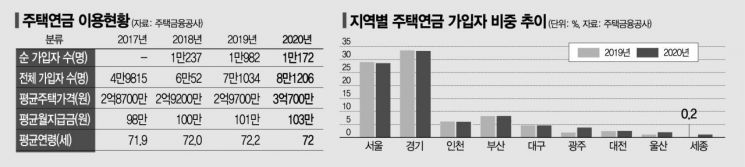
According to the Korea Housing Finance Corporation on the 7th, the number of Housing Pension subscribers increased by only 10,172 (14.3%) last year. This is a slower growth compared to the previous year’s increase of 10,982 (18.2%). It is also less than the increase of 12,037 two years ago. The total number of subscribers is 81,206.
The growth in subscribers has retreated mainly in Seoul and Gyeonggi areas, where house prices soared during the Moon Jae-in administration. At the end of last year, the number of Housing Pension subscribers in these two regions was 23,223 and 27,037, respectively, accounting for 28.6% and 33.3% of the total. This proportion has decreased annually from 30.7% (15,292) and 34.3% (17,092) in 2017. Although the average monthly payment is the highest at 1.39 million KRW and 1.07 million KRW respectively, their share has actually declined.
The Housing Pension is a system where the state guarantees a pension to middle-aged and older adults who own a house but have insufficient income. They can live in the house used as collateral and receive a stable income for life or a certain period. Anyone aged 55 or older who owns a house or whose spouse is a Korean citizen can subscribe.
Homeowners Hesitant About Housing Pension... Experts Say "It’s Advantageous to Use Even If House Prices Rise"
The average monthly payment of the Housing Pension has been increasing every year thanks to rising house prices. The average monthly payment was 989,000 KRW in 2017 and rose to 1.03 million KRW at the end of last year. The average house price of subscribed homes also increased by about 10 million KRW from 297 million KRW the previous year to 307 million KRW. The average house price was 287 million KRW in 2017.
The criteria for subscribing to the Housing Pension have been relaxed in various ways to secure subscribers. In April last year, the subscription age was lowered from 60 to 55 years old. This helps fill the income gap between retirement and receiving the National Pension. At the end of the year, the eligible house price criteria changed from market price under 900 million KRW to publicly announced price under 900 million KRW. Ownership of residential officetels was also allowed.
Measures to increase subscriber options are also being implemented. The ‘trust method Housing Pension,’ where ownership of the house is transferred to the Korea Housing Finance Corporation and the pension is received, is a representative example. When this system is introduced, if one spouse dies, the pension rights automatically transfer to the surviving spouse. Owners of single-family or multi-family houses who rent out part of their homes can also subscribe. ‘Decreasing’ and ‘increasing’ Housing Pension plans, which allow flexible design of payment methods according to retirement timing and financial circumstances, will also be launched. Future subscribers will be able to adjust their pension to receive more initially and less later.
There are concerns that if house prices continue to rise and the public price is continuously adjusted to reflect reality, it will inevitably limit the number of Housing Pension subscribers. Not only will the eligible houses decrease, but worries may increase that subscribers might suffer losses or that the lifetime pension received is less than the current house price. According to the Ministry of Land, Infrastructure and Transport’s ‘2021 Apartment Public Price Announcement,’ the number of apartments with a publicly announced price exceeding 900 million KRW, which are ineligible for the pension, has exceeded 520,000 households. This is an increase of 210,000 households from 310,000 last year. In Seoul, 16% of apartments exceed 900 million KRW in public price, meaning one in six homeowners cannot subscribe to the Housing Pension.
Despite this, the Korea Housing Finance Corporation and pension experts say that the guaranteed benefits and tax reduction effects make it advantageous to utilize the Housing Pension for retirement preparation. A Korea Housing Finance Corporation official advised, “The Housing Pension guarantees a certain pension even if house prices fall. Even if house prices rise, most of the increase goes to the children, so it is better to use it according to the situation.”
© The Asia Business Daily(www.asiae.co.kr). All rights reserved.
![Clutching a Stolen Dior Bag, Saying "I Hate Being Poor but Real"... The Grotesque Con of a "Human Knockoff" [Slate]](https://cwcontent.asiae.co.kr/asiaresize/183/2026021902243444107_1771435474.jpg)
















