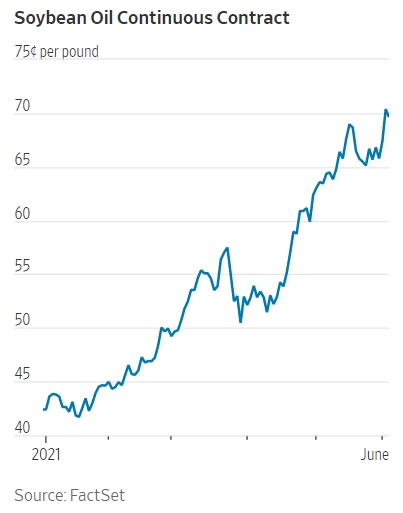
[Asia Economy Reporter Park Byung-hee] Soybean oil futures prices have soared to an all-time high, the Wall Street Journal reported on the 6th (local time).
The WSJ reported that on the 4th, soybean oil futures traded on the Chicago Board of Trade (CBOT) approached 72 cents per pound, surpassing the previous all-time high recorded in 2008.
According to Bloomberg News, soybean oil futures traded on the CBOT on the 4th closed at 71.34 cents per pound, up 3.62% from the previous trading day. During the session, prices reached a high of 71.84 cents. Soybean oil futures have risen nearly 70% so far this year, recording one of the highest returns alongside lumber, corn, and pork futures.
Soybean oil is commonly used as a cooking ingredient, but recently demand has increased as a biofuel. The Joe Biden administration is actively promoting eco-friendly policies, making soybean oil a spotlighted eco-friendly biofuel.
The U.S. Department of Agriculture forecasted in its May report that soybean oil consumption by the biofuel industry for the 2021-2022 fiscal year will reach 12 billion pounds, a 26% increase from the estimated 9.5 billion pounds in the 2020-2021 fiscal year.
Accordingly, soybean oil production is also expected to increase significantly. Financial services firm StoneX projected that soybean oil production in the U.S. this year will nearly double compared to last year, reaching 935 million gallons. In 2023, production is expected to exceed 2 billion gallons, more than twice this year's amount.
Soybean oil producer ADM announced last month that it will invest $350 million to build a new processing facility in Spiritwood, North Dakota. ADM explained that once completed, the plant will be able to process 150,000 bushels of soybeans per day. Cargill also announced in March that it will invest $475 million to upgrade soybean processing facilities across seven states. In April, Cargill revealed plans to establish a new eco-friendly diesel plant in Hastings, Nebraska, through a joint venture. Cargill stated that once the new plant is completed, it will be able to supply 80 million gallons of eco-friendly diesel annually.
Reduced palm oil production in the Asia region is also a factor driving up soybean oil prices. Due to the impact of COVID-19, production in Asia has declined, causing global palm oil inventories to fall to their lowest level in four years.
The rising price of raw soybeans is also a factor in the increase in soybean oil prices. Last month, CBOT soybean futures prices rose to $16.43 per bushel, the highest since September 2012. Soybean prices have been rising recently due to a surge in demand for pig feed in China. In 2018, China culled about one-third of its pig population due to African swine fever. As pig farming numbers have recently increased again, China has significantly increased imports of corn and soybeans from the U.S. for pig feed.
© The Asia Business Daily(www.asiae.co.kr). All rights reserved.

















