"Fighting Low Interest Rates and Inflation for 10 Years"
"Hope for Normalization to Return"
May Consumer Price Index Released on 10th... Market Forecast 4.7%
Fed Faces Pressure Ahead of June FOMC Meeting
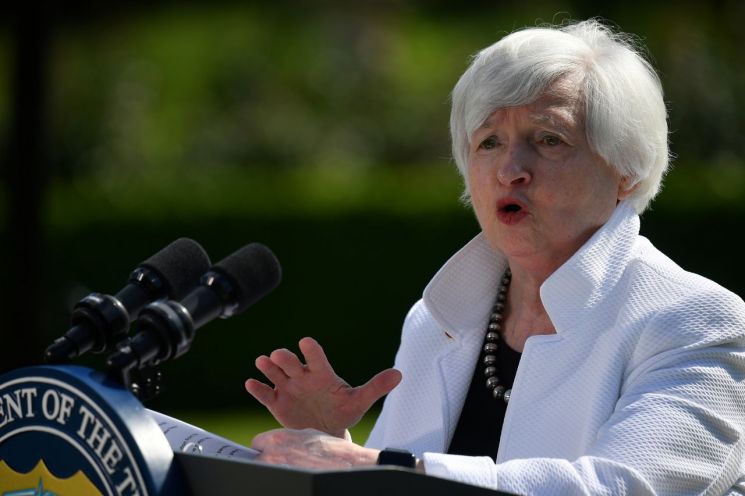
[Asia Economy New York=Correspondent Baek Jong-min] "Raising interest rates slightly is a ‘plus’ for the U.S. economy." Janet Yellen, U.S. Treasury Secretary, once again made remarks accepting interest rate hikes due to rising inflation. Although the May employment report came out worse than expected, easing concerns about the Federal Reserve's (Fed) tapering of asset purchases, debates over normalization of monetary policy are expected to continue if inflation persists. The market is focusing on the U.S. Consumer Price Index (CPI) for May, which will be released this week.
◆ "Wanting to return to normal" = On the 6th (local time), Secretary Yellen said in an interview with Bloomberg, "If interest rates rise slightly, it would actually be a ‘plus’ from the perspective of society and the Federal Reserve (Fed)."
She added, "We have been fighting too low inflation and too low interest rates for the past decade," and said, "We want to return to a (normal interest rate) environment." She especially emphasized, "If returning to a normal interest rate environment can ease several situations a little, that is not a bad thing. It is a good thing."
Secretary Yellen also reiterated that the rise in inflation is still a temporary phenomenon and that the Biden administration’s $4 trillion infrastructure investment plan will not have a significant impact on inflation, stating, "Inflation will disappear next year."
She predicted that even if inflation rises, central banks around the world can handle it. She said, "I know that world. They are very capable. I do not believe they will mess it up."
Secretary Yellen has recently expressed her stance on interest rates repeatedly. Earlier, she caused a stir by saying, "We may need to raise interest rates somewhat to prevent the economy from overheating."
U.S. monetary policy is the Fed’s responsibility. While Secretary Yellen’s main role is fiscal policy such as taxation, her experience as a former Fed Chair has led to speculation that she could influence monetary policy as well. Her remarks reflect a virtuous cycle where large-scale infrastructure investment plans raise inflation, prompting the Fed to raise benchmark interest rates.
However, neither Secretary Yellen nor the Treasury Department expects the Fed to make rapid interest rate hikes. According to the Biden administration’s $6 trillion fiscal year 2022 budget plan submitted to Congress, the large-scale infrastructure investment is expected to increase the U.S. fiscal deficit to $1.3 trillion annually over the next decade. It also forecasts that by 2031, government debt due to fiscal deficits will reach 117% of the Gross Domestic Product (GDP).
The Biden administration’s plan for such large-scale spending is based on the premise that low benchmark interest rates will continue in the long term, so the government’s interest burden will not increase significantly. Secretary Yellen has also predicted that the U.S. government’s interest burden will not be large.
◆ Attention on May U.S. inflation = Although the May employment report fell short of expectations, making early tapering decisions by the Fed difficult, inflation remains a source of uncertainty for monetary policy. The May Consumer Price Index (CPI) will be released on the 10th. According to Dow Jones’ compiled forecasts, the expected May CPI increase is 4.7% year-over-year. This is expected to rise further from April’s 4.2%, which caused a significant market shock.
If the May CPI continues to rise, the Fed’s burden ahead of the Federal Open Market Committee (FOMC) regular meeting on the 15th-16th will inevitably increase. The Fed maintains that the inflation rise is due to base effects and is temporary. Karl Tannenbaum, Chief Economist at Northern Trust Bank, expects the base effects from COVID-19 to continue until January next year. He anticipates inflation will continue a significant upward trend until January 2022.
© The Asia Business Daily(www.asiae.co.kr). All rights reserved.
![Clutching a Stolen Dior Bag, Saying "I Hate Being Poor but Real"... The Grotesque Con of a "Human Knockoff" [Slate]](https://cwcontent.asiae.co.kr/asiaresize/183/2026021902243444107_1771435474.jpg)
















