2020 Elderly Survey
Economic Stability and Health as Independence Factors
55% Economic Activity Participation Among Ages 65-69
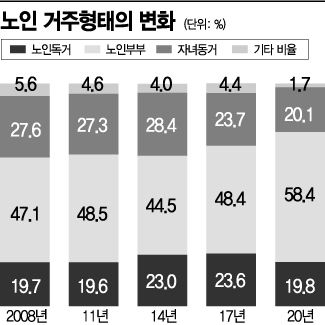
[Asia Economy Reporter Seo So-jeong] It has been found that 8 out of 10 elderly households do not live with their children. This is interpreted as a rapid increase in elderly couple households and elderly single-person households due to increased income and economic independence among the elderly.
According to the results of the "2020 Elderly Survey" conducted by the Korea Institute for Health and Social Affairs from March to November last year, targeting 10,097 elderly residents in 969 survey districts nationwide, elderly single-person households composed of elderly couple households and elderly single-person households increased from 66.8% in 2008 to 78.2% last year.
On the other hand, during the same period, households living with children decreased from 27.6% to 20.1%. The proportion of those wishing to live with their children also decreased from 32.5% in 2008, which was about one in three households, to 12.8% last year.
The rapid increase in single-person households is analyzed to be due to independent factors such as the elderly's economic stability and health.
The individual income of the elderly more than doubled from 7 million KRW in 2008 to 15.58 million KRW last year. As earned income, business income, and private pension income increased, the economic independence of the elderly also showed a rising trend.
However, private transfer income decreased from 46.5% in 2008 to 13.9% last year, while public transfer income, supported by the expansion of the basic pension, accounted for the highest proportion at 27.5% of individual income.
The majority of the elderly owned real estate. 96.6% of elderly households owned real estate, with an average value of 261.82 million KRW. Financial assets were held by 77.8%, with an average amount of about 32.12 million KRW.
The economic activity participation rate of the elderly steadily increased from 30% in 2008 to 36.9% last year. In particular, the participation rate of those aged 65 to 69 rose significantly from 39.9% to 55.1% during the same period. The main reason for working currently was to cover living expenses, accounting for 73.9%.
The level of information technology device usage among the elderly also increased significantly. The proportion of elderly owning smartphones was only 0.4% in 2011 but rose to 56.4% last year. It was also found that 74.1% of the elderly consider the age criterion for elderly to be '70 years and older.' In 2008, the proportion of those who considered 70 years and older as elderly was 68.3%, showing a slight increase.
Yang Seong-il, the 1st Vice Minister of Health and Welfare, said, "Based on the survey results, it is necessary to strengthen care for elderly single-person households, support age-friendly residential environments, and promote well-dying practices." He added, "We will work with related ministries to enhance new elderly jobs, social participation, and information technology capabilities that can satisfy the diverse needs of the newly emerging elderly generation."
© The Asia Business Daily(www.asiae.co.kr). All rights reserved.

















