Foreigners Turn to Net Buying in 7 Weeks... Last Week Net Purchase of 892.7 Billion KRW
Samsung Electronics Most Bought
Institutions Focus on Buying Kia and Hyundai
Semiconductor and Auto Markets Regain Leadership
[Asia Economy Reporters Song Hwajeong and Lee Minwoo] Foreign investors, who had been continuously selling in the domestic stock market, have turned to buying after 7 weeks, and the KOSPI is expected to gain upward momentum. In particular, with foreign and institutional investors heavily purchasing IT and automobile (Jeoncha) stocks, the 'Jeoncha Corps' is expected to lead the stock market rally for the first time in a while.
According to the Korea Exchange on the 7th, foreign investors net purchased about 892.7 billion KRW in the domestic stock market last week (May 31 to June 4). Foreign investors bought 918.4 billion KRW in the KOSPI market but sold 25.3 billion KRW in the KOSDAQ market. This is the first time in 7 weeks that foreign investors have recorded net buying in the domestic stock market on a weekly basis.
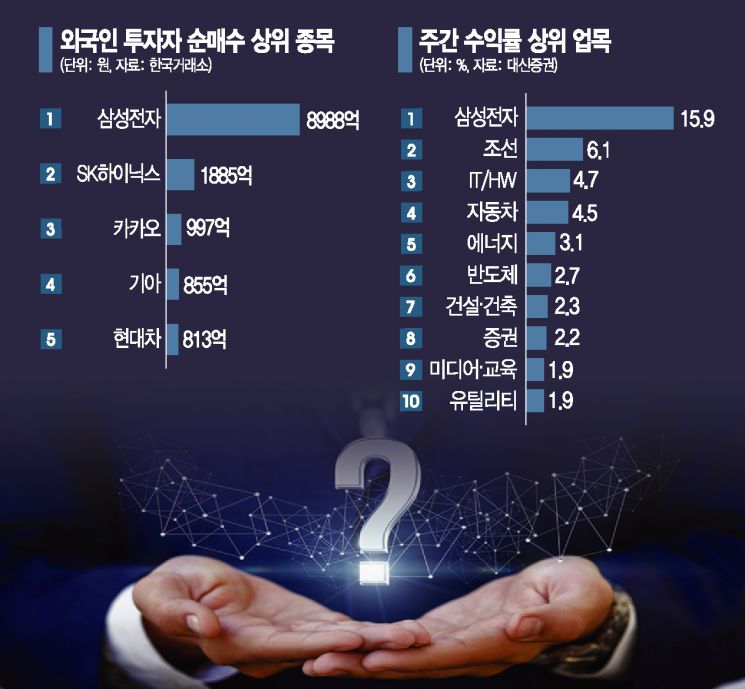
The stock most purchased by foreign investors who turned to net buying was Samsung Electronics. Foreign investors net bought 898.8 billion KRW worth of Samsung Electronics last week. Considering the total net buying scale, foreign investors’ buying was concentrated on Samsung Electronics. Next, they net bought SK Hynix for 188.5 billion KRW. Foreign investors also bought a lot of automobiles, ranking high in net purchases with 85.5 billion KRW and 81.3 billion KRW for Kia and Hyundai Motor, respectively.
Not only foreign investors but also institutions purchased many Jeoncha sector stocks. Institutions bought 190.5 billion KRW of Kia and 123.1 billion KRW of Hyundai Motor last week, ranking first and second in net purchases. In addition, they also bought 45.6 billion KRW of SK Hynix.
Kim Younghwan, a researcher at NH Investment & Securities, analyzed, "Last week, foreign investors net bought KOSPI every day except one day," adding, "The expectation of a semiconductor industry upturn is the main reason for foreign investors’ return to the domestic stock market." This is because recent favorable DRAM supply and demand conditions have led major companies to announce plans to expand production investment in the second half of the year, easing concerns about semiconductor supply chain disruptions.
The strength of semiconductors and automobiles is supporting the KOSPI’s upward trend. As of last week, among the top 10 weekly gainers, automobiles and semiconductors ranked 4th (4.5%) and 6th (2.7%), respectively. The contribution to KOSPI’s rise reached 63% (automobiles 18.8%, semiconductors 44.2%). Lee Kyungmin, a researcher at Daishin Securities, explained, "Considering that the market capitalization weight of these two sectors is 34.3%, they showed nearly double the leading power."
There is an analysis that the recovery of market leadership by semiconductors and automobiles can be interpreted as a signal breaking away from the previously somewhat sluggish trend. The automobile sector, considered the biggest victim of the semiconductor supply shortage, has attempted a rebound since early May and showed a trend reversal signal at the end of May. Semiconductors also attempted a rebound since mid-May. However, whether the price breaks through and settles above the lower end of the previous upward trend range of 3,800 to 3,900 will be an important turning point for the trend reversal. The researcher said, "Although significant resistance to the downward reversal was confirmed last weekend, considering the high likelihood that Korean semiconductor companies will attract attention during the supply chain resolution process, the trend reversal is only a matter of time."
This is interpreted as reflecting the fact that the semiconductor supply chain bottleneck, which had held back both the semiconductor and automobile sectors, is now past its worst point. The researcher predicted, "Since production capacity still remains and if the employment market recovers during the economic normalization process, semiconductor supply disruptions are expected to gradually resolve," adding, "In this situation, domestic companies with global competitiveness and solidified cooperation with the U.S. are bound to attract attention, and with the recovery of the global manufacturing economy and policy support joining in, the upward trend phase is expected to continue."
© The Asia Business Daily(www.asiae.co.kr). All rights reserved.

















