25% of Sales Invested Mostly in AI
Research Center Established with Seoul National University and KAIST... Hundreds of Billions Invested
Massive HyperCLOVA Unveiled
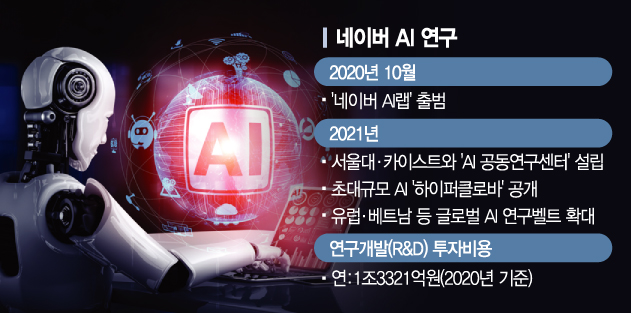
Naver has bet its future on artificial intelligence (AI). The company invests 25% of its annual revenue in research and development (R&D), with the majority of these R&D expenses dedicated to AI research. Last year, Naver's R&D expenditure amounted to approximately 1.3321 trillion KRW. This year, Naver plans to establish an ‘AI Joint Research Center’ with Seoul National University and KAIST, and has announced investments worth hundreds of billions of won. Naver is determined to compete head-to-head with global IT giants through AI technology.
Dreaming of an ‘AI Triumvirate’
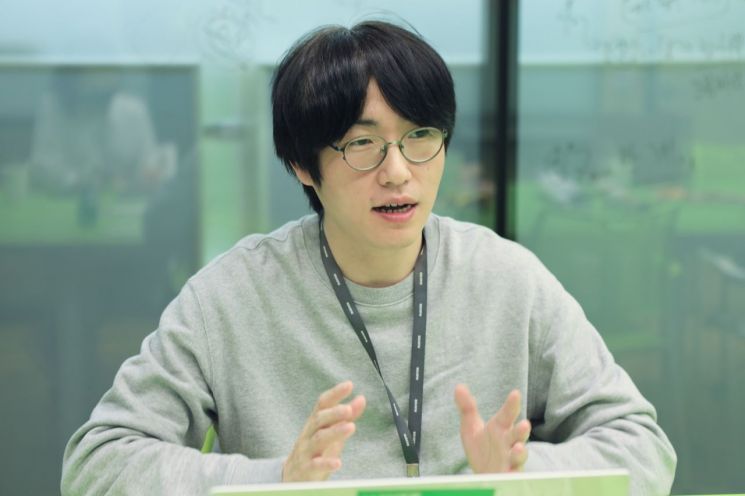
Ha Jung-woo, head of Naver AI Lab (chief leader), stated in an interview with Asia Economy on the 7th, "In 5 to 10 years, I expect an AI tripartite competition among North America, China, and Naver." Currently, the United States and China lead the global AI technology race. He explained, "Aside from North America and China, Europe, Korea, Japan, and Southeast Asia form a third force, and among this entire third force, Naver will become the leading AI company." In fact, Naver has built a ‘global research belt’ and is collaborating on AI research with Naver Labs Europe located in France and top universities in Vietnam.
Ha predicted that AI will become more deeply integrated into people's lives than smartphones are today. This is why Naver is committed to AI technology research. Last year, Naver separated its research organization from Clova CIC to form the independent ‘Naver AI Lab’ for mid- to long-term AI technology research. Naver’s research achievements have reached a significant level. The data augmentation technology ‘CutMix’, developed by Naver in 2019, is used by Google and Facebook as well. Ha said, "Currently, it is the highest-performing single data augmentation method."
The number of papers Naver presented at global AI conferences reached 43 last year alone, which is comparable to Google when considering the number of researchers. Recently, Naver also unveiled the massive-scale AI model ‘HyperClova’. HyperClova was developed with 204 billion parameters, surpassing the current top AI technology ‘GPT-3’ (175B). The higher the number of parameters, which indicate the size of an AI model, the more problems the AI can solve.
Most of Naver’s major services incorporate AI technology, and new services continue to emerge. A representative example is ‘Clova Care Call’, which has been used for monitoring during the COVID-19 situation. Clova Care Call uses AI to make calls to check on individuals under active monitoring and to observe adverse reactions to vaccines. Ha also mentioned, "We are considering a conversation model for elderly people living alone." Additionally, the AI technology ‘Clova Optical Character Recognition (OCR)’, which extracts and analyzes text from images, has created new markets such as receipt recognition and business card recognition services.
"We Will Defend AI Sovereignty"
Securing AI sovereignty is also a crucial concern for Naver. There is a fear that if essential future technology like AI is not researched directly, services will become dependent on global companies. Ha pointed out that using AI from global companies would lead to differences in images, language, and data tailored to Korean characteristics, ultimately causing obsolescence. He warned, "The consequence of technological dependency is a decline in service quality," adding, "This will lead to a vicious cycle of falling behind in global competition." For this reason, Naver trained HyperClova with Korean language data. HyperClova is the world’s largest Korean ultra-large language model, having learned over 6,500 times more Korean data than GPT-3.
Naver plans to accelerate the establishment of a research belt for future global AI competition. First, it will strengthen the research network connecting Asia and Europe. In March, Naver established a joint AI center at Hanoi University of Science and Technology in Vietnam, and recently opened another center with Posts and Telecommunications Institute of Technology. Through collaboration with Seoul National University and KAIST, Naver aims to develop ultra-large and ultra-creative AI models. Ha emphasized, "Creating high-quality AI tools is essential for global competition," and added, "Our goal is to achieve sustainable growth for Naver through AI technological competitiveness."
© The Asia Business Daily(www.asiae.co.kr). All rights reserved.


















