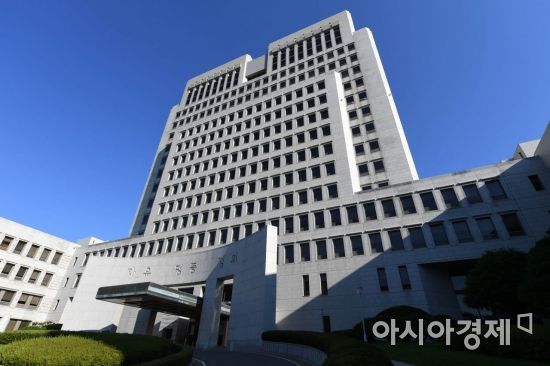
[Asia Economy Reporter Baek Kyunghwan] The Supreme Court has ruled that duplicating an MR file without the permission of the production company during the album production process constitutes an infringement of reproduction rights.
Recently, the Supreme Court's First Division (Presiding Justice No Taeak) overturned the lower court's ruling that dismissed the damages claim filed by the album production company Pastel Music against singer-songwriter Cha Sejung for unauthorized duplication of MR files, and remanded the case to the Seoul Western District Court with a ruling in favor of the plaintiff.
In August 2014, Cha signed a contract with Pastel Music stipulating that during the contract period, the company would hold rights as the album producer for content created by Cha, while Cha would retain copyright and neighboring rights.
However, in November 2016, Pastel Music entered into a contract transferring the master rights, which include the rights to use Cha's sound recordings, to a music portal company. Subsequently, Cha terminated the exclusive contract with Pastel Music and duplicated the instrument performance recording files stored by Pastel Music onto an external hard drive for safekeeping.
In May 2017, Cha performed two songs created while affiliated with Pastel Music at an outdoor concert. Pastel Music then filed a lawsuit demanding Cha compensate 102 million KRW for album production costs, alleging that Cha used the MR files containing instrument recordings without authorization during the performance.
The first trial court ruled against the plaintiff, stating that although the plaintiff held neighboring rights to the MR files, these rights had been transferred to NHN Bugs, and therefore Cha had no obligation to compensate.
The appellate court determined that despite the transfer contract, the usage rights to the MR files still belonged to Pastel Music. However, it ruled in favor of the defendant, agreeing with the first trial court that no damages had occurred to Pastel Music.
The Supreme Court reversed these decisions. It held that "the MR files in question qualify as sound recordings under the Copyright Act, and Pastel Music, as the album producer, holds reproduction rights and other neighboring rights thereto." Furthermore, it stated, "Since Cha duplicated the MR files without the plaintiff's permission, it constitutes an infringement of reproduction rights, and there is a possibility that damages equivalent to the claimed amount have occurred."
© The Asia Business Daily(www.asiae.co.kr). All rights reserved.

















