[Asia Economy Reporter Seulgina Jo] "Powerless individual creators will bear the full brunt of the commission fee reduction." "Our government, above all, should be outraged by the reality where foreign companies are eroding market share and threatening their own citizens, yet it is truly lamentable that the bill remains stalled."
Ahead of Google's planned enforcement of in-app payments in the second half of the year, domestic creators and internet companies have once again called for the swift passage of the 'Google Gapjil Prevention Act (Amendment to the Telecommunications Business Act).' This is because the burden from Google's commission fee increase will ultimately fall back on creators and consumers of webtoons, web novels, and other content.
The Google Gapjil Prevention Act, which was a major issue during last year's national audit, became embroiled in various lobbying controversies within just over a month and has yet to see proper discussion even after crossing into the new year. Criticism is mounting that the National Assembly has given up, satisfied with Google's 'trick' conditional commission policy introduced in response to the bill's enforcement, resulting in all damages returning to the domestic industry.
Ultimately, the National Assembly's Science, Technology, Information and Broadcasting and Communications Committee (STIBC) is considering holding a second subcommittee meeting this month to discuss the issue, but it remains uncertain whether the bill will be passed.
◆Ahead of In-App Payment Enforcement...Criticism of "Google Free Riding" and "National Assembly Stalling" Pours In
According to related industries on the 5th, associations composed of domestic creators such as the Korea Creative Story Writers Association, Korea Webtoon Industry Association, and Korea Web Novel Industry Association have recently issued statements one after another, urging the National Assembly to promptly pass the bill instead of stalling for time.
The day before, the Korea Web Novel Industry Association, through its 'Statement Opposing Google's Mandatory In-App Payment,' argued, "Google's partial reduction of payment commissions is a cunning act that distracts from the fundamental issue of forced payment methods," adding, "Most content creators serialize on platforms where a 30% commission applies, so this is an ineffective measure." They further criticized, "After deeply penetrating services into consumers' lives, Google is now monetizing and raising commissions, a crafty act that further strengthens Google's monopoly in the app market," calling it "an unauthorized infringement on creators' intellectual property rights under the guise of 'rent' and 'toll fees.'"
The Korea Creative Story Writers Association also stated, "If numerous domestic platforms using app markets are subjected to a 30% commission, the damage will inevitably be passed on to frontline creators producing content," and criticized, "Google's policy is no different from 'free riding' on the sweat and effort of creators." The Webtoon Industry Association expressed concern that "user burdens may increase" and warned that "Google's monopoly could shake the status of K-webtoons."
Earlier this year, Google announced that it would enforce its own payment method for app developers selling content and items on its app market, Google Play, while charging a hefty 30% commission. This policy, previously applied only to games, has been expanded to all content and apps. This threatens the survival of domestic app developers and will inevitably lead to price increases for major content such as webtoons, web novels, and music.
Under heavy criticism, Google later announced plans to reduce commissions by 15% based on revenue tiers, but this too has been widely criticized as a mere trick. From July, Google plans to charge a 15% commission on annual revenue up to $1 million, and 30% on the excess.
According to a survey by the Ministry of Science and ICT, Google's conditional commission reduction decision will save domestic small and medium-sized enterprises related to mobile apps and content about 40.6 billion KRW in expenses. However, Google is estimated to collect approximately 500 billion KRW annually in payment commissions from domestic businesses with annual revenue exceeding $1 million due to the enforcement of in-app payments.
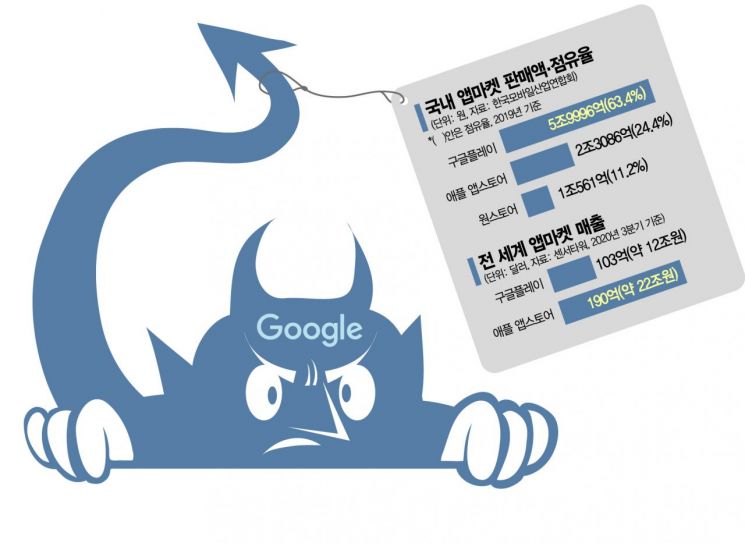
An IT industry insider criticized, "The core issue of the commission policy itself is still being enforced, so Google's conditional commission reduction is meaningless," adding, "Ultimately, the profits of the domestic content industry will flow to Google, leading to platform dependency." This has been pointed out as an 'anti-ecosystem move' aimed at dominating app developers and users by leveraging its nearly 70% domestic market share.
Professor Byungjun Yoo of Seoul National University predicted that Google's enforcement of in-app payments and commission increases will cause adverse effects such as a decrease of approximately 2.1127 trillion KRW in annual content industry sales and a reduction of 18,220 workers in 2021. By 2025, domestic mobile content industry sales are estimated to decrease by more than 5 trillion KRW.
Another industry insider strongly criticized, "The bill should be passed before the commission reduction in July, but the National Assembly is doing nothing," adding, "Google is monopolizing the domestic digital industry comprehensively and starting to directly harm our citizens."
◆National Assembly Missed the Golden Time to Stop Google's Gapjil, Considering Resuming Discussions Amid Criticism...Passage Uncertain
Discussions on the Google Gapjil Prevention Act have also lost momentum. A representative from the Korea Internet Corporations Association expressed concern, saying, "With just over four months before the enforcement of in-app payments, the bill must be passed to prepare enforcement decrees and other measures." However, the likelihood of the bill passing and enforcement decrees being prepared before October is low. Seven bills, including provisions preventing app market operators from forcing specific payment methods, have been proposed in the National Assembly's STIBC but remain pending.
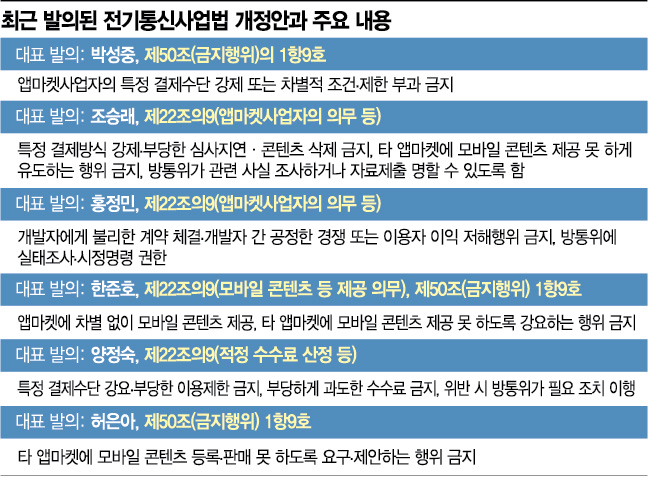 As of mid-October 2020. Since then, Assemblyman Jo Myeong-hee of the People Power Party also took the lead in proposing an amendment to the Telecommunications Business Act aimed at prohibiting app market operators from forcing payment methods and resolving related disputes.
The National Assembly's STIBC is currently considering holding the Information and Communications Broadcasting Bill Review Subcommittee (Bill 2 Subcommittee) after the People Power Party's leadership election ends on the 11th to discuss the Google Gapjil Prevention Act.
A STIBC official said, "There is a consensus that we cannot continue to leave the bill pending," describing the atmosphere. While the Democratic Party advocates for swift passage, the People Power Party insists on careful discussion to avoid a hasty bill. A STIBC official from the People Power Party said, "There is no such law globally," adding, "We want to consider the views of operators who do not oppose the bill, as well as potential trade friction and industrial side effects."
Meanwhile, the Korea Internet Corporations Association, together with the North Nevada International Exchange Center (NNIC), STIBC Chairman Wonwook Lee, and Whip Seungryong Jo, will jointly hold an online international conference on the 8th titled 'The Direction of Global App Fairness (Mandatory In-App Payments).' This event will bring together experts from Korea and the U.S. to discuss the impact of mandatory in-app payment policies in app markets. Specifically, discussions will cover the possibility of reintroducing a bill to ban mandatory in-app payments in the U.S. House of Representatives, the positions of lawmakers from both countries on trade friction concerns related to mandatory in-app payments, and the impact and scale of damages caused by such policies.
Park Seongho, chairman of the Korea Internet Corporations Association, said, "We hope this conference will provide an opportunity to approach Google's mandatory in-app payment policy from an international perspective and lead to the swift passage of the amendment to the Telecommunications Business Act."
© The Asia Business Daily(www.asiae.co.kr). All rights reserved.
!["The Woman Who Threw Herself into the Water Clutching a Stolen Dior Bag"...A Grotesque Success Story That Shakes the Korean Psyche [Slate]](https://cwcontent.asiae.co.kr/asiaresize/183/2026021902243444107_1771435474.jpg)

















