670,000 Jobs Added in May... Below Expectations but Twice the Previous Month
Fed Assessed as Unable to Decide on Tapering
Biden Emphasizes "Need to Expand Infrastructure Investment"
New York Stock Market Rises Broadly... Treasury Yields Fall
International Oil Nears $70, Gold Price Approaches $1900
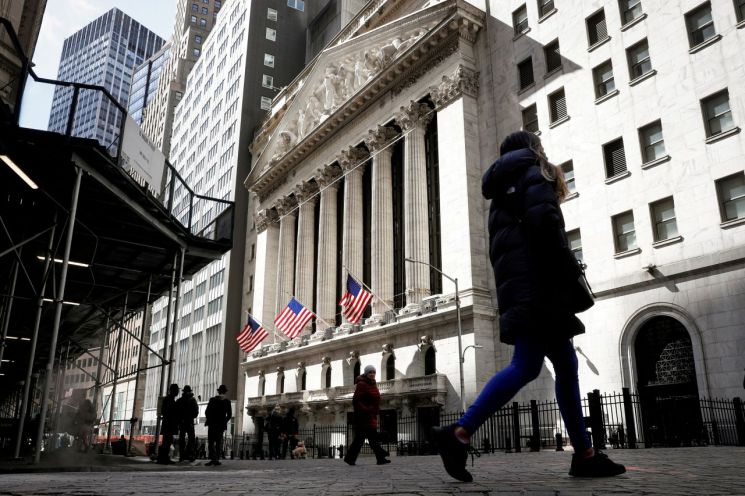
[Asia Economy New York=Correspondent Baek Jong-min] Although the U.S. employment data for May was weaker than expected, it indicated that the economic recovery is continuing. Concerns that the U.S. Federal Reserve (Fed) would begin tapering asset purchases early were alleviated, leading to gains in the New York stock market and a decline in U.S. Treasury yields.
According to the employment data released by the Department of Labor on the 4th (local time), the number of jobs added in May was 559,000. This fell short of the market experts' expectation of 675,000. For two consecutive months, including April, job growth was below market expectations. In April, the number of jobs increased by only 278,000, overturning the market forecast of a 1 million increase.
Although the May job growth was below market expectations, it nearly doubled compared to the previous month.
Despite the sluggish job growth, the unemployment rate in May fell to 5.8% from 6.1% in the previous month, a decrease of 0.3 percentage points. The unemployment rate was lower than the market experts' forecast of 5.9%.
The New York Times (NYT) highlighted that the job increase in May was more than double that of the previous month.
The renewed momentum in job recovery is attributed to the rapid increase in labor demand due to expanded COVID-19 vaccine distribution and increased social activities and consumption driven by government fiscal spending.
The significant reduction in new COVID-19 cases, the lifting of business restrictions in most states, and the discontinuation of expanded unemployment benefits?which had hindered employment growth in many states?are also analyzed as causes for the employment expansion.
U.S. President Joe Biden, in a speech following the employment data release, said, "America is finally moving again," calling the increase in the U.S. job market last month "great news." President Biden emphasized, "This is progress that is pulling our economy out of the worst crisis in a century," and claimed that among major countries worldwide, no country has increased jobs as quickly as the U.S.
He further stated that the job growth is due to the cooperation of the people and the effect of the $1.9 trillion stimulus package implemented last March, urging Congress to promptly pass the pending infrastructure investment plan.
President Biden initially proposed a $2.25 trillion social infrastructure investment plan called the "American Jobs Plan," but after ongoing conflicts with the Republican Party, it was recently reduced to $1.7 trillion. It is also reported that he may abandon the proposed corporate tax rate hike intended to fund the investment.
Following the employment data release, the securities market was buoyant. On the New York Stock Exchange, the Dow Jones Industrial Average rose 0.52%, the S&P 500 increased 0.88%, and the Nasdaq index closed up 1.46%. This is interpreted as confirming that while the employment data is not at a level prompting the Fed to taper, the economic recovery is continuing.
The Wall Street Journal assessed, "The labor market is improving, but it is not yet time for the Fed to begin tapering."
This week, the New York stock market continued a cautious trading session amid concerns that a strong employment report could accelerate the Fed's tapering decision. On a weekly basis, the Dow rose 0.7%, the S&P 500 0.6%, and the Nasdaq 0.5%.
James McCann, Chief Economist at Aberdeen Standard Investments, said, "There is no reason for the Fed to act immediately based on today's employment data," adding "Since the Fed is confident that inflation is a short-term factor, interest rate hikes are expected to be postponed until 2023."
With the easing of tapering concerns following the employment data, the 10-year U.S. Treasury yield fell by a relatively large 0.07 percentage points to 1.557%. A decline in Treasury yields means a rise in bond prices.
Along with the drop in Treasury yields, the dollar also weakened, causing international gold prices to rise 1.1% to $1,894, approaching the $1,900 level again.
International oil prices reached their highest level in two years, reflecting expectations of demand recovery and a weaker dollar. The July West Texas Intermediate (WTI) crude oil price closed at $69.72 per barrel, up 81 cents (1.2%) from the previous session.
© The Asia Business Daily(www.asiae.co.kr). All rights reserved.

















