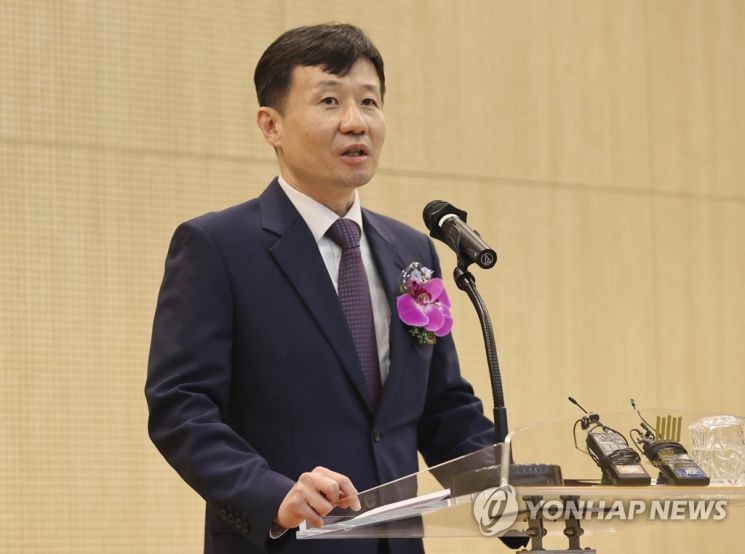
 Cho Sang-chul, Chief Prosecutor of the Seoul High Prosecutors' Office, is delivering his retirement speech at the retirement ceremony held on the afternoon of the 4th at the Seoul High Prosecutors' Office in Seocho-dong, Seoul.
[Asia Economy Reporter Choi Seok-jin] Cho Sang-chul, Chief Prosecutor of the Seoul High Prosecutors' Office (age 52, Judicial Research and Training Institute class 23), emphasized to junior prosecutors on the 4th, as he left the prosecution, to equip themselves with ‘capability and dignity,’ adhere to ‘facts and legal principles,’ and keep ‘responsibility and appropriateness’ in mind.
At the retirement ceremony held at 3 p.m. at the Seoul High Prosecutors' Office in Seocho-dong, Seoul, Cho began his farewell speech by saying, "It has been 24 years and 3 months since I was commissioned as a prosecutor," and "Over a long time, I have met many people, formed connections, received guidance, and grown. I deeply thank everyone who has been with me."
He said, "As I leave, I cannot say everything I want to say, and it is not appropriate to say too much, but I would like to share a few fragments of my thoughts."
Cho stated, "First, ‘capability and dignity,’ second, ‘facts and legal principles,’ and third, ‘responsibility and appropriateness,’" adding, "These are the virtues we must possess, follow, and engrave in our hearts to perform the prosecution’s fundamental duties of ‘upholding constitutional values and fair law enforcement.’"
He pointed out, "To do anything properly, sufficient capability must first be supported," and "When a person is seriously ill, the outcome varies greatly depending on whether they meet a renowned doctor, an ordinary doctor, or a substandard doctor."
Cho said, "The same applies to our prosecution work," emphasizing, "We must see things from the perspective of the parties involved and the public."
He stressed the importance of expertise, saying, "For example, when the Financial Crimes Division investigates stock manipulation cases, victims hope the prosecutor in charge is a veteran securities investigation expert. However, if the specialized department is just a place where prosecutors rotate through once in a while, resulting in a lack of expertise, it becomes a disaster for the parties involved."
He added, "Expertise is as important as fairness in personnel matters, and it is essential to have a system that strengthens and develops professional capabilities not only for individuals but also at the organizational level."
Cho also urged to cultivate dignity along with capability, saying, "It is a big problem to be evaluated as ‘capable but lacking in character.’"
He emphasized, "Character and dignity are not acquired automatically. One must consciously think, speak, and act with dignity for it to be internalized." He also urged, "Keep in mind that individual ability and character lead to the organization’s capability and dignity."
Cho stated, "Secondly, the foundation of our prosecution work is to follow ‘facts and legal principles.’"
He pointed out, "First, we must uncover what the facts are," and noted, "Our society is full of normative theories about how the world should be, but relatively cold and accurate fact-finding for realistic understanding has weakened."
He added, "Moreover, subjective opinions are often disguised as objective facts to spread and enforce one’s claims," emphasizing, "What matters is the objective facts."
Cho urged, "Especially for prosecutors who bear the burden of proof, it is necessary to minimize the gap between presumed truth and proven facts."
He said, "The application of laws must also be accurate," explaining, "The same things should be treated the same, and different things differently. There is no side here or there. The standards must not fluctuate."
He added, "The more difficult and complex the issue appears, the more important it is to proceed based on facts and law in a natural order."
Cho’s third point was that prosecutorial power is a ‘responsibility’ exercised for the people before it is a power granted to us, and "responsibility means it should not be exercised arbitrarily."
He emphasized, "We must always consider whether our duties are the best from the perspective of the parties involved and the public," and "To make the best choice, we must view things from the public’s perspective and exercise our authority correctly and precisely with diligence."
Cho said, "Also, the exercise of prosecutorial power must be ‘appropriate,’" meaning "It should be neither excessive nor insufficient."
He explained, "We do not recklessly conduct compulsory investigations for minor cases," because "According to the principles of proportionality and prohibition of excess, compulsory measures should be limited to the minimum necessary."
He added, "On the other hand, investigation methods and content should not be inadequate or insufficient for the case."
Cho urged, "Even if there is a possibility of legal violation, we must always consider whether others in the same situation would not have acted similarly, whether there is culpability, and to what extent," and "We must strive for rational and balanced dispositions rather than formal processing."
At the end of his retirement speech, Cho briefly introduced his family and expressed gratitude to his wife.
He said, "I met my wife in the first year I was commissioned as a prosecutor in 1997 and married her in 1998," adding, "She took full charge of household affairs quietly and supported me to focus on my work. I am always grateful."
Cho revealed, "Although my shy and quiet personality in my youth has not changed drastically, I have become someone who listens more to others."
He said, "While I may not think ‘I am the best in the world,’ I have gained enough composure to tell myself ‘You are okay,’ and that makes me happy now."
Finally, Cho urged, "Our prosecution work involves bearing the worries of others," and "If we ourselves are sick and struggling, we cannot care for others. We must be joyful and composed to look after and give to those around us."
Born in Hongseong, Chungnam, Cho graduated from Yeouido High School and Seoul National University’s College of Law. After passing the 33rd Judicial Examination in 1991, he completed the Judicial Research and Training Institute as class 23.
After serving as an Air Force legal officer, he began his career as a prosecutor at the Seoul District Prosecutors’ Office in 1997. He has held key positions in the Ministry of Justice and prosecution, including prosecutor at the Ministry of Justice’s Prosecution Bureau, prosecutor at the Ministry’s Prosecution Division 1, prosecutor at Seoul Northern District Prosecutors’ Office, deputy chief prosecutor at Seoul Northern District Prosecutors’ Office, chief prosecutor at Jeju District Prosecutors’ Office, research officer at the Supreme Prosecutors’ Office, head of Sokcho branch of Chuncheon District Prosecutors’ Office, head of Criminal Planning Division at the Ministry of Justice, head of Prosecution Division at the Ministry of Justice, chief prosecutor of Criminal Division 1 at Seoul Central District Prosecutors’ Office, spokesperson for the Ministry of Justice, planning officer at the Supreme Prosecutors’ Office’s Public Security Bureau, head of Dongbu branch of Busan District Prosecutors’ Office, first deputy chief prosecutor at Seoul Southern District Prosecutors’ Office, director of Planning and Coordination at the Ministry of Justice, chief prosecutor at Daejeon District Prosecutors’ Office, chief prosecutor at Seoul Western District Prosecutors’ Office, chief prosecutor at Suwon High Prosecutors’ Office, and chief prosecutor at Seoul High Prosecutors’ Office.
He was especially respected by colleagues and senior and junior prosecutors for his meticulous case handling, outstanding planning skills, and characteristic gentle personality.
© The Asia Business Daily(www.asiae.co.kr). All rights reserved.

















