Korea Research Foundation Develops Eco-Friendly Quantum Dots Absorbing Short-Wavelength Infrared, Opening New Avenues for Infrared Applications
[Asia Economy Reporter Kim Bong-su] An eco-friendly quantum dot synthesis method that absorbs light from the visible to the infrared spectrum has been developed, overcoming previous limitations.
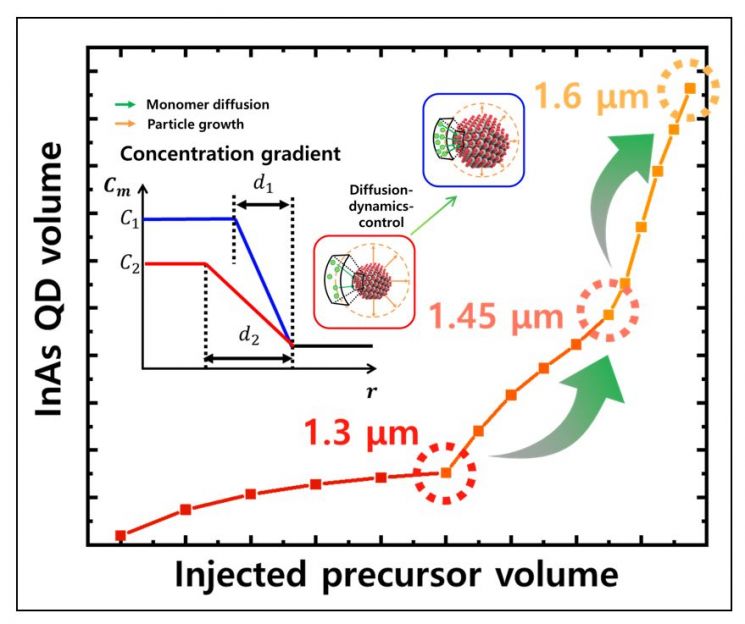
The National Research Foundation of Korea announced on the 3rd that Professor Sohee Jeong's research team at Sungkyunkwan University elucidated the growth principles of covalent eco-friendly quantum dots and developed a new synthesis method that finely controls the diffusion rate of monomers, allowing free control over quantum dot growth.
The infrared application fields are vast, including military, medical, optical communication, and sensors for autonomous vehicles. However, materials containing heavy metals such as lead or mercury were mainly used to achieve optical properties in the infrared range. Efforts have been made to apply quantum dot materials, which absorb and emit various lights depending on particle size, to infrared applications. However, covalent eco-friendly materials like indium arsenide (InAs) have limitations in growing beyond 9 nm in size with existing growth principles, restricting applications to the 1100?1300 nm wavelength range.
The research team elucidated the growth principles of quantum dots and proposed a new synthesis method based on this. Simulation results of quantum dot growth reflecting various experimental variables revealed that certain conditions, such as solution volume and reactant concentration, must be met to suppress unintended side reactions and achieve ideal quantum dot growth. By adjusting the concentration of the actual reaction solution according to the simulation results, quantum dots more than four times larger than before could be synthesized. The quantum dots produced in this way can absorb wavelengths above 1700 nm, and their size distribution was 9.0 ± 1.1 nm, indicating uniform particle synthesis.
This research is expected to contribute not only to the infrared research field but also to various nanoparticle synthesis fields. The study was published on the 21st in the international journal Nature Communications.
© The Asia Business Daily(www.asiae.co.kr). All rights reserved.
![Clutching a Stolen Dior Bag, Saying "I Hate Being Poor but Real"... The Grotesque Con of a "Human Knockoff" [Slate]](https://cwcontent.asiae.co.kr/asiaresize/183/2026021902243444107_1771435474.jpg)
















