GIST Professor Byeongseung Ham Proposes Technology Based on Quantum Entanglement Fundamentals
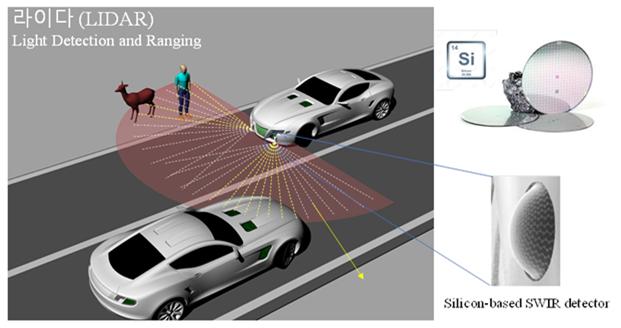
[Asia Economy Reporter Kim Bong-su] A fundamental technology that can significantly enhance the sensitivity and performance of LiDAR, a core technology for autonomous vehicles, has been developed by a domestic research team.
The Gwangju Institute of Science and Technology (GIST) announced on the 3rd that the research team led by Professor Ham Byung-seung of the School of Electrical Engineering and Computer Science proposed a quantum laser that can be realized in the macroscopic world by reinterpreting conventional quantum mechanics, which was limited to the microscopic world, in terms of the wave nature rather than the particle nature of photons.
The research team explained that while conventional lasers are light beams based on classical coherence theory, the proposed quantum laser is a non-classical light beam based on quantum entanglement (a phenomenon where the smallest units of matter are correlated in pairs, allowing their properties to be identified regardless of distance), which can revolutionarily solve the single-photon detection trap, a major challenge in quantum sensing and quantum communication.
Above all, a key challenge in autonomous driving, which is essential for electric vehicles, lies in the physical limitations of LiDAR. The proposed quantum laser uses quantum-entangled light beams to transform LiDAR into quantum LiDAR, simultaneously addressing scanning speed, resolution, and visible range.
The macroscopic quantum entanglement technology proposed by the research team implements entangled light pairs using existing lasers, thereby realizing the principle of quantum sensing on a macroscopic scale. By using light itself rather than single photons as the quantum LiDAR signal, it resolves the overall issues of conventional LiDAR.
The biggest challenge in existing quantum cryptographic communication is the detection trap limited to single photons, but the quantum laser is inherently free from this. It is deterministic in quantum signal generation and uses existing detectors, making quantum communication at the level of current optical communication practically possible.
Professor Ham Byung-seung said, “The core of current quantum mechanics is the Copenhagen interpretation, which involves the duality of light as both particle and wave. However, the quantum mechanics community has been overly focused on particle nature, which has largely caused its own limitations. Now, by studying the wave nature as the other axis, we can expand the duality of the Copenhagen interpretation with new interpretations and perspectives, and it is time to consider quantum information communication compatible with existing information and communication technologies.”
The research results were published online on the 31st of last month in the international journal 'Scientific Reports,' a sister journal of Nature.
© The Asia Business Daily(www.asiae.co.kr). All rights reserved.
![Clutching a Stolen Dior Bag, Saying "I Hate Being Poor but Real"... The Grotesque Con of a "Human Knockoff" [Slate]](https://cwcontent.asiae.co.kr/asiaresize/183/2026021902243444107_1771435474.jpg)
















