
[Asia Economy Reporter Yujin Cho] Elon Musk, CEO of Tesla, said the shortage of automotive semiconductors is similar to the early COVID-19 pandemic phenomenon of "toilet paper hoarding."
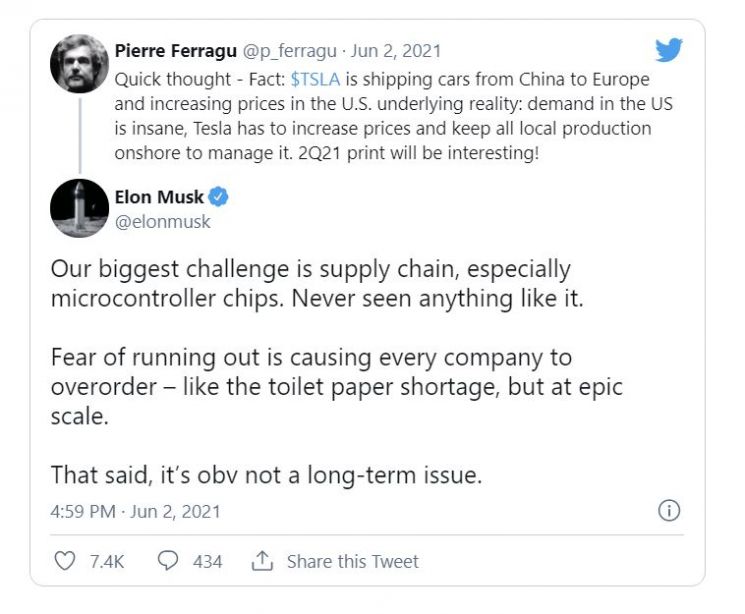
On the 2nd (local time), Musk tweeted, "The semiconductor chip shortage has caused all automakers to 'overorder,'" adding, "This is like an enormous toilet paper hoarding situation."
This compares the situation where many automakers are hoarding semiconductor chips due to concerns over supply chain disruptions to the surge in demand and resulting toilet paper shortages caused by anxiety in the early days of the COVID-19 pandemic.
However, Musk said, "This is not a long-term problem." He went on to say that the semiconductor chip shortage is a serious situation and is significantly affecting Tesla's electric vehicle production.
Musk expressed concern, saying, "Our biggest challenge lies in the supply chain, especially microcontroller (vehicle non-memory semiconductor) chips," and added, "This kind of semiconductor shortage is unprecedented."
The day before, Musk also tweeted that Tesla's vehicle price increases were due to supply chain pressures across the automotive industry and rising prices of raw materials such as semiconductors.
Earlier, as the semiconductor chip crisis deepened, reports emerged that Tesla was considering prepaying semiconductor companies in Taiwan, South Korea, and the United States, as well as purchasing foundry (contract manufacturing) plants.
Business Insider reported that in recent months, automakers have been rushing to stockpile semiconductor chips, and due to factory shutdowns caused by chip shortages, new car inventory shortages have become severe, while used car prices have soared to record highs.
U.S. consulting firm AlixPartners forecasted that the semiconductor chip shortage would cause global automakers to lose about $110 billion in revenue this year. This is an 81% increase from the $60.6 billion revenue loss estimated at the end of January.
Mark Wakefield, Global Co-Lead of Automotive & Industrial at AlixPartners, stated, "The chip crisis caused by the pandemic was worsened by factory shutdowns due to the unusual cold wave in Texas and a fire at a key chip manufacturing plant in Japan. All of these are major issues for the industry, and ultimately, there is a growing need to build supply chain resilience domestically over the long term."
Meanwhile, Pat Gelsinger, CEO of U.S. semiconductor company Intel, warned last month that the semiconductor chip shortage is due to issues such as foundry production capacity shortages and that it may take years to resolve.
© The Asia Business Daily(www.asiae.co.kr). All rights reserved.


















