Follow-up Measures to the Government's August 4 Supply Plan
Half of the Relaxed Floor Area Ratio Must Be Contributed to the Public
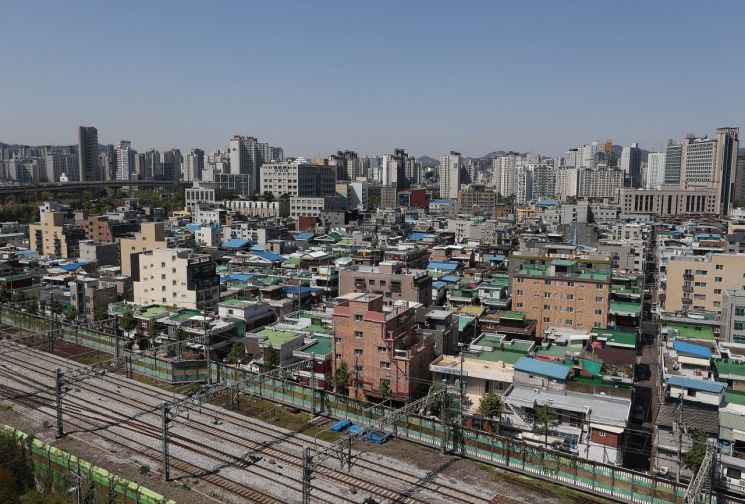
[Asia Economy Reporter Onyu Lim] High-density development around transit stations will become fully feasible in Seoul. On the 2nd, the Seoul Metropolitan Government announced that it will implement the 'Standards for Establishing District Unit Plans for Transit Station Complex Development (High-Density Residential)' as a follow-up measure to the government's 'August 4th Supply Plan' announced last year.
This follows the government's amendment of the Enforcement Decree of the 'National Land Planning and Utilization Act' to allow the floor area ratio (FAR) in residential areas to be increased up to 700% when complex-use development is carried out through district unit plans in transit station areas.
With the revised law, the application of district unit plans for complex-use development around transit stations has been expanded not only to quasi-residential and commercial areas but also to residential areas (Type 2 and 3 general residential zones). However, this law requires that a certain percentage, as stipulated by urban planning ordinances, of the increased land value from the relaxed FAR must be donated as public rental housing.
Until now, the maximum FAR allowed for Type 3 general residential areas designated by district unit plans in Seoul was about 400-500%, limiting high-density development around transit stations. However, going forward, if certain criteria set by the city are met, the zoning can be upgraded to quasi-residential, allowing FAR up to 700%.
The 'Standards for Establishing District Unit Plans for Transit Station Complex Development' announced by the city this time establish detailed criteria regarding the targets and scope of FAR relaxation. The main contents include ▲ criteria for project sites ▲ FAR system ▲ standards for utilizing relaxed FAR ▲ and building plan standards. From now on, district unit plans for transit station complex development in Seoul must follow these standards.
First, the project site must be within the transit station area (a radius of 250m from the platform boundary) and meet road and area requirements. It must secure an appropriately sized site (between 1,500㎡ and 5,000㎡ and at least half of the street block) and be adjacent to roads on two or more sides while meeting the criteria for aging buildings. If these criteria are met within general residential areas, the zoning will be changed to quasi-residential to proceed with the project.
The maximum FAR will be applied differentially considering the urban planning aspects such as the central place system, public transportation accessibility, and the width of access roads. In transit station areas located in central places (downtown, metropolitan centers, regional centers, district centers as per the '2030 Seoul Plan') that face arterial roads and have access roads at least 10m wide, development with a maximum FAR of 700% will be possible.
Private developers must contribute 50% of the relaxed FAR as 'public contribution.' Of this, at least 70% should be provided as public rental housing, and up to 30% can be allocated to public facilities, as a principle. The city has amended the urban planning ordinance related to this.
Additionally, to enhance the feasibility of high-density development, height restrictions previously set for securing daylight have been relaxed differentially up to twice the maximum FAR. Furthermore, to promote resident community activation, communal facilities of at least 100㎡ must be installed, and building setback lines and plans for publicly accessible open spaces must be established.
Hong Seon-gi, Director of the Urban Management Division of Seoul City, said, "We will promote complex development in transit station areas with convenient public transportation to strengthen the highly demanded live-work proximity and contribute to rapid housing supply."
© The Asia Business Daily(www.asiae.co.kr). All rights reserved.
![Clutching a Stolen Dior Bag, Saying "I Hate Being Poor but Real"... The Grotesque Con of a "Human Knockoff" [Slate]](https://cwcontent.asiae.co.kr/asiaresize/183/2026021902243444107_1771435474.jpg)
















