US Begins Review of MagnaChip's Potential Sale to China... Approval Decision Expected Between July and September
Industry Says Not Advanced Technology... Ministry of Trade to Decide Based on US Decision
MagnaChip to Present Sale Agenda as Scheduled at Shareholders Meeting on 15th
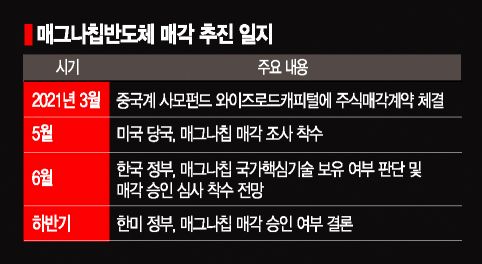
[Sejong=Asia Economy Reporters Haeyoung Kwon and Suyeon Woo] The U.S. intervention in the sale of Korea MagnaChip Semiconductor to a Chinese private equity fund has put the government and industry on alert. Initially, the government was expected to conclude its decision on the approval of the MagnaChip sale as early as the end of last month, but with the U.S. involvement, it has become difficult to reach an independent conclusion. The outcome of the MagnaChip sale has now been postponed to the second half of the year.
An industry insider said on the 1st, "The U.S. authorities are expected to decide whether to approve Wise Road Capital's acquisition of MagnaChip as early as early July or as late as September," adding, "For the sale of MagnaChip to proceed, approval from both Korea and the U.S. is required, and if either side disapproves, the sale will be canceled."
The U.S. Committee on Foreign Investment in the United States (CFIUS) recently began reviewing Wise Road's M&A of MagnaChip, a Chinese private equity fund. If the acquisition is disapproved, the sale of MagnaChip will be automatically canceled regardless of the Korean government's approval. The review was initiated based on the Foreign Investment Risk Review Modernization Act (FIRRMA), which prohibits transactions if M&A or investment deals in military or advanced technology sectors are deemed to affect national security.
With the situation in the U.S. becoming tense, both the government and MagnaChip have become busy. MagnaChip plans to hold a shareholders' meeting as scheduled on the 15th to put the sale of the company on the agenda.
The Ministry of Trade, Industry and Energy is expected to begin reviewing the MagnaChip sale within this month. However, it is likely to postpone the final decision while closely monitoring the U.S. authorities' moves.
The domestic variable in the MagnaChip sale is whether it holds national core technology. The ministry will determine whether to block the M&A after examining if MagnaChip possesses national core technology. The key issue is whether MagnaChip's display driver IC (DDI) technology for organic light-emitting diode (OLED) displays qualifies as national core technology, which currently it does not. While the industry generally agrees that it is not advanced technology, the Ministry of Trade, Industry and Energy finds it difficult to independently decide on M&A approval amid uncertainty about the U.S.'s stance as it restructures semiconductor supply chains.
The ministry's push to designate OLED-related DDI technology as national core technology is also interpreted as a strategic move anticipating the possibility of the U.S. disapproving the M&A. Inside and outside the industry, it is expected that the Korean and U.S. governments exchanged views on the MagnaChip sale during last month's summit, where they agreed to strengthen semiconductor supply chain cooperation.
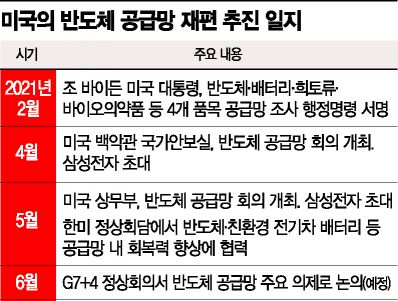
▲Semiconductors as a National Security Issue for the U.S.= Within the semiconductor industry and government circles, the U.S. blocking the MagnaChip sale is interpreted as viewing semiconductor supply chain issues as a national security matter, indicating the seriousness with which it is regarded. The industry consensus is that while MagnaChip's technology is excellent, it does not possess advanced technology that must be strictly protected from overseas leakage. Although the U.S. has shown strong intentions to curb China by restructuring semiconductor supply chains, its intervention in the sale of MagnaChip, which does not hold advanced technology, is seen as sending a signal not only to China but also to global semiconductor companies and governments worldwide.
The U.S. will discuss the establishment of a 'Semiconductor Supply Chain Consultative Body' with allied countries at the G7+4 summit in the UK from the 11th to 13th. The creation of a semiconductor supply chain consultative body at an international meeting excluding China is interpreted as the beginning of the U.S.'s supply chain restructuring efforts to block China's 'semiconductor rise.' The White House requested Congress at the end of last month to increase the Department of Commerce's budget by 29.4%, including spending under the Semiconductor Support Act, demonstrating its commitment to semiconductor supply chain restructuring.
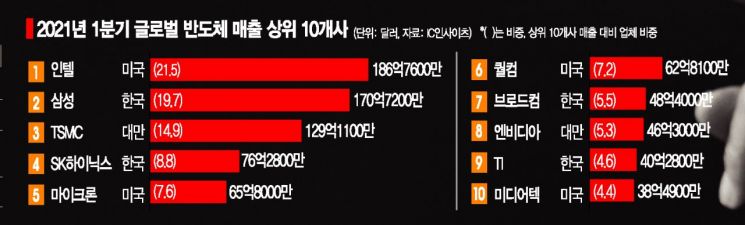
▲Korea's Dilemma in the Semiconductor Hegemony Competition= The semiconductor industry views the MagnaChip sale as clearly exposing Korea's difficult position caught in the middle of the U.S.-China semiconductor hegemony war. From the Korean government's perspective, it must consider the U.S. stance but cannot outright oppose the sale of MagnaChip from the standpoint of attracting foreign capital and employment. Political and diplomatic relations with China must also be taken into account as much as those with the U.S. Some predict that given the recent approval process of SK Hynix's acquisition of Intel's NAND business, where Chinese regulatory approval became a variable, the Korean government is unlikely to risk upsetting China by disallowing the MagnaChip acquisition.
The industry fears that if massive Chinese capital is injected in the future, MagnaChip could rapidly grow and emerge as a competitor threatening Korean companies. Even though the major shareholder is a private equity fund, it can always access technical details, and if synergies with local Chinese display companies are realized, there is a significant possibility that China could seize leadership in next-generation display panels.
A semiconductor industry insider said, "If MagnaChip is sold to a Chinese private equity fund, it is highly likely to prioritize sales to local Chinese customers over domestic display clients," adding, "With Chinese companies already dominating the LCD panel sector, it is uncertain how MagnaChip will grow and potentially threaten our companies."
© The Asia Business Daily(www.asiae.co.kr). All rights reserved.
![Clutching a Stolen Dior Bag, Saying "I Hate Being Poor but Real"... The Grotesque Con of a "Human Knockoff" [Slate]](https://cwcontent.asiae.co.kr/asiaresize/183/2026021902243444107_1771435474.jpg)


















