Household Loans Excluding Mid-Interest Rates Managed Within 5.4%
Industry: "We Have No Choice but to Selectively Lend to Low-Credit Borrowers"
July's Maximum Interest Rate Reduction Coming... Will Illegal Private Loans Increase?
 [Image source=Yonhap News]
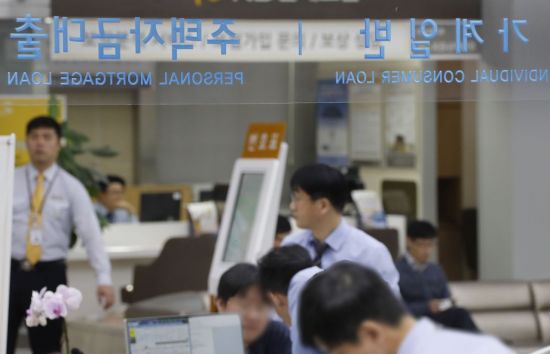
[Asia Economy Reporter Song Seung-seop] Financial authorities have decided to apply the ‘21% household loan growth rate rule’ to savings banks. This means they intend to strongly regulate the total loan volume, raising concerns that many borrowers with credit ratings of grade 6 or lower may be driven to illegal private loans, and that blind spots could further expand. Critics argue that this approach, which focuses on superficial numerical management, diverges from the government and ruling party’s policy of managing loans without stifling the livelihood-related financial activities of low-credit borrowers.
According to financial authorities and the savings bank industry on the 2nd, the Financial Supervisory Service recently conveyed the ‘2021 Household Loan Management Plan for Savings Banks’ to individual companies through the Korea Federation of Savings Banks.
The plan includes guidelines to ensure that the total household loan growth rate this year does not exceed 21.1%. This means keeping it at the industry’s household loan growth rate of 21.1% (KRW 5.5 trillion) from last year.
The growth rate of household loans, excluding mid-interest loans and policy financial products (such as Haetsal Loan and Saeitdol), must be managed within 5.4%. Private mid-interest loans are defined as unsecured credit loans with an annual interest rate of 16% or less for borrowers in the lower 50% credit score bracket.
Industry: "Total volume control inevitably reduces loans to low-credit borrowers"
According to the guidelines, savings banks must prepare and submit future loan management plans by referring to past loan performance, business plans, and government policies. Starting at the end of this month, they must present how they will manage the total household loan balance and product-specific balance plans quarterly, and separately report sales strategies or loan products to achieve these goals. They must also include plans on how to respond if loan targets are exceeded.
The industry voices concern that stricter total volume control will shrink loan issuance. A savings bank official hinted, "We will have to reduce loans given to 10 low-credit borrowers down to 1 or 2. Considering the risks, we can only selectively lend to ‘good low-credit borrowers’ who narrowly fall outside the mid-interest target."
With the legal maximum interest rate being lowered to 20% next month, there are growing concerns that if the loan path through savings banks is also blocked, more people will be driven to illegal private loans. It is analyzed that over 300,000 borrowers who currently borrow at rates exceeding 20% could immediately face financial crises.
This measure strongly follows the ‘Household Debt Management Plan’ announced by financial authorities. The Financial Services Commission plans to suppress the total household loan growth rate to around 5-6% this year through the management plan. From next year, it will be lowered to the pre-COVID-19 level of around 4%.
© The Asia Business Daily(www.asiae.co.kr). All rights reserved.
![Clutching a Stolen Dior Bag, Saying "I Hate Being Poor but Real"... The Grotesque Con of a "Human Knockoff" [Slate]](https://cwcontent.asiae.co.kr/asiaresize/183/2026021902243444107_1771435474.jpg)















