Establishment of Joint Venture Within the Year... Cooperation on Hydrogen Business Based on Byproduct Hydrogen
Start of Hydrogen Fuel Cell Power Plant Business
Lotte Chemical Produces Byproduct Hydrogen... SK Gas Provides Infrastructure
[Asia Economy Reporter Hwang Yoon-joo] Lotte Group, which has entered the hydrogen business, is expanding cooperation on all fronts. Lotte has a relatively large share of the chemical industry within the group, and its affiliate Lotte Chemical produces the largest amount of by-product hydrogen in Korea as a single company. Following a business agreement with a French industrial gas company to build hydrogen charging stations, Lotte Chemical has decided to establish a joint venture with SK Gas, the No. 1 domestic liquefied petroleum gas (LPG) operator. This aims to build a value chain encompassing hydrogen production to consumption, increasing the proportion of high value-added products while growing the hydrogen business as a key growth engine.
On the 31st, Lotte Chemical and SK Gas signed a memorandum of understanding to establish a joint venture (JV) to jointly promote the hydrogen business. According to this agreement, the two companies will establish the JV within this year to build gaseous hydrogen charging stations and hydrogen fuel cell power plants, and plan to expand their cooperation into various fields in the future. The company explained that they plan to build a business model covering the entire hydrogen value chain, including supplying liquefied hydrogen produced by utilizing the low-temperature energy of liquefied natural gas (LNG).
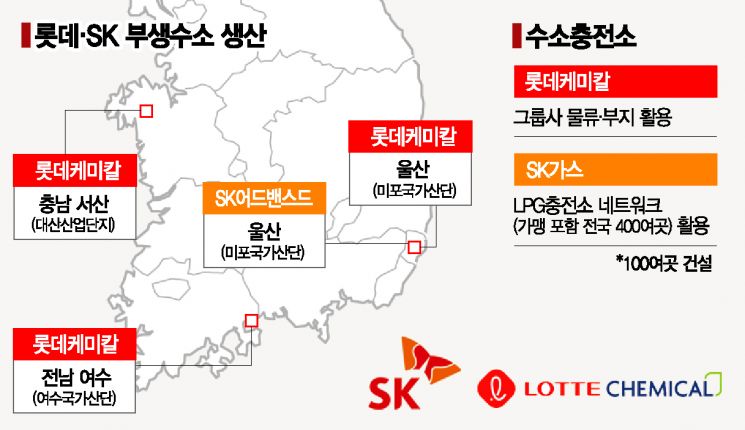
First, they decided to proceed with a business based on by-product hydrogen in the Ulsan area. By-product hydrogen mainly occurs as a by-product in petrochemical processes, and it plays a key role in creating the initial hydrogen ecosystem due to its low carbon dioxide emissions during production and economic feasibility. Lotte Chemical, which has large-scale production facilities in Korea’s three major petrochemical complexes?Yeosu, Daesan, and Ulsan?produces 680,000 tons of by-product hydrogen annually, the largest amount in the country. SK Gas also produces by-product hydrogen through its Ulsan-based affiliate SK Advanced.
Although by-product hydrogen requires refining, it has the advantage of being immediately commercializable by utilizing existing facilities. The JV plans to create demand for by-product hydrogen by engaging in businesses such as hydrogen charging stations and hydrogen fuel cell power plants. The hydrogen charging station business will utilize SK Gas’s LPG charging station network and logistics sites already secured by Lotte Chemical and group affiliates. SK Gas holds nearly half of the domestic LPG market and operates about 400 charging stations nationwide (including franchises). Securing sites is considered crucial for the hydrogen charging station business. The JV plans to expand the business by supplying liquefied hydrogen and gradually build about 100 hydrogen charging stations.
The hydrogen fuel cell power plant business is expected to be promoted by utilizing subsidiaries and resources of the two companies located in Ulsan. The Ulsan area has a well-established hydrogen pipeline network to utilize by-product hydrogen, so there is an advantage in that no separate site is needed to build additional pipelines. SK Gas is also conducting a fuel cell power plant business in Gwangju Metropolitan City, which is expected to create synergy in the future.
Lotte Chemical, which recently announced new business plans such as eco-friendly plastics and secondary battery materials, is also increasing investment in hydrogen mobility as a major new growth engine. Earlier this year, it announced the ‘Green Promise 2030’ strategy aiming to achieve 6 trillion KRW in eco-friendly business sales and pursue carbon neutrality by 2030. The memorandum of understanding with the French company Air Liquide, known for hydrogen charging station design and construction, was also part of this effort.
Kim Kyo-hyun, CEO of Lotte Chemical (Head of Lotte Group’s Chemical BU), said, "We expect to lead the future eco-friendly hydrogen market by taking the initiative in forming the early ecosystem of the hydrogen industry, which will be a core axis of future energy growth, and by collaborating on various challenges." Yoon Byung-seok, CEO of SK Gas, stated, "We will continue to collaborate with various partners to lead the establishment of the hydrogen ecosystem, and by linking the existing LPG business with LNG and hydrogen businesses, we will complete a stable yet future-oriented business portfolio."
© The Asia Business Daily(www.asiae.co.kr). All rights reserved.

















