Industrial Production Down 1.1% Due to Semiconductor Output Decline
Facility Investment Up 3.5%, Construction Output Down 0.8%
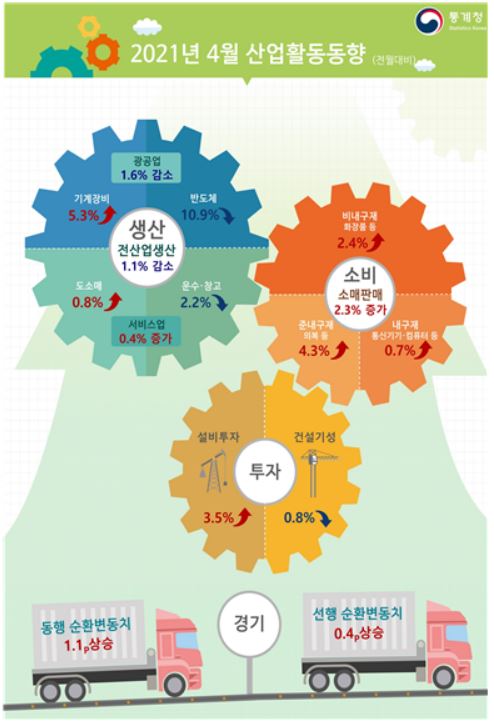
[Sejong=Asia Economy Reporters Kim Hyunjung and Moon Chaeseok] As COVID-19 vaccinations accelerate, domestic demand is rapidly recovering. Investment in machinery and transportation equipment showed strong performance, leading to an increase in facility investment. Although production declined month-on-month due to the base effect adjustment of the semiconductor index, noticeable improvements appeared in service sectors such as wholesale and retail.
According to the 'April Industrial Activity Trends' released by Statistics Korea on the 31st, the retail sales index (seasonally adjusted) last month reached 120.5, the highest since statistics began in 1995. This index represents the scale of domestic retail sales after removing external factors such as holidays and seasonal effects, and has been recovering since hitting a low of 110.8 in July last year.
◆ Increased outings as vaccinations rise... strong sales of cosmetics and clothing = By type, sales of non-durable goods such as cosmetics (2.4%), semi-durable goods such as clothing (4.3%), and durable goods such as communication devices and computers (0.7%) all increased simultaneously. In particular, the month-on-month increase in non-durable goods sales has expanded since February (-3.8%), rising from 1.6% in March. Compared to last year, semi-durable goods increased by 22.0%, durable goods by 7.7%, and non-durable goods by 4.2%, resulting in an overall increase of 8.6%.
By business type, consumption surged year-on-year at department stores (30.6%), convenience stores (8.0%), non-store retailing (15.3%), and duty-free shops (51.6%). However, supermarkets and general stores (-8.9%) and large discount stores (-1.2%) declined. Regarding this, Eo Unseon, Director of Economic Trend Statistics at Statistics Korea, explained, "With the expansion of vaccinations, consumer sentiment is improving, and various consumption support policies are in place, so retail sales continue to increase."
Facility investment increased by 3.5% month-on-month, with investments rising in machinery such as special industrial machinery (3.0%) and transportation equipment such as aircraft (5.0%). Construction performance decreased by 0.8% month-on-month due to a decline in civil engineering (-7.2%) despite an increase in building construction (1.7%).
The coincident composite index of current economic conditions (101.3) rose by 1.1 points month-on-month due to increases in non-agricultural employment and import amounts. The leading composite index predicting future economic conditions (103.6) increased by 0.4 points month-on-month as economic sentiment and inventory cycle indicators rose despite a decrease in construction orders. The leading index has risen for 11 consecutive months, marking the longest period of increase since the 12-month rise from February 2009 to January 2010.
◆ Overall industrial production declines due to semiconductor base effect = While consumption and investment showed improvement, production turned downward due to the base effect of the semiconductor index. Last month, the total industrial production index (seasonally adjusted, excluding agriculture and forestry) was 111.4, down 1.1% from the previous month. This is the largest decline since May last year (-1.5%).
Production in the service sector increased by 0.4%, but manufacturing (-1.6%) declined due to decreases in semiconductors (-10.9%) and rubber and plastics (-4.0%). The semiconductor decline was the largest in a year since April last year (-14.7%). Director Eo explained, "Semiconductors had been performing well due to the expansion of the global non-face-to-face economy after the COVID-19 outbreak. The index reached an all-time high last month, but last month it adjusted due to the base effect."
Additionally, production of machinery equipment (5.3%), communication and broadcasting equipment (12.0%), and electrical equipment (1.9%) increased. Service sector production rose 0.4%, continuing the growth trend for the third consecutive month following 1.1% in February and 1.3% in March. Increased consumption of clothing, cosmetics, and food and beverages led to a 0.8% rise in wholesale and retail production, and easing of gathering restrictions contributed to a 3.1% increase in accommodation and food services. Transportation and storage (-2.2%) declined.
© The Asia Business Daily(www.asiae.co.kr). All rights reserved.
!["The Woman Who Threw Herself into the Water Clutching a Stolen Dior Bag"...A Grotesque Success Story That Shakes the Korean Psyche [Slate]](https://cwcontent.asiae.co.kr/asiaresize/183/2026021902243444107_1771435474.jpg)
















