[Asia Economy Reporter Changhwan Lee] Last year, the performance of the domestic automotive parts industry showed resilience thanks to increased domestic demand. However, concerns were raised about the growing number of deficit companies and the deepening polarization between large corporations and small and medium-sized enterprises (SMEs).
On the 31st, the Korea Automotive Technology Institute analyzed 110 domestic automotive parts companies subject to external audits and found that total sales last year amounted to 70.6296 trillion KRW, a 2.69% decrease compared to the previous year.
Considering that global automobile sales dropped by 13.8% due to COVID-19 and Korean parts exports fell by 17.3%, this performance is relatively strong. This is attributed to a 4.7% increase in domestic sales of locally produced vehicles compared to the previous year.
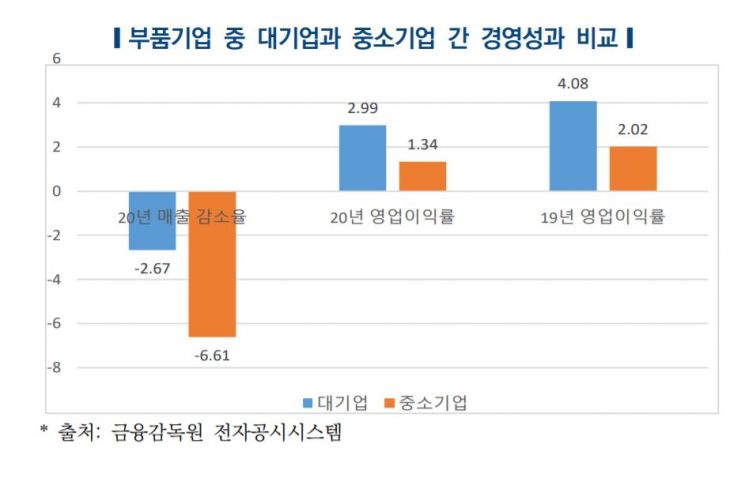
Seventy-seven companies experienced a decline in sales. The sales of 10 domestic finished vehicle affiliates decreased by 2.06% to 38.6649 trillion KRW, while 100 non-affiliated companies saw a 3.44% decrease to 31.9647 trillion KRW. By scale, sales of large corporations decreased by 2.67% year-on-year, while SMEs saw a 6.61% decline.
The average operating profit margin fell by 1.05 percentage points from 3.86% in 2019 to 2.81% in 2020. Sixty-eight companies reported decreased operating profits. The average operating profit margin of large corporations dropped from 4.08% to 2.99%, whereas that of SMEs fell from 2.02% to 1.34%.
The number of deficit companies also increased. Among the 110 companies analyzed, 40 (36.4%) were in deficit, an increase of 17 companies compared to the previous year.
Regarding employment, among 105 companies for which data was available, two-thirds saw a reduction in workforce. Among 62 large corporations, 49 reduced employment, and among 43 SMEs, 21 reduced employment.
The institute analyzed that due to the overall decline in business performance and polarization within the industry, the reduction of high school graduate industrial technical personnel was notable, and total employment, including high school graduates, slightly decreased.
The institute emphasized that preventing polarization within the industry while establishing a future vehicle supply chain and ecosystem is an urgent task.
Researcher Hanggu Lee of the Korea Automotive Technology Institute explained, "The share of SMEs in total sales among the 110 companies surveyed decreased from 6.99% in 2019 to 6.76% last year," adding, "The gap between large corporations and SMEs is widening in terms of workforce, R&D investment, and growth potential, intensifying polarization."
Researcher Lee also added, "From an ecosystem perspective, although the government is supporting the transition of internal combustion engine parts manufacturers to future vehicles, it is essential to smoothly establish a future vehicle supply ecosystem by expanding reallocation through retraining existing personnel and fostering vehicle software talent."
© The Asia Business Daily(www.asiae.co.kr). All rights reserved.

















