Bank of Korea Mentions Monetary Policy... US Fed Still Advocates Easing
Market Interest Rate Volatility May Increase Further
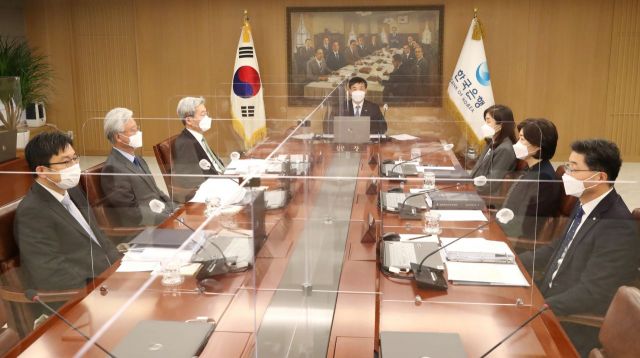
[Asia Economy Reporter Gong Byung-sun] There is a difference in perspectives between the central banks of Korea and the United States. As a result, opinions are emerging that the timing of Korea's interest rate hikes could be earlier than the U.S. asset purchase tapering.
On the 29th, according to Kiwoom Securities, the Bank of Korea's Monetary Policy Committee (MPC) unanimously decided to keep the interest rate steady at 0.5%. However, the growth and inflation forecasts were both revised upward. The growth rate forecast was significantly raised from the previous 3.0% to 4.0%, and the inflation forecast was increased from 1.3% to 1.8%. Amid this, the possibility of policy adjustment was also mentioned. Although the rise in core inflation remains limited and demand-side inflation is weak, the Bank of Korea emphasized at the press conference that addressing the accumulated risks of financial imbalances through timely monetary policy adjustments is important.
The U.S. Federal Reserve (Fed) continued to advocate the need for accommodative monetary policy. Recently, some Fed officials expressed a hawkish view that tapering should be discussed. However, most officials, including Fed Chair Jerome Powell, reiterated the need for accommodative policy considering that inflation is temporary following last month's weak employment data and that it will take some time for the labor market to recover. Due to expectations of Fed policy control, the 10-year U.S. Treasury yield has been fluctuating around the 1.60% level without breaking above 1.70%.
As a result, with the difference in perspectives between the Korean and U.S. central banks, opinions are emerging that Korea's interest rate hike timing could be earlier than the Fed's tapering. An Ye-ha, a researcher at Kiwoom Securities, said, "We maintain the forecast of no rate hike within this year and a rate hike in the first half of next year, but the timing of policy decisions could be brought forward," adding, "Market interest rate volatility may also increase further."
In particular, if core inflationary pressures in the U.S. rise and inflation expectations remain high during the third quarter, concerns about Fed tapering are expected to resurface. This could lead to a further widening of the weakness in U.S. Treasury bonds. Researcher An explained, "If the possibility of U.S. policy adjustment increases during the third quarter and the Bank of Korea strengthens its stance on not missing the timing, volatility in government bonds will increase," adding, "The yield curve spread is expected to maintain its current level but then ease as short-term government bonds weaken sharply following the emergence of dissenting opinions within the Bank of Korea."
© The Asia Business Daily(www.asiae.co.kr). All rights reserved.

















