Korea Research Foundation, Research Team of Professors Yoon Ho-geun and Son Myung-hyun (Yonsei University College of Medicine)
[Asia Economy Reporter Kim Bong-su] The discovery of a protein causing pulmonary fibrosis has opened a new avenue for developing treatments.
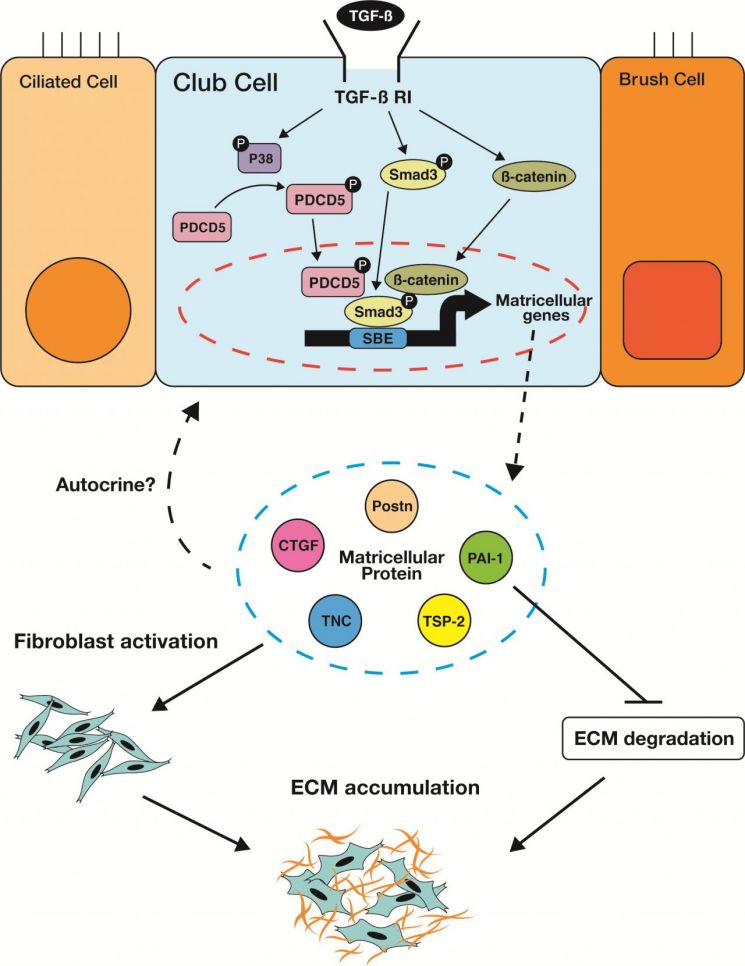
The National Research Foundation of Korea announced on the 27th that a research team led by Professors Yoon Ho-geun and Son Myung-hyun (Yonsei University College of Medicine) found that in club cells of patients with idiopathic pulmonary fibrosis, an increase in programmed cell death protein 5 (PDCD5) leads to the excessive secretion of fibrosis-inducing proteins.
The research team expects that this protein could serve as a biomarker for diagnosing pulmonary fibrosis and could be the starting point for developing new therapeutics that inhibit this protein.
Club cells are a type of epithelial cell in the small airways of the lungs that protect the lungs by secreting proteins such as club cell secretory protein (CCSP) when lung damage occurs, but their role in pulmonary fibrosis was previously unknown. PDCD5 (Programmed cell death 5) protein is known to increase due to DNA damage and is involved in cancer cell death, but its exact mechanism remained unclear.
The research team discovered that when PDCD5 increases in club cells, matricellular proteins that induce fibrosis are secreted excessively into the extracellular matrix, stimulating fibroblasts and leading to the progression of fibrosis, which hardens lung tissue. The fibrosis process involves the excessive accumulation of extracellular matrix (ECM) components such as collagen, which destroys normal tissue structure. They revealed that excessive PDCD5 in club cells distorts normal signaling by TGFβ, a master regulator of fibrosis-inducing secretory factors, causing abnormal ECM accumulation.
Furthermore, when a gene knockout mouse model lacking PDCD5 production in club cells was injected with bleomycin, a compound that induces fibrosis, these mice showed less pulmonary fibrosis and higher survival rates compared to mice with the PDCD5 gene. However, removing PDCD5 from other alveolar epithelial cells (AT2) did not produce these effects. This confirmed that PDCD5 in club cells is critical for pulmonary fibrosis.
The research team stated, "By first elucidating the relationship between club cells and pulmonary fibrosis and proposing the role of PDCD5, we expect to contribute to pulmonary fibrosis treatment research."
This research was published online on the 19th in the international journal Nature Communications.
© The Asia Business Daily(www.asiae.co.kr). All rights reserved.
![Clutching a Stolen Dior Bag, Saying "I Hate Being Poor but Real"... The Grotesque Con of a "Human Knockoff" [Slate]](https://cwcontent.asiae.co.kr/asiaresize/183/2026021902243444107_1771435474.jpg)
















