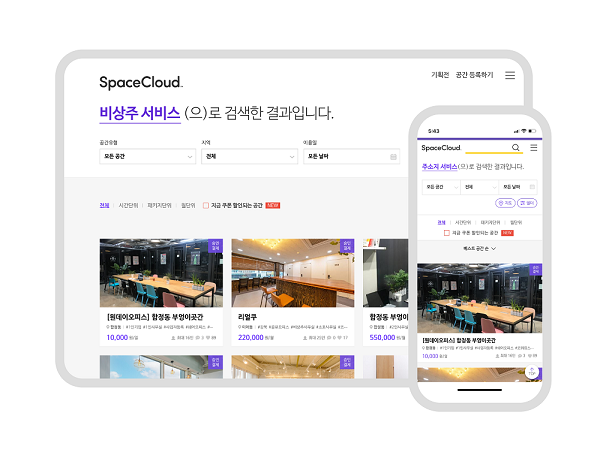
SpaceCloud, a space-sharing platform, announced on the 27th that it will open a non-resident service feature for shared offices.
The 'non-resident service' is a type of virtual office program that provides business registration and postal address management for shared offices. Recently, as the online shopping business has grown significantly, the demand for non-resident services has increased among creators and small business owners.
SpaceCloud, which launched shared office and independent office services in 2017, currently shares 2,100 workspace products as of this year. Starting with partnerships for 200 workspace products, the platform has grown about tenfold in scale. The platform views this growth rate of shared offices as proportional to the growth of small-scale creator groups such as startups, freelancers, and remote workers.
The growth market attracting attention in the post-COVID-19 pandemic economy is the SME (Small and Medium Enterprise) group leading 'online shopping malls.' For example, Naver Shopping's Smart Store has seen an average of 33,000 new shopping malls created monthly since March last year. This is more than a 50% increase compared to before, mainly due to a higher proportion of office workers seeking additional income through various side jobs beyond their regular wages. The emergence of various startup services that conveniently handle product and inventory management, tax management, and more for sole proprietors aligns with this context.
The increase in SME business owners leads to demands not only for physical space but also for various services provided within the space. In fact, besides non-resident services, specialized office services such as shared secretary services and warehouse management services are being launched targeting the SME group. Non-resident services have been recognized as essential additional services that must be provided in the shared office service industry for over 10 years.
Real estate experts recommend that both parties carefully check essential items before signing a non-resident service contract. Users must verify that the applicant is a sublessor (shared office company) who has obtained consent from the landlord or the landlord themselves before applying for the non-resident service. They also emphasize that some industries may have restrictions on dedicated facility construction and area limits, making it impossible to use non-resident services through shared offices, so inquiries with relevant institutions before contracting are essential.
A SpaceCloud host operating a small 30-pyeong shared office in Daechi-dong said, "Since COVID-19, inquiries about non-resident services have increased by more than 30% among all space service inquiries. We have felt the growing demand for additional services targeting shared offices. Users can compare and search various convenience services of shared offices, including non-resident services, all at once."
With the opening of the non-resident service feature, shared office operators can introduce service prices and contract methods in detail. Meanwhile, users can easily find more suitable services by comparing additional services of shared offices by region at a glance through search terms such as 'non-resident office,' 'virtual office,' and 'address service.' Actual contracts can be consulted directly with space operators connected through the platform.
Meanwhile, registration and usage inquiries about the non-resident service can be found in detailed guide documents at the Host Center.
© The Asia Business Daily(www.asiae.co.kr). All rights reserved.
![Clutching a Stolen Dior Bag, Saying "I Hate Being Poor but Real"... The Grotesque Con of a "Human Knockoff" [Slate]](https://cwcontent.asiae.co.kr/asiaresize/183/2026021902243444107_1771435474.jpg)
















