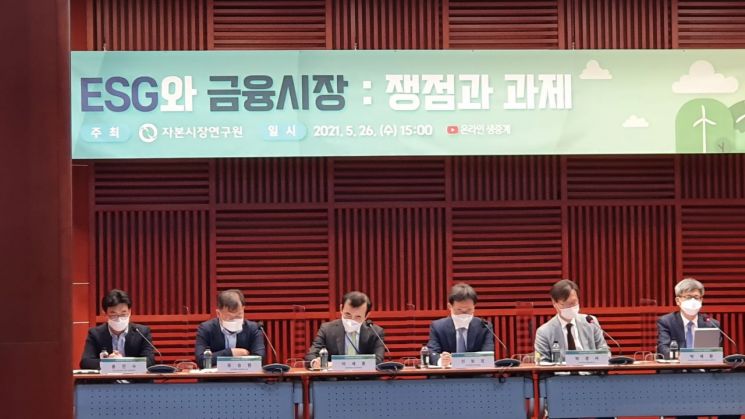
 At the 'ESG and Financial Markets: Issues and Challenges' seminar held on the 26th at the Bulls Hall in the Korea Financial Investment Association building in Yeouido, Seoul, participants are actively engaged in discussion.
 Photo by Minji Lee
[Asia Economy Reporter Minji Lee] There is a growing call for the establishment of evaluation criteria and standards for information disclosure to promote corporate ESG (Environmental, Social, and Governance) management. Although interest in ESG investment is increasing in the financial market, it is judged that ESG management satisfying stakeholders cannot be achieved without established standards.
On the 26th, a lively discussion on "ESG and the Financial Market: Issues and Challenges" took place at the Bulls Hall in the Korea Financial Investment Association building in Yeouido, Seoul.
On that day, Professor Kwak Kwan-hoon of the Department of Law and Police Science at Sunmoon University stated that, from the perspective of current laws and systems, there are few incentives for managers to participate in ESG. Professor Kwak argued, "Looking at the systems surrounding companies, they are aligned with shareholder capitalism, leaving no factors that allow consideration of ESG." According to company law, shareholders and management are the main actors, meaning that if management causes losses to shareholders due to ESG management, they inevitably bear legal responsibility.
He also expressed concerns about the inadequacy of the ESG evaluation system. Professor Kwak said, "In the current system, year-end evaluations of management focus on how much profit was made and how the stock price is performing," adding, "In this situation, asking for ESG management is like asking for morally and ethically good deeds, so an environment where management can fulfill their responsibilities is necessary."
Globally, investment banks (IBs) such as BlackRock and Goldman Sachs are driving corporate ESG management. Financial institutions are encouraging ESG management by investing primarily in companies with high ESG ratings. Regarding this, Professor Park Kyung-seo of Korea University Business School agreed that ESG management is starting mainly with financial institutions but said it remains to be seen whether ESG investment can be sustained over time.
Professor Park explained, "When financial institutions build portfolios using a negative screening strategy that excludes companies producing tobacco or firearms, the selection of stocks inevitably becomes limited, reducing diversification effects," adding, "Given the current poor long-term returns, it is necessary to observe whether sustainable investment can be maintained." Furthermore, he added that the government inevitably has to provide incentives to companies and financial institutions participating in ESG management, but if this proceeds without clear standards, the government may become overly dependent on decision-making, preventing the proper operation of the incentive system.
Regarding corporate ESG information disclosure standards, opinions were expressed that decisions should be made considering both utility and cost. To enhance utility, it was explained that corporate information disclosure must be standardized. Previously, in 2018, the European Union encouraged companies with more than 500 employees to voluntarily disclose non-financial information, but this was criticized for inconsistency. Park Se-hwan, standing member of the Accounting Standards Committee at the Korea Accounting Standards Board, stated, "Creating a single disclosure guideline is a key solution," and argued, "If disclosure guidelines are introduced domestically, following the guidelines to be announced next year by the IFRS Foundation, which has gathered opinions from about 570 organizations, will increase utility internationally and reduce corporate cost burdens."
On the same day, Professor Yoo Seung-won of Korea University Business School mentioned the need for discussions related to evaluation, certification, and regulation after establishing certification and disclosure standards. Professor Yoo explained, "Once standards are set and disclosures are made, discussions are needed on the role of the board of directors within companies, who should be the certification bodies, and who should be the regulatory agencies." He continued, "Ultimately, what is important is that someone with credibility certifies and evaluates," advising, "Regarding post-management, regulatory agencies should also establish standards on how to respond to prevent poor disclosures."
Meanwhile, there was also an opinion that ESG disclosure is necessary for unlisted companies meeting certain requirements to enhance the substance of ESG-related products. Yoon Jin-soo, head of the Business Division at the Korea Corporate Governance Service, explained, "Many ESG bond issuers are unlisted companies, but evaluations of these companies are not properly conducted," adding, "Even unlisted companies belonging to large business groups have the capacity to disclose information, so efforts should be made to ensure that information is disclosed."
Additionally, there was an opinion that certification standards for ESG products should be established to prevent ESG washing. This is because investors who want to invest in ESG products find it difficult to discern what kind of ESG they are dealing with. Director Yoon said, "There is a tendency for equity-type products to be launched as ESG products, so certification standards should be established to distinguish genuine ESG funds," adding, "Furthermore, to expand investors' investments, benefits such as sunset clauses and tax relief are needed."
In response, Lee Se-hoon, Director of the Financial Policy Bureau at the Financial Services Commission, said, "For ESG to function properly, awareness among companies and the financial sector must change, and experience and know-how must be accumulated by applying this in the field," adding, "The issue of ESG washing is also a task that will take time because the current criteria for judgment are insufficient."
© The Asia Business Daily(www.asiae.co.kr). All rights reserved.

















