Interview with Seo Young-kyo, Chair of the Public Administration and Security Committee: "Compensation for Losses and Nationwide Disaster Relief Payments to Be Distributed Together"
Payment Needed Before Chuseok in September to Boost Economy
[Asia Economy Reporter Oh Ju-yeon] As the Loss Compensation Act, which compensates small business owners affected by COVID-19, awaits passage in the National Assembly, there is growing attention to proposals to provide both the Loss Compensation Act and a nationwide disaster relief fund simultaneously. Following mentions of nationwide disaster relief payments by leading ruling party presidential candidates, the ruling party has also proposed providing 500,000 won per household before Chuseok in September.
On the 25th, Seo Young-kyo, chairperson of the National Assembly's Public Administration and Security Committee and a member of the Democratic Party of Korea, emphasized the need for nationwide disaster relief payments in an interview with Asia Economy the previous day, saying, "Selective compensation targeting industries affected by COVID-19 is insufficient. It only prevents small business owners and self-employed individuals from suffocating; a more proactive measure to save them is necessary." She explained that in addition to the 'tailored' loss compensation aimed at COVID-19 affected industries, a disaster relief fund for the entire population is needed.
Seo added, "Even if it is not at the level of last year's nationwide disaster relief fund, a certain amount should be paid to serve as a catalyst. I think 500,000 won for a family of four would impose less fiscal burden." The first nationwide disaster relief fund paid in May last year was up to 1 million won per household (four-person family).
Seo emphasized, "If payments are made in September before Chuseok, it will help stimulate the economy," and added, "We will also ensure that discussions take place at the party level."
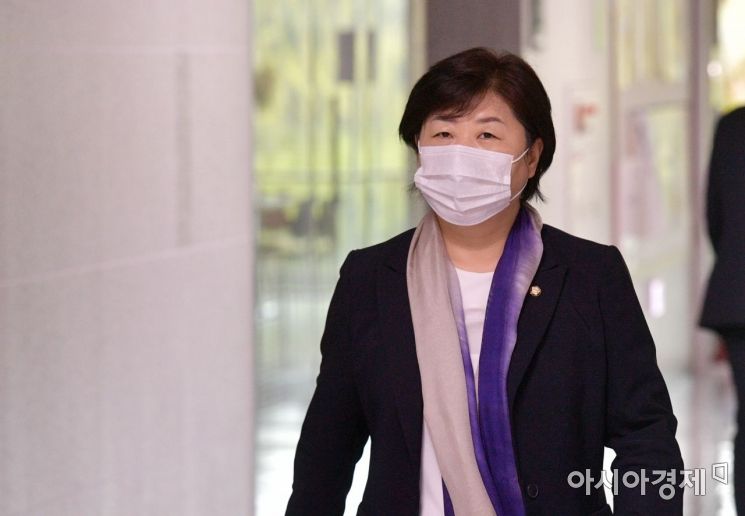 Seo Young-kyo, a member of the Democratic Party of Korea, is attending a meeting of three-term Democratic Party lawmakers held at the National Assembly on the 13th. Photo by Yoon Dong-joo doso7@
Seo noted that after the nationwide disaster relief fund was paid in April last year, small business sales recovered to the previous year's level in May.
According to the 'COVID-19 Damage Analysis' data commissioned by Seo Young-kyo and Lee Dong-joo from Korea Credit Data, sales in the food service industry and indoor sports facilities in May last year recovered to the levels of January and February before the spread of COVID-19.
Separately, data received by Seo's office from the Ministry of the Interior and Safety showed that most of the nationwide disaster relief fund paid in May last year was spent in May and June, and the polarization gap in the second quarter was 4.23, the lowest compared to the first quarter (5.41), third quarter (4.88), and fourth quarter (4.72). Seo interpreted this as "very meaningful that the polarization gap decreased the most in the second quarter after the disaster relief fund was paid," calling it "a way to resolve polarization." She also added, "The income of socially vulnerable groups increased the most when the nationwide disaster relief fund was paid compared to selective support."
Based on this evidence, Seo held a Small Business Policy Forum at the National Assembly main building with Lee Dong-joo the previous day, emphasizing the need for a nationwide disaster relief fund. At the forum, Seo said, "It seems herd immunity will be achieved by November," and added, "It would be good to boost the mood around that time to revitalize the economy."
Seo reiterated, "When I meet small business owners and self-employed people, they complain that not being able to work and just staying still is itself painful," and said, "To revive the sluggish economy, goods must be bought and sold to circulate. This is why a nationwide disaster relief fund that serves as a catalyst is necessary."
© The Asia Business Daily(www.asiae.co.kr). All rights reserved.

















